The Best Audio Interfaces in 2026, Ranked by the Producers Who Track Through Them Every Day
Universal Audio, Focusrite, Audient, MOTU, SSL, RME. Gavler ranks the interfaces worth buying — from a $129 portable to the $1,099 standard.
The 2026 audio-interface market has fully matured around three clear tiers. The under-$200 segment is a two-horse race between Focusrite's class-leading Scarlett 2i2 4th Gen and MOTU's monitoring-champion M2 — both deliver specs that were the exclusive territory of $500 interfaces just a few product cycles ago. The $200-to-$500 mid-tier is where preamp character matters most: Audient's console-grade iD14 MkII, SSL's Legacy 4K analog circuit, and the bundled-software value of PreSonus, Arturia, and Native Instruments cover every workflow priority a serious home producer might bring to the desk. Above $500, the conversation shifts to the Universal Audio Apollo Twin X and its Unison preamp ecosystem at $1,099 and to RME's Babyface Pro FS at $899 for the professionals who refuse to compromise on driver stability or routing flexibility.
May is one of the better months on the calendar to buy. The spring graduation and tax-return retail cycle is fully active at Sweetwater, B&H, and Reverb, the 2026 refresh wave from Focusrite, MOTU, and Universal Audio is fully shipped, and the prior-generation flagships from the late-2025 cycle are at their cheapest before fall speculation begins. Gavler's community has ranked ten of them by lived experience — pick the interface you would actually put on your next desk, not the one with the brand cachet. The picks below are pulled from the live Best Audio Interfaces list.
How the Rankings Work
One vote per person on the Best Audio Interfaces list. Pick the interface you would put on stands tomorrow morning before the first record button is pressed — the one you trust on a six-hour tracking session, a four-hour podcast edit pass, or a vocal scratch take that needs to ship by midnight. Switched interfaces mid-project because of a DAW migration, a workflow shift, or a feature gap? Move your vote. The result is a ranking built on what real producers actually track through, not what a brand paid a YouTuber to demo on a Tuesday.
The Top Picks
Universal Audio Apollo Twin X — The Home Studio Gold Standard
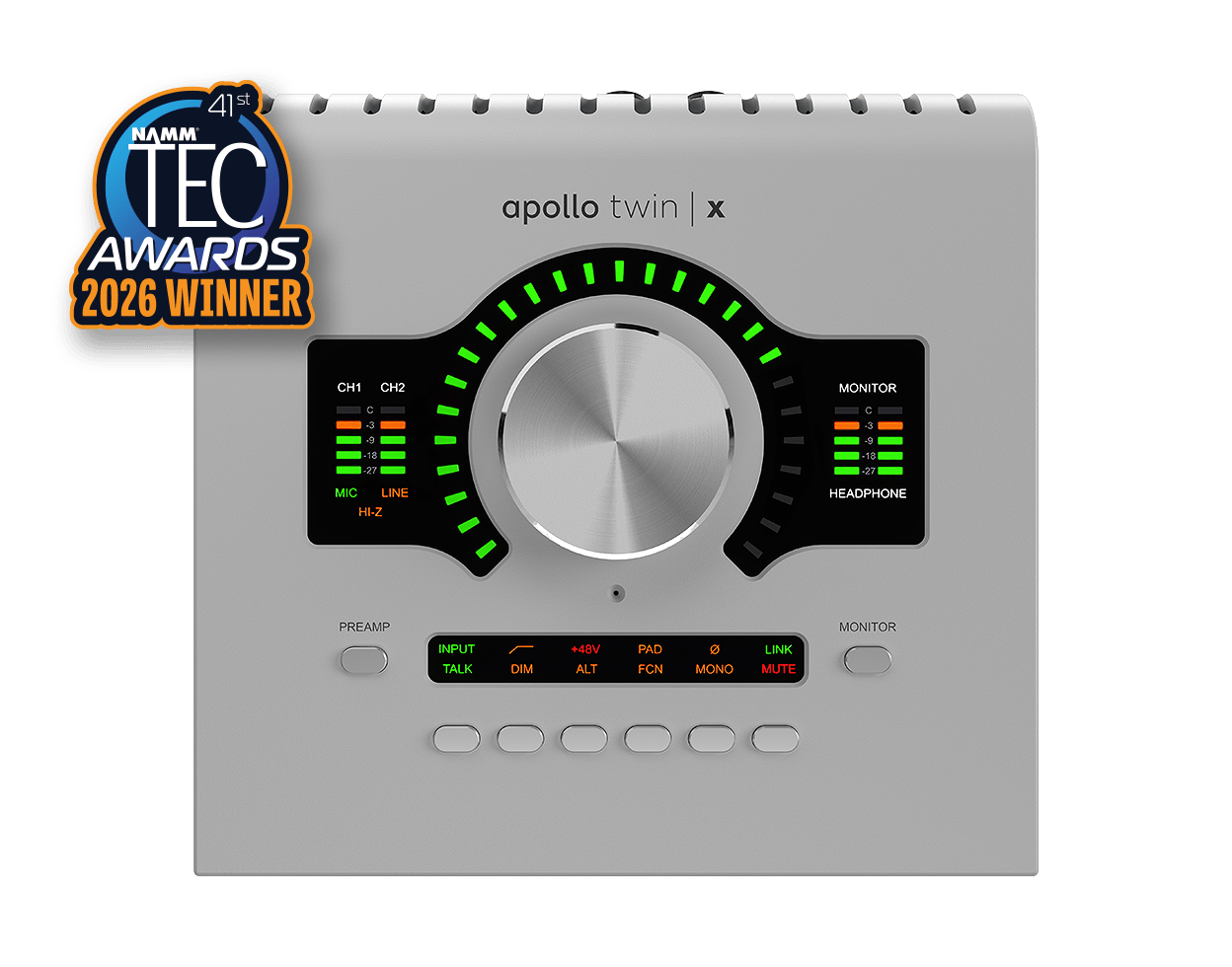
Universal Audio Apollo Twin X
UA's Apollo Twin X runs classic Neve and API preamp emulations with near-zero latency on dedicated SHARC processors.
Amazon affiliate · price subject to change
The Apollo Twin X is the audio interface that home producers buy to stop buying audio interfaces. The defining feature is Universal Audio's Unison preamp modeling, which uses dedicated SHARC DSP to run real-time emulations of classic analog preamps — Neve 1073, API Vision, Avalon VT-737, and dozens more — at near-zero latency. Unison is not a plugin running on your computer's CPU. It is dedicated hardware that changes the actual impedance and gain staging of the input circuit so the microphone responds the way it would on the original analog preamp. The sonic difference is immediately audible: a Shure SM7B plugged into a Neve emulation sounds noticeably different than the same microphone plugged into an API emulation, in a way that no amount of post-processing EQ can fully replicate.
The Twin X features two Unison-enabled preamps with 127 dB dynamic range, Thunderbolt 3 connectivity for rock-solid low-latency performance, and a console-style front panel with a large monitor knob, talkback button, and input selector that feels like a scaled-down recording console rather than a computer peripheral. Sweetwater's editorial describes the Twin X's updated AD/DA conversion as an incredibly smooth signal path. Higher Hz's review called it well worth the money. The UAD plugin ecosystem — sold separately — is widely regarded as the finest collection of analog emulations in production, and the Apollo's onboard DSP runs those plugins during tracking without loading your computer's CPU. The honest caveat: at $1,099 plus the cost of UAD plugins, the Apollo Twin X is a multi-year commitment, not a single purchase. For producers building a long-term home studio, it is the right commitment. 36 community votes and a 9.7 score.
Focusrite Scarlett 2i2 4th Gen — The Safe-and-Smart Default
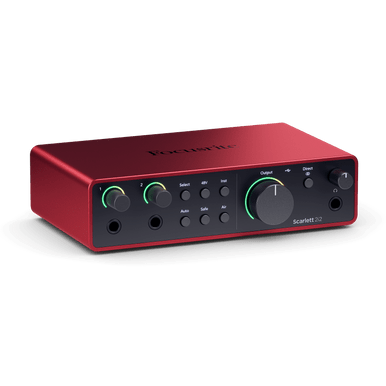
Focusrite Scarlett 2i2 4th Gen
The 4th Gen Scarlett 2i2 adds Air mode for open vocals and class-leading dynamic range at an unbeatable price.
Amazon affiliate · price subject to change
The Scarlett 2i2 has been the world's best-selling audio interface for over a decade, and the 4th generation makes a compelling case that the streak will continue. Sound On Sound's review highlighted 116 dB dynamic range on the mic inputs and 120 dB on the line outs as a meaningful step up over the third generation, and the new Auto Gain feature analyzes your source and sets optimal levels automatically — eliminating the most common gain-staging mistakes that new producers make. Engaging Clip Safe extends the protection, monitoring levels continuously and adjusting gain in real time when clipping is detected. The Air mode now cycles through three positions (off, Air Presence, Air Presence and Drive) and adds a switchable analog high-shelving boost that immediately flatters vocals and acoustic instruments.
The two preamps deliver 57 dB of gain through Focusrite's evolved circuit, and the bus-powered USB-C connection provides reliable low-latency performance with the driver stability that is genuinely class-leading — Focusrite's driver team has been refining their software for over a decade and the result is among the most reliable in the industry. The iconic red anodized chassis is now matte-finished and feels substantial, and the gain-halo indicators around each input knob shift from green to amber to red as levels increase. Focusrite bundles a generous software package including Ableton Live Lite, the Focusrite plugin suite, and three months of selected subscription services. At $189, the Scarlett 2i2 4th Gen is the safe choice that is also the smart choice — there is genuinely no plausible scenario where a first-time producer regrets buying it. 40 votes and a 9.5 score.
Audient iD14 MkII — The Console-Grade Preamp Pick
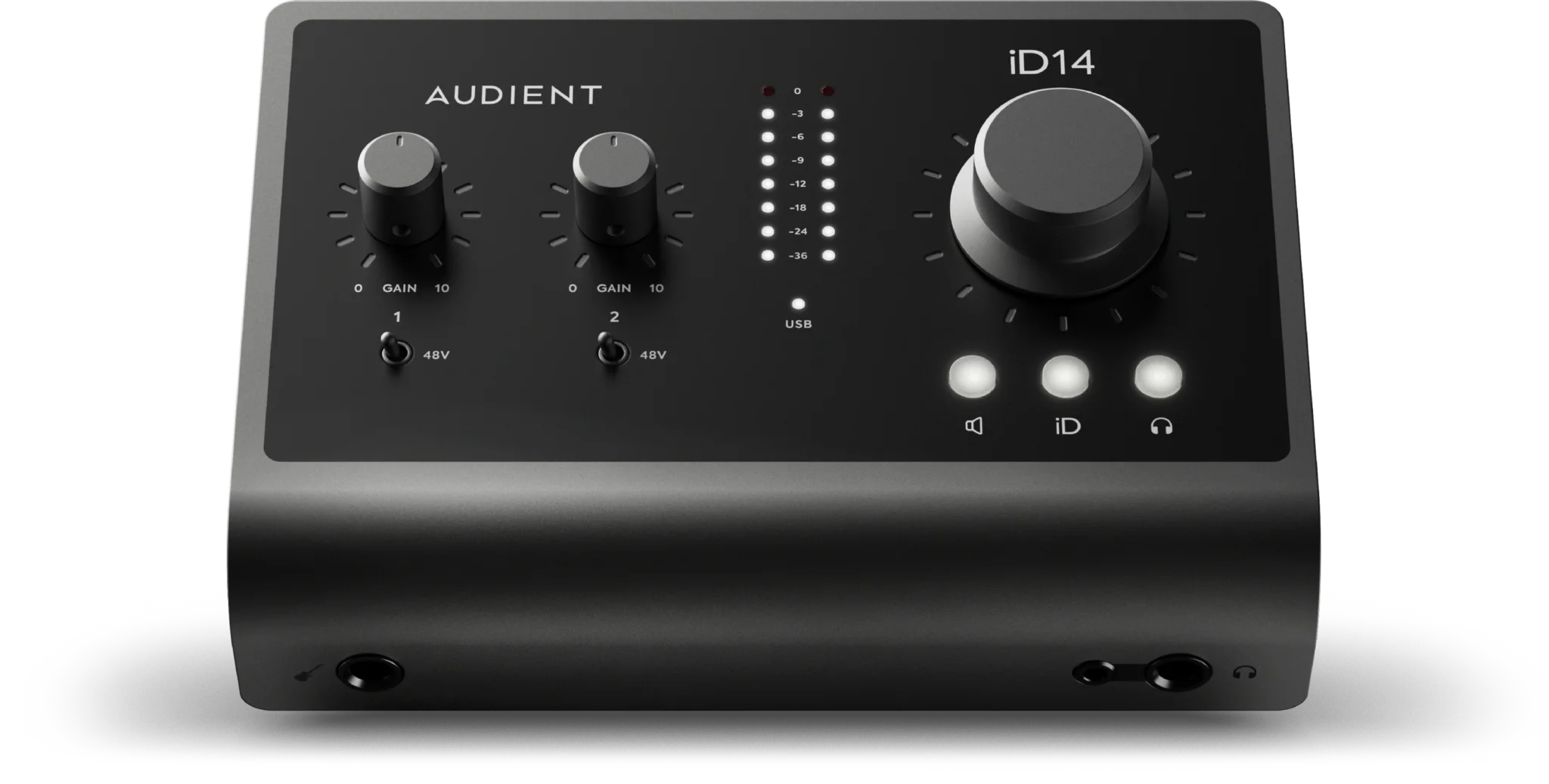
Audient iD14 MkII
Audient's large-format console preamp heritage delivers a rich, open sound that punches well above the iD14's price.
Amazon affiliate · price subject to change
The Audient iD14 MkII is the interface for producers who care about preamp character more than software bundles or feature counts. Audient's heritage is in large-format recording consoles — the ASP8024, used in commercial studios for decades — and the iD14 MkII inherits the same discrete Class-A microphone preamp topology used in those five-figure consoles. The sonic difference is audible the first time you plug in: vocals have a richness and openness that budget preamps flatten, and acoustic instruments are captured with a natural dimensionality that reveals the character of the room and the instrument in a way that lesser preamps compress. MusicRadar called the iD14 MkII an excellent upgrade that is a better unit all round than its predecessor, with sonically clean and transparent preamps and a satisfyingly loud and dynamic improved headphone amp.
The iD14 MkII features two microphone preamps with 60 dB of gain, a JFET instrument DI that emulates the impedance characteristics of a vintage tube amplifier input, and an ESS Sabre DAC for monitoring. The JFET DI is a standout feature — plugging a guitar or bass directly into the iD14 MkII produces a warmer, more responsive tone than the typical solid-state DI circuits in competing interfaces. The scroll-wheel monitor controller on the top of the unit is a small design touch that makes daily use genuinely pleasurable, providing precise tactile volume control where competitors offer cramped knobs. Sound On Sound noted the sound quality is exemplary and that the iD14 MkII's flawless sound and solid build quality are what will put it on your desk. At $249, the iD14 MkII costs $60 more than the Scarlett 2i2 and delivers meaningfully better preamp quality that experienced ears immediately appreciate. 32 votes and a 9.4 score.
MOTU M2 — The Monitoring Champion Under $200
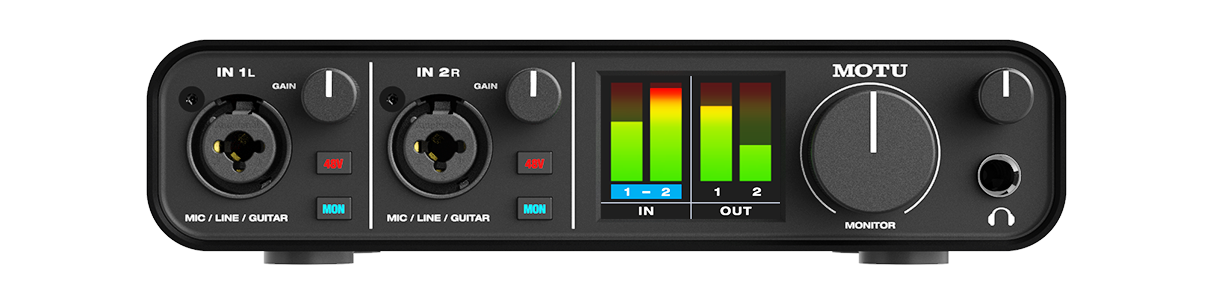
MOTU M2
MOTU's ESS Sabre DAC delivers reference-grade monitoring quality with real-time LCD metering for visual level confirmation.
Amazon affiliate · price subject to change
The MOTU M2 did something that seemed impossible when it launched: it put an ESS Sabre ES9018 DAC — the same chip found in high-end audiophile equipment costing thousands — in a $199 audio interface. The result is a monitoring path that is measurably cleaner, more transparent, and more detailed than any competing interface at this price. When you plug headphones or studio monitors into the M2, you hear your mix with a fidelity that reveals details masked by lesser converters. Sound On Sound's review described MOTU's debut entry-level interfaces as raising the bar by quite some distance, with bags of headroom and superb quality whether monitoring or recording.
The two microphone preamps deliver clean gain with low noise — they lack the character of the Audient iD14 MkII's console-grade preamps but are transparent rather than colored, capturing what is in front of the microphone without adding warmth. For producers who prefer to add character through plugins rather than hardware, this transparency is a feature. The full-color LCD display on the front panel provides real-time input and output metering with peak hold — large enough to read at arm's length and responsive enough to track transients accurately. The loopback feature routes the computer's audio output back into the interface as a virtual input, enabling podcast recording with remote guests and multi-source streaming without additional software. MOTU's driver stability is legendary — the company has been building audio interfaces for decades and their driver team produces consistently reliable, low-latency drivers across macOS and Windows. At $199, the M2 is the interface for producers who listen critically and value DAC transparency above all else. 30 votes and a 9.2 score.
The Performance Tier
SSL 2+ — The Analog Character Pick
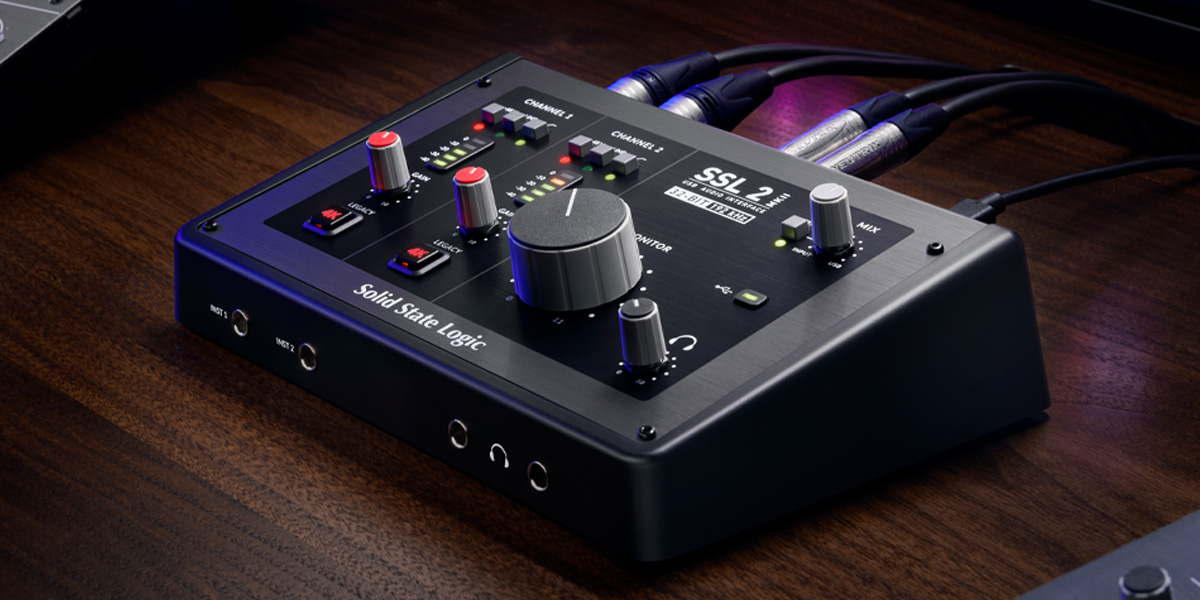
SSL 2+
Solid State Logic's Legacy 4K button adds the signature SSL high-end sheen and low-end punch to any source.
Amazon affiliate · price subject to change
The SSL 2+ brings the DNA of the most iconic recording console brand in history to a desktop audio interface. Solid State Logic consoles — the 4000, the 6000, the Duality — have shaped the sound of popular music for decades, and the 2+ distills that heritage into a format that fits next to your keyboard. The headline feature is the Legacy 4K button, which engages an analog circuit modeled after the classic SSL 4000-series console's high-frequency enhancement and low-frequency thickening. Sound On Sound's review noted the 4K Legacy button engages a combination of saturation and high-frequency boost said to emulate classic SSL 4000-series consoles, and described the mic preamps as probably best-in-class — though the review cautioned that the 4K effect, like Focusrite's Air, could cause problems at the mix if over-used or applied to the wrong source.
The two SuperAnalogue microphone preamps deliver 62 dB of clean gain with a transparent, uncolored character that lets the source and the microphone speak for themselves until you engage the 4K button to add SSL character. The SSL 2+ includes four outputs (two main monitor, two headphone) compared to the base SSL 2's two outputs, making it more flexible for artist monitoring and multi-speaker setups. MIDI I/O is included for hardware synthesizer and drum machine connectivity. SSL bundles a compelling software package including their Native channel strip plugin, Vocalstrip 2, Drumstrip, and third-party instruments and effects. At $299, the SSL 2+ costs more than the Scarlett 2i2 and MOTU M2 but delivers something neither can: genuine analog character from one of the most respected names in professional audio. 28 votes and a 9.1 score.
RME Babyface Pro FS — The Professional's No-Compromise Choice
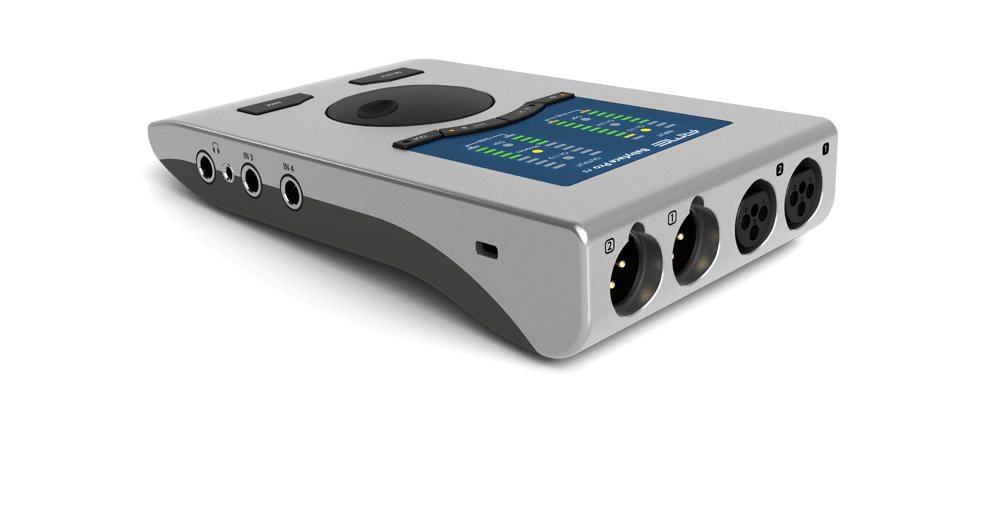
RME Babyface Pro FS
RME's TotalMix FX routing and rock-solid drivers make the Babyface Pro FS the professional's choice for mission-critical audio.
Amazon affiliate · price subject to change
The RME Babyface Pro FS is the audio interface you choose when failure is not an option. RME has built its reputation on two pillars: TotalMix FX — the most powerful and flexible routing software in the audio interface world — and drivers so stable that they have become the benchmark against which all other manufacturers are measured. Sound On Sound's review described the Babyface Pro FS as transparent, clear, and pristine, with the inclusion of the SteadyClock FS circuit from the ADI-2 Pro FS as the key technical improvement — RME's proprietary clocking technology produces measurably lower jitter than conventional clock designs, contributing to a wider, more detailed stereo image.
The four analog inputs include two preamps with 76 dB of gain range and exceptionally low noise. The twelve analog and digital outputs (including ADAT optical) provide routing flexibility that no other portable interface can match. TotalMix FX is RME's killer application: a fully independent routing matrix with per-channel EQ, dynamics, reverb, and delay — all processed on the interface's onboard DSP with zero CPU load. For live performers, this means custom in-ear monitor mixes on the fly. For studio users, it means cue mixes for multiple musicians without loading a single plugin in your DAW. The build quality is industrial-grade with a machined aluminum chassis, Neutrik combo jacks, and a breakout-cable design that keeps the main unit compact. At 345 grams with USB bus power, the Babyface Pro FS travels in a laptop bag and delivers professional results in any environment. At $899, it is the most expensive interface on this list short of the Apollo Twin X, but for professionals who need absolute reliability and routing power that no competitor matches, it is worth every cent. 24 votes and a 9.0 score.
The Specialist Tier
PreSonus Studio 24c — The Complete Starter Package
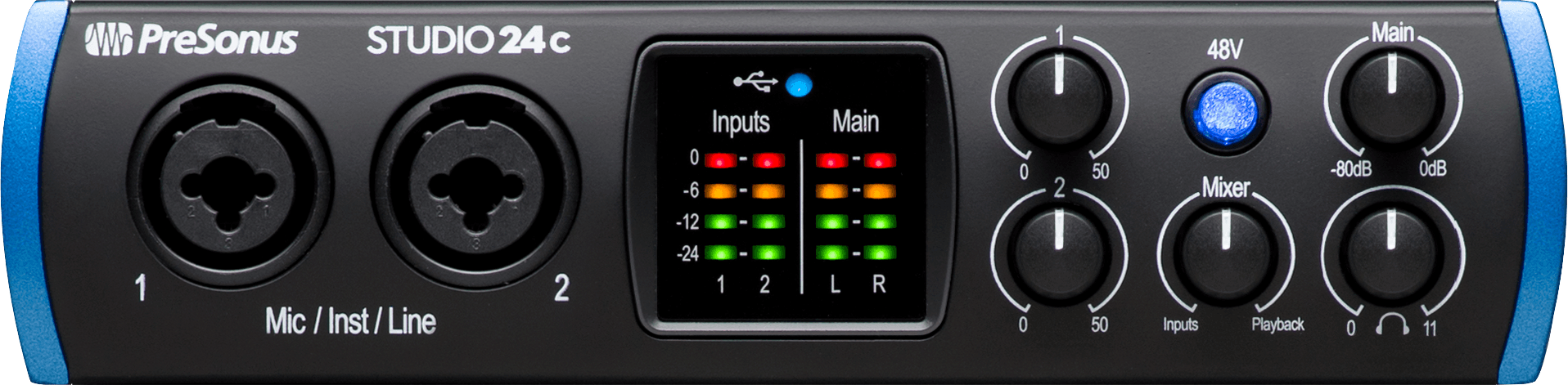
PreSonus Studio 24c
The Studio 24c bundles PreSonus's Studio One Artist DAW and a generous plugin suite for a complete production package under $200.
Amazon affiliate · price subject to change
The PreSonus Studio 24c is the audio interface that gives first-time producers everything they need to start making music in a single purchase. The headline is the bundled software: Studio One Artist — PreSonus's professional-grade DAW — comes included at no additional cost. This is not a stripped-down demo version; Studio One Artist includes unlimited tracks, virtual instruments, and effects processing that can take a producer from their first beat to a finished master without spending another dollar on software. The interface itself features two XMAX-L microphone preamps with 60 dB of gain and a clean, transparent character refined across multiple PreSonus product generations.
Beyond Studio One Artist, PreSonus bundles the Studio Magic plugin suite — a collection of virtual instruments, effects, and sound packs that represents hundreds of dollars in retail value. For a producer starting from zero, the Studio 24c eliminates the fragmented buying experience of interface plus DAW plus plugins plus instruments. MIDI I/O is included on the rear panel for hardware synthesizer connectivity. The build quality is solid with a metal chassis that feels durable, though it lacks the premium tactile quality of the Audient iD14 MkII or SSL 2+. At $139, the hardware alone would be competitive — with the software bundle, the Studio 24c is the most complete production starter package available at any price. 22 votes and an 8.8 score.
Arturia MiniFuse 2 — The Smartphone-Sized Serious Interface
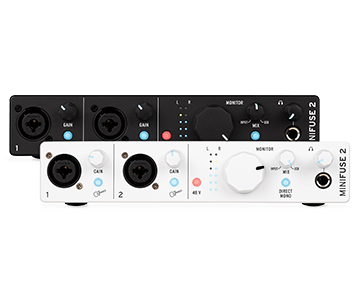
Arturia MiniFuse 2
Arturia's MiniFuse 2 packs capable preamps and converters into a USB-C bus-powered body barely larger than a smartphone.
Amazon affiliate · price subject to change
The Arturia MiniFuse 2 challenges the assumption that small interfaces mean compromised audio quality. At roughly the size of a large smartphone and weighing just 340 grams, the MiniFuse 2 is the most portable serious audio interface available — and the emphasis is on serious. Arturia designed the preamps and converters to match the performance of their larger AudioFuse product line, delivering a signal quality that genuinely rivals interfaces twice the price and size. The two preamps offer 56 dB of gain with a noise floor low enough for quiet condenser microphones and ribbon mics.
Arturia bundles a substantial software package including Analog Lab Intro (a curated selection from Arturia's renowned V Collection of vintage synthesizer emulations), Ableton Live Lite, and Native Instruments Guitar Rig LE. The Analog Lab Intro inclusion alone adds hundreds of dollars in synthesizer sounds — Mini Moog, ARP 2600, CS-80, and Jupiter-8 emulations that are industry standards in electronic and soundtrack production. The USB-C connection provides bus power and solid driver performance across macOS and Windows. The design is clean and modern with a matte finish and color accent options (black, white, or blue). At $129, the MiniFuse 2 is the most affordable way to get Arturia's audio quality and software ecosystem. For mobile recording, travel production, and producers who need a reliable interface that disappears into a laptop bag, the MiniFuse 2 is the ideal companion. 20 votes and an 8.6 score.
Native Instruments Komplete Audio 2 — The Electronic Producer's Software Stack
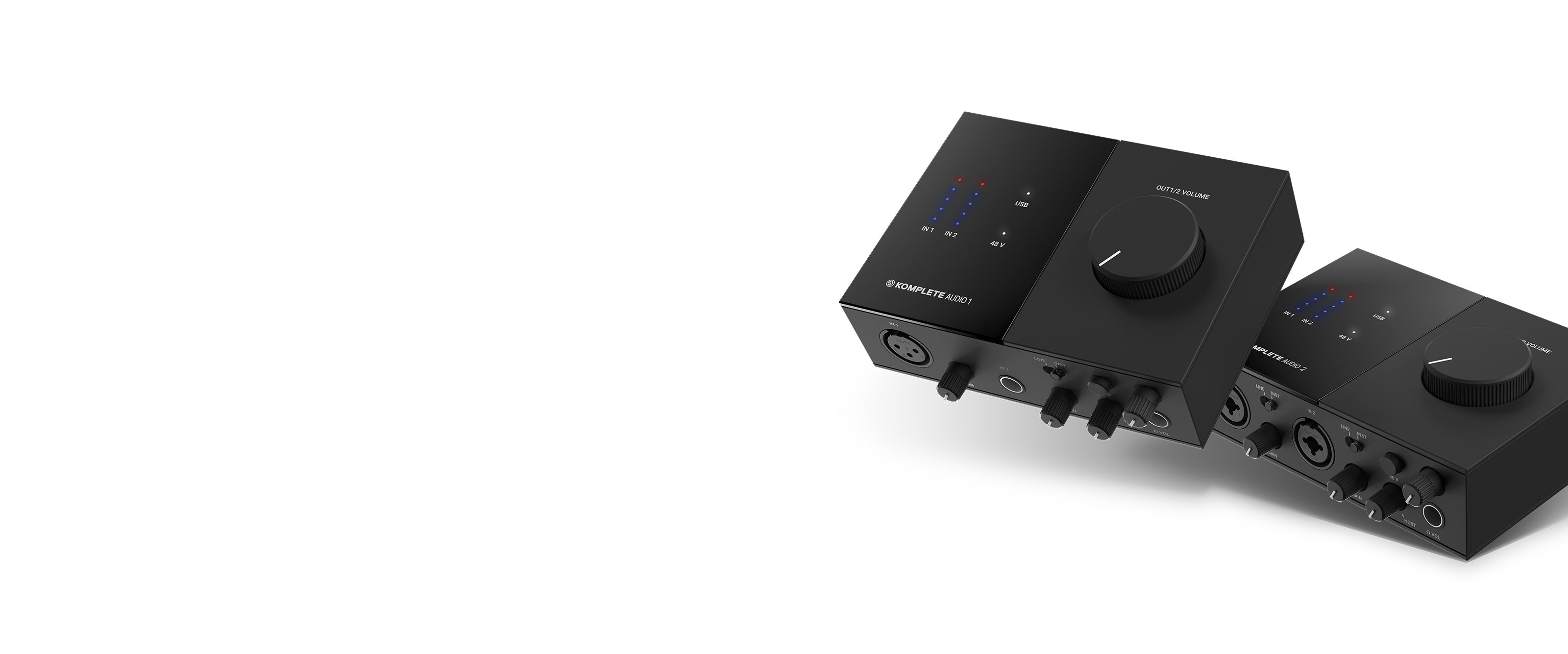
Native Instruments Komplete Audio 2
Bundled with a massive selection of NI instruments and effects, the Komplete Audio 2 offers unmatched software value for electronic music.
Amazon affiliate · price subject to change
The Native Instruments Komplete Audio 2 is the interface that makes the most sense for electronic music producers, and the reason is entirely software. The bundled Komplete Start package includes Massive, Monark, Reaktor Player, Guitar Rig, and a selection of Kontakt libraries that represent hundreds of dollars in retail value — synthesizers, samplers, and effects that are industry standards in electronic, hip-hop, and soundtrack production. No other audio interface at any price bundles this quality and quantity of production software.
The hardware is competent without being exceptional. Two preamps with 54 dB of gain deliver clean, transparent audio capture suitable for vocals, instruments, and podcasting. The conversion is 24-bit and 192 kHz, and the USB-C connectivity provides bus-powered operation with reliable drivers. The interface pairs naturally with NI's Maschine and Komplete Kontrol hardware, creating a unified hardware and software production ecosystem. At $139, the Komplete Audio 2 is priced identically to the PreSonus Studio 24c, and the choice between them comes down to workflow preference: PreSonus for Studio One and general production, NI for electronic music and NI ecosystem integration. 18 votes and an 8.4 score.
Steinberg UR22C — The Warm-Voiced Cubase Companion
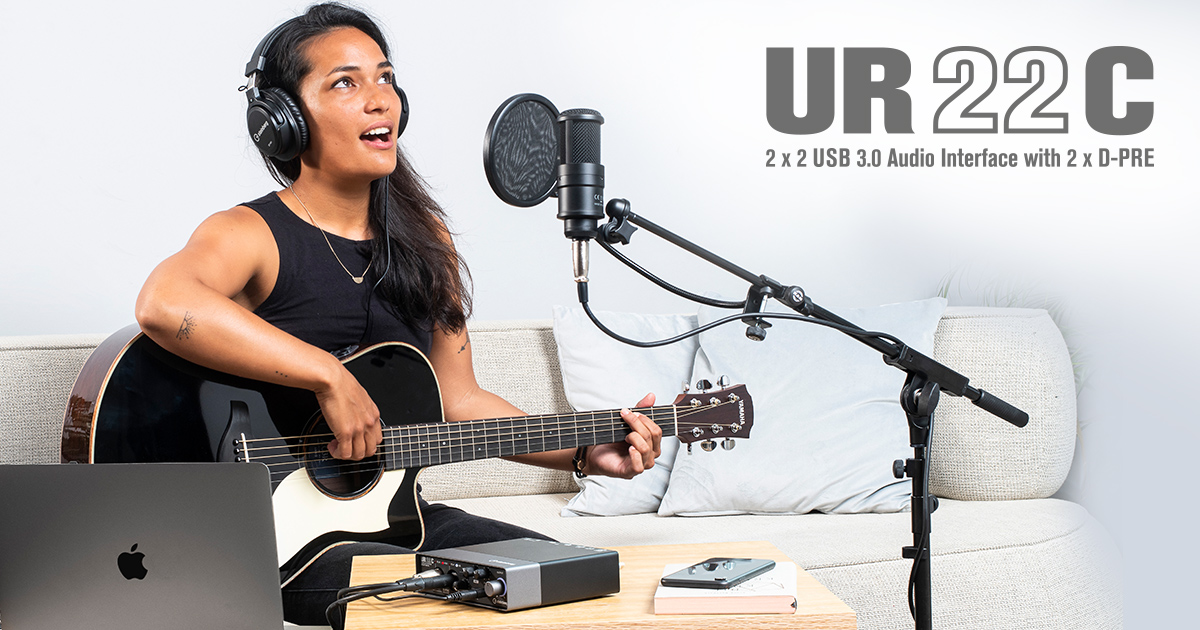
Steinberg UR22C
Yamaha-designed preamps and 32-bit/192kHz conversion give the UR22C a smooth character with native Cubase workflow integration.
Amazon affiliate · price subject to change
The Steinberg UR22C leverages two powerful relationships: Steinberg's ownership by Yamaha, which provides access to Yamaha's acclaimed D-PRE microphone preamp designs, and Steinberg's own creation of Cubase — one of the most venerable and capable DAWs in music production. The two D-PRE preamps feature an inverted Darlington circuit that delivers a smooth, musical quality with natural saturation characteristics at higher gain settings. The sound is warmer and more forgiving than the clinical transparency of the MOTU M2 or the Focusrite Scarlett 2i2, making it particularly flattering for vocals and acoustic instruments.
The 32-bit and 192 kHz conversion provides exceptional headroom and dynamic range, though the practical benefit of 32-bit over 24-bit is more theoretical than audible for most production work. The UR22C includes Cubase AI with unlimited audio and MIDI tracks, 32 VST instrument slots, and a comprehensive set of included effects. For Cubase users, the UR22C offers dspMixFx — onboard DSP processing that provides zero-latency monitoring with reverb, channel strip, and guitar amp effects processed on the interface itself. The integration is seamless: DSP effects appear as part of the Cubase mixing environment, and settings transfer between the hardware and software without manual configuration. At $159, the UR22C is the natural choice for Cubase users and a strong option for any producer who finds clinical transparency fatiguing and prefers warmth. 16 votes and an 8.2 score.
Buying Guide: The Three Decisions That Matter
Software bundle or preamp character — pick the priority that matches your workflow. Three interfaces on this list deliver meaningfully better preamp character than the budget tier: the Audient iD14 MkII for console-grade Class-A discrete preamps, the SSL 2+ for genuine analog SSL 4000-series saturation via the Legacy 4K button, and the RME Babyface Pro FS for transparent clinical precision with the lowest measurable jitter in the category. Three other interfaces deliver bundled software value that no preamp can match: the PreSonus Studio 24c for Studio One Artist, the Arturia MiniFuse 2 for Analog Lab Intro and V Collection emulations, and the Native Instruments Komplete Audio 2 for Massive, Monark, Reaktor, and Guitar Rig. If your priority is the recording chain itself, prioritize preamps. If your priority is producing more music tomorrow, prioritize software. The Scarlett 2i2 4th Gen and MOTU M2 are the rare interfaces that balance both reasonably well at the under-$200 tier.
USB-C is the right answer for almost everyone — Thunderbolt is only for Unison DSP. Of the ten interfaces on this list, nine use USB-C and exactly one uses Thunderbolt (the Universal Audio Apollo Twin X, which requires Thunderbolt to deliver the bandwidth and low-latency performance the Unison DSP architecture needs). Round-trip latencies on USB-C interfaces have closed the gap with Thunderbolt to within a millisecond at typical buffer settings — Sound On Sound's MOTU M2 review measured 2.5 ms round-trip at 192 kHz, comparable to Thunderbolt interfaces at the same buffer. Unless you are committing to Unison DSP and the UAD plugin ecosystem, USB-C is the right answer. The compatibility advantages over Thunderbolt are material: USB-C works on Windows, macOS, and iPadOS interchangeably, while Thunderbolt remains a mac-leaning ecosystem with patchier Windows driver support.
The 2025-model interface is almost always the smart spring buy. Audio-interface refresh cycles run 24 to 36 months, with the next wave of flagship updates timed to NAMM each January. The May-to-July spring sale window is when the prior-generation flagships hit their lowest prices before fall speculation begins. The Focusrite Scarlett 2i2 4th Gen has dropped from $189 to $149 reliably during graduation-season promotions. The MOTU M2 sees similar markdowns at Sweetwater, B&H, and Reverb. The Universal Audio Apollo Twin X rarely discounts new but does see occasional refurb pricing through Sweetwater that knocks 10 to 15 percent off — and refurbished UA hardware ships with the same warranty as new. The Audient iD14 MkII and SSL 2+ both see real markdowns in this window. For a 2026 home-studio buyer, watching the sale calendars at Sweetwater, B&H, Reverb, and the manufacturer-direct stores from now through early July is the most reliable way to save 10 to 20 percent without sacrificing model currency.
For the full community ranking with current prices and live vote counts, head to Gavler's Best Audio Interfaces list. Architecture first — 2-in USB vs conversion class, then loopback, then DSP vs clean. The full decision tree is in our Audio Interface Buying Guide. If you are building out a full creator-audio setup, the Gavler Audio hub now anchors community-ranked picks across studio monitors, USB microphones, audio interfaces, and headphone amps and DACs — four lists in total. Architecture first for speakers — nearfield vs midfield in the studio-monitor buying guide, then the ranking story in The Best Studio Monitors in 2026. Capsules first — dynamic vs condenser in the USB microphone buying guide, then the ranking story in The Best USB Microphones in 2026. Dual-output mics like the Shure MV7+ or Samson Q9U graduate into a proper interface like the ones above, using each microphone's XLR output to step into a real signal chain.
See all 10 products ranked by the community
Best Audio Interfaces
See Full Rankings →266 community votes cast
Common Questions
The Universal Audio Apollo Twin X tops Gavler's community ranking with a 9.7 score and 36 votes. The defining feature is Unison preamp modeling, which uses dedicated SHARC DSP to run real-time emulations of Neve, API, and Avalon preamp circuits with near-zero latency — Unison changes the actual impedance and gain staging of the input circuit so the microphone responds the way it would on the original analog hardware. Sweetwater's editorial describes the Twin X's updated AD/DA conversion as an incredibly smooth signal path with 127 dB dynamic range, and Higher Hz called it well worth the money. The honest caveat: at $1,099 it is the most expensive interface on this list, and the UAD plugin ecosystem that justifies the Unison architecture is sold separately. For producers who want to track through vintage analog character at the source and stop the upgrade cycle, the Apollo Twin X is the right answer. For everyone else, the Focusrite Scarlett 2i2 4th Gen at $189 covers 80 percent of the practical use cases.
The Focusrite Scarlett 2i2 4th Gen at $189 is the consensus answer. Sound On Sound's review highlighted the 116 dB dynamic range on the mic inputs and 120 dB on the line outs as a meaningful upgrade over the third generation, and the new Auto Gain plus Clip Safe features make level setting genuinely beginner-proof. The Air mode now cycles through three positions (off, Air Presence, Air Presence and Drive) and adds a broad high-shelving boost in the analog domain that immediately flatters vocals. The MOTU M2 at $199 is the alternative — its ESS Sabre ES9018 DAC delivers measurably cleaner monitoring than anything else at this price, and MOTU's driver stability is legendary. Pick the Scarlett if you prioritize preamp character and the most polished software bundle. Pick the M2 if you prioritize monitoring quality and DAC transparency. Both are correct answers.
These two answer different questions. The Apollo Twin X at $1,099 is a tracking interface with onboard DSP that runs Unison preamp emulations — it changes how your microphones sound at the source and provides near-zero-latency processing through UAD plugins during recording. The Scarlett 2i2 4th Gen at $189 is a clean, transparent interface with 120 dB dynamic range and Air mode for high-frequency presence. Pick the Apollo Twin X if you want analog character built into your tracking chain and plan to invest in UAD plugins over time — this is a multi-year commitment to an ecosystem. Pick the Scarlett 2i2 if you want a reliable, well-supported interface with class-leading specs at a price that does not require an ongoing software investment. The Apollo is the right call for serious home producers building a long-term studio. The Scarlett is the right call for everyone else.
Three interfaces on this list have meaningfully better preamps than the budget tier. The Audient iD14 MkII uses Class-A discrete preamps derived from Audient's ASP8024 large-format console — MusicRadar called the iD14 MkII an excellent upgrade with sonically clean and transparent preamps, and Sound On Sound emphasized the flawless sound and solid build quality. The SSL 2+ uses SuperAnalogue mic preamps that Sound On Sound described as best-in-class, and the Legacy 4K button adds genuine SSL 4000-series saturation and high-frequency boost as an analog circuit in the signal path. The RME Babyface Pro FS combines RME's clinical transparency with SteadyClock FS — RME's proprietary clocking technology that produces measurably lower jitter than competing designs — and Sound On Sound described the audio as transparent, clear, and pristine. The iD14 MkII at $249 is the value pick. The SSL 2+ at $299 is the character pick. The Babyface Pro FS at $899 is the no-compromise professional pick.
Almost certainly not. Only one interface on this list uses Thunderbolt — the Universal Audio Apollo Twin X, which requires Thunderbolt to deliver the bandwidth and low-latency performance that the Unison DSP architecture needs. Every other interface in Gavler's top ten uses USB-C, including the professional-tier RME Babyface Pro FS, and round-trip latencies on USB-C interfaces have closed the gap with Thunderbolt to within a millisecond at typical buffer settings. The MOTU M2's measured round-trip latency on USB-C is comparable to most Thunderbolt interfaces at the same buffer size. Unless you are tracking with onboard plugin processing through the Apollo's DSP, USB-C is the right answer for 95 percent of home and project studios in 2026 — and USB-C compatibility with Windows, macOS, and iPadOS is materially better than Thunderbolt's mac-leaning ecosystem.
Spring is a strong window for audio interface buying. Sweetwater, B&H, and Reverb all run pre-summer sales tied to graduation season and tax-return retail spend, and the most-discounted category in those promotions is consistently entry-level and mid-tier interfaces. The Focusrite Scarlett 2i2 4th Gen drops from $189 to $149 reliably during the May-to-July window. The MOTU M2 sees similar markdowns. The Universal Audio Apollo Twin X rarely discounts but does see occasional refurb pricing through Sweetwater that knocks 10 to 15 percent off. Manufacturers refresh interface model lines on a 24-to-36-month cycle aligned with NAMM in January, which means the late-2024 and early-2025 flagship refreshes are now at their cheapest before the next speculation wave begins in October. For graduates, summer-project producers, and home-studio rebuilders, May is the right month.
Rankings come from community votes by producers, engineers, podcasters, and musicians who actually track through the interfaces daily. Each user gets one vote on the Best Audio Interfaces list — pick the interface you would put on your next desk, not the one with the most marketing budget or the flashiest unboxing video. Switched interfaces after a workflow change, a DAW migration, or an upgrade cycle? Move your vote. No affiliate commissions or manufacturer sponsorships influence the ranking. Vote totals at the time of publication appear next to each pick on the live list.
Products Mentioned
Jump to the full ranking and community verdict for each pick named above.
- Universal Audio Apollo Twin XAudio · Best Audio Interfaces
- Focusrite Scarlett 2i2 4th GenAudio · Best Audio Interfaces
- Audient iD14 MkIIAudio · Best Audio Interfaces
- MOTU M2Audio · Best Audio Interfaces
- SSL 2+Audio · Best Audio Interfaces
- RME Babyface Pro FSAudio · Best Audio Interfaces
- PreSonus Studio 24cAudio · Best Audio Interfaces
- Arturia MiniFuse 2Audio · Best Audio Interfaces
- Native Instruments Komplete Audio 2Audio · Best Audio Interfaces
- Steinberg UR22CAudio · Best Audio Interfaces
- Shure MV7+Audio · Best USB Microphones
- Samson Q9UAudio · Best USB Microphones