Hisense U8N vs U9N 2025: Is the Upgrade Worth It?
Buying Guide
Flagship Mini-LED with nearly 4,000 nits peak brightness, 5,000+ dimming zones, and a built-in 4.1.2 Dolby Atmos speaker system.
Gavler Meta-Score
“The U9N is Hisense's statement piece — record-breaking brightness, refined local dimming with deep blacks, and a Dolby Atmos speaker system that's genuinely good enough to use without a soundbar. At $2,000 for the 75", it undercuts Sony and Samsung flagships by a wide margin while matching or exceeding their brightness. The main compromise: only two size options and slightly higher input lag than the best gaming TVs.”
The Gavler Verdict
Hisense U9N Review: The Brightest TV You Can Buy, Built-In Speakers Included
The Hisense U9N ranks number six on Gavler's Best TVs list with an 8.7, and its pitch is refreshingly blunt: the brightest picture on the market, backed by sound quality good enough to skip the sound bar. TechRadar summed it up as delivering "an incredibly bright and refined picture, augmented by a powerful built-in 4.1.2-channel Dolby Atmos speaker system." Buy it if you want flagship-level brightness and audio without flagship pricing. Skip it if you need more than two size options, or if you're chasing the last few percent of motion and upscaling polish that pricier sets deliver.
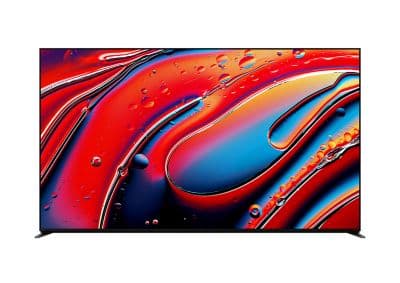
The U9N is Hisense's flagship ULED Mini-LED panel, and it leads with a genuinely record-setting spec: nearly 4,000 nits of peak HDR brightness, driven by more than 5,000 local dimming zones. That's a meaningfully higher brightness ceiling than most OLED competitors can reach, including Samsung's S95D, and the dense zone count is there specifically to keep blooming under control around bright highlights — the classic weakness of Mini-LED backlighting.
The Hi-View Engine X chipset, borrowed down from Hisense's limited-edition ULED X series, handles upscaling and motion processing with what the company positions as flagship-tier precision. Gaming is well covered too, with dual HDMI 2.1 ports supporting 4K at 144Hz, VRR, FreeSync Premium Pro, and Dolby Vision gaming.
The feature that sets the U9N apart from nearly every other TV in this brightness class is the built-in audio: a 4.1.2-channel Dolby Atmos speaker system rated at 82W. It's positioned not as a nice-to-have but as a genuine alternative to buying a sound bar, and at roughly $1,999 for the 75-inch model, the U9N undercuts Sony and Samsung's comparably bright flagships by a wide margin. The trade-off for that value is size flexibility — the U9N ships in only 75- and 85-inch sizes, so it's not an option for smaller rooms.
Tom's Guide's review leaned into the sound system as the standout: "near-flagship performance at a more reasonable price, with strong 82W 4.1.2 Dolby Atmos sound built in." That's an unusual thing for a TV review to emphasize, and it reflects genuine surprise — built-in TV speakers are almost always an afterthought, and here they're strong enough to be a real selling point rather than a checkbox feature.
Picture quality lives up to the brightness spec in practice, not just on paper. With over 5,000 dimming zones working the backlight, HDR highlights land with real punch, and the deep zone density keeps blooming — the halo effect around bright objects on a dark background — well controlled for a Mini-LED panel at this price.
The criticism worth taking seriously came from the same Tom's Guide review: "Motion processing isn't always flawless and upscaling trails pricier sets — the cheaper U8N is in many ways a better deal." That's a notable qualifier from an outlet that otherwise praised the set, and it's a useful reality check — the U9N's headline specs (brightness, zone count, built-in audio) are genuinely class-leading, but the fit-and-finish of the processing behind them isn't uniformly at the same level as $1,000-more competitors.
The U9N's value proposition is real, but it comes with specific compromises worth knowing before you buy.
On Gavler's Best TVs list, the U9N sits directly below the Samsung S95D QD-OLED at rank five — the two represent opposite bets on how to solve brightness. The S95D uses QD-OLED's infinite per-pixel contrast plus an anti-glare coating to fight ambient light; the U9N uses raw Mini-LED backlight power and zone density to simply out-brighten the room, undercutting the Samsung by roughly $400 in the process. Further down the list, the TCL X11L pushes the same brightness-first philosophy to an even further extreme — 10,000 nits and 20,000 dimming zones — at nearly triple the U9N's price, a specialist choice for large-format home theaters rather than a mainstream living-room set.
An 8.7, earned by genuinely class-leading brightness and a built-in audio system that punches well above what TV speakers usually deliver. The Hisense U9N is the right buy for anyone who wants flagship-level HDR impact and doesn't want to budget separately for a sound bar, provided a 75- or 85-inch screen fits the room. Buyers who want the sharpest possible motion and upscaling, or who need a smaller size option, should look elsewhere on Gavler's list — but as a statement of what Mini-LED brightness can do at a mid-flagship price, the U9N delivers.
Yes, for buyers who want maximum brightness and don't want to budget separately for a sound bar. It ranks sixth on Gavler's Best TVs list with an 8.7. TechRadar described it as delivering 'an incredibly bright and refined picture, augmented by a powerful built-in 4.1.2-channel Dolby Atmos speaker system' — and at roughly $1,999 for the 75-inch, it undercuts Samsung and Sony's flagship brightness competitors substantially.
For most viewers, yes. The built-in 4.1.2-channel, 82W Dolby Atmos system is strong enough that Tom's Guide highlighted it as a standout feature rather than a footnote, and it handles dialogue positioning and everyday viewing well. Home-theater enthusiasts chasing reference-level bass and dynamic range will still want a dedicated system, but this is one of the few TVs where skipping the sound bar purchase is a genuinely reasonable option.
Buy the U9N if raw brightness, deep local-dimming contrast, and built-in audio matter more than perfect per-pixel black levels — it's roughly $400 cheaper and available in larger 75- and 85-inch sizes. Buy the Samsung S95D if you specifically want OLED's infinite per-pixel contrast and its anti-glare coating; the trade-off is a smaller size range and a real step up in price.
Prices checked regularly
90-day price history
Steady at $1,999 for the entire 90-day tracking window — no increases, no discounts, across 91 tracked days.
Tracked daily across retailers. Vote Want itabove and we’ll alert you the moment the price drops.
Some links are affiliate links — Gavler may earn a commission. This never affects rankings or scores. Learn more.
Precise local dimming for deep blacks and minimal blooming in dark scenes.
Dual HDMI 2.1 ports with VRR, FreeSync Premium Pro, and Dolby Vision gaming support.
Built-in speaker system delivers spatial audio good enough to skip the soundbar.
Record-breaking brightness and excellent built-in audio. Input lag slightly high for competitive gaming.
Do you think Hisense U9N deserves the #6 spot in Best TVs?
“Near-flagship performance at a more reasonable price, with strong 82W 4.1.2 Dolby Atmos sound built in.”
“Motion processing isn't always flawless and upscaling trails pricier sets — the cheaper U8N is in many ways a better deal.”
“An incredibly bright and refined picture, augmented by a powerful built-in 4.1.2-channel Dolby Atmos speaker system.”
Watch
Hand-picked from creators we trust — playable inline.
Hisense U8N vs U9N 2025: Is the Upgrade Worth It?
Hisense U9N Review – The Best Mini-LED TV of 2025?
Can Hisense Knock Sony Off the Throne? | Bravia 9 vs. U9N
Hisense U9N Review – Is This 2024 Flagship Model Worth It?
Hisense U9N First Impressions & Measurements | 5K-Nit Surprise TV
is Hisense U9N the Poor Man's Bravia 9? The specs say it all!
See how other top picks compare in this category.
Reference OLED contrast or the brightest TV you can buy? The two best-value TVs of Prime Big Deal Days 2026 solve opposite problems — here's how to choose.
Prime Big Deal Days runs October 6-7, 2026. The OLED, mini-LED, and budget TV picks worth watching, what they actually discount to, and which to buy anyway.
Most Labor Day TV deals are doorbuster bait. Here's how to spot a real record low versus a marketing banner — and which sets are actually worth buying now.
Samsung's 2026 flagship QD-OLED gets brighter and glare-free, solving OLED's one real weakness. A divisive new frame and steep price complicate the pick.
Sony's QD-OLED Bravia 8 II costs nearly twice as much as the LG C5. Here's exactly what the extra money buys — and when it isn't worth it.
OLED, QD-OLED, Mini-LED, and the new RGB Mini-LED — what each technology actually delivers in 2026, what to pay, and which one matches your room.
The two flagship OLED TVs every home theater buyer cross-shops. Here's how Samsung's QD-OLED S95H and LG's G6 actually compare.
Sony, LG, Samsung, Hisense. Gavler's home theater community ranks the TVs worth watching — OLED, QD-OLED, and Mini-LED, by votes not ad spend.