I guess I need a new TV... - TCL X11L
ShortCircuit
20,000 dimming zones, 10,000 nits peak brightness, 100% BT2020 color — Mini-LED pushed to absurd extremes.
75-inch
Gavler Meta-Score
“The X11L is the brightest LCD TV ever made, and in a big, bright home theater the impact is genuinely spectacular. But it is still LCD at OLED-flagship prices: buy it for maximum HDR punch on a big screen in a room with real daylight. Skip it if you watch in the dark or care about clean contrast — reviewers still see blooming around bright objects, slower pixel response, and narrow viewing angles that a same-priced OLED simply doesn't have.”
The Gavler Verdict
TCL X11L Review: The Brightest LCD TV You Can Buy, With Caveats
The TCL X11L is the strongest argument yet that an LCD can fight OLED on its own terms, and at 8.5 on Gavler's Best TVs list it is the set we recommend for one specific buyer: someone with a big, bright room who wants the most punishing HDR highlights available and is comfortable spending flagship money. Everyone else should read the trade-offs section before committing, because it is still a backlit LCD with a flagship price, and some of the headline numbers do not survive independent measurement.
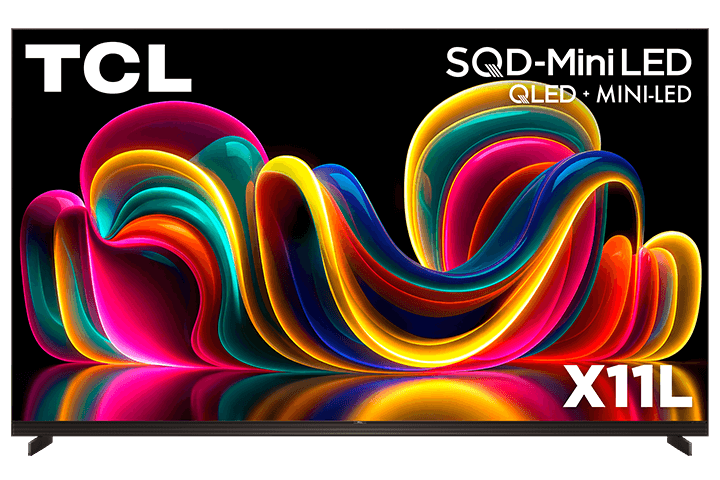
The X11L is TCL's 2026 flagship, built around a Super Quantum Dot (SQD) Mini-LED panel with local dimming zones numbering in the tens of thousands, up to 20,736 on the 98-inch according to What Hi-Fi?, and about 11,500 on the 75-inch. TCL claims 10,000 nits of peak brightness and 100 percent BT.2020 color. It runs Google TV, has a Bang & Olufsen-tuned sound system, and comes in 75, 85, and 98-inch sizes. Launch list prices were $6,999, $7,999, and $9,999 respectively. As of November 10, 2026, TCL.com lists them at $2,999.99, $4,999.99, and $6,999.99 and shows all three available, so the 75-inch is now the entry point and the cheapest way into this panel.
The headline claim is brightness, and the reviews back up the impression if not the exact number. What Hi-Fi? reporter John Archer said the combination of claimed 10,000 nits and over 20,000 zones delivers truly spectacular contrast, and highlighted how the set holds its peak brightness even when a bright highlight sits against a near-black backdrop.
Measurements are more modest than TCL's marketing. Tom's Guide recorded 2,679 nits on a 10 percent HDR window, matching the Sony Bravia 9's 2,713 and trailing the Samsung QM8K's 3,332. eCoustics measured a 4,860-nit peak in Vivid mode and about 2,174 nits in Filmmaker mode on its 75-inch unit, while Expert Reviews saw peaks of 8,760 nits in Vivid and 3,650 in Filmmaker. The spread comes from different modes, window sizes, and panel sizes, so read the figures as a range: real, class-leading brightness, but not a literal 10,000 nits in any mode you would watch movies in.
Color is strong. Tom's Guide measured 97.74 percent DCI-P3 and 91.77 percent Rec.2020, and eCoustics measured 89.7 percent Rec.2020 in Filmmaker mode, short of TCL's 100 percent claim. Calibration is a mixed story: eCoustics found out-of-box accuracy so-so and the adjustment controls limited.
For gamers it is well equipped. It supports 4K at 144Hz across four HDMI 2.1 ports, and measured input lag was 11.7 ms at Tom's Guide, 11.8 ms at Expert Reviews, and 14.5 ms at eCoustics. One review, Home Theater Review, measured 32 ms and told readers not to buy it for gaming, so that conflict deserves a firmware check.
It is still an LCD. Off-axis, reviewers report real blooming. Expert Reviews said head-on viewing keeps blooming to a minimum but off-angle viewing exposes it, and What Hi-Fi? noted mild off-axis blooming and some color shift at wide angles. FlatpanelsHD, quoted in our short verdict, noted that stars on dark backgrounds can bloom or disappear compared with OLED.
Motion and response. Tom's Guide saw occasional smearing in fast action and said motion handling is not class-leading. Expert Reviews listed blurrier motion than top OLEDs.
Brightness pumping. eCoustics noted the picture sometimes pumped in brightness during bright scenes.
Price and size. Even after the cuts, the 85-inch and 98-inch models need a big wall and a big budget. Tom's Guide listed it as extremely expensive and eCoustics concluded the X11L is undeniably a great TV, but that clearly better values exist. Home Theater Review said the price exists in a narrow niche.
If you watch mainly in a dark room, an OLED is a better match.
On our list, the much cheaper TCL QM7K (from $699) delivers the bright-room Mini-LED experience at a much lower price and is the better value for most. Among premium alternatives, the Hisense U9N is the closer Mini-LED rival, and Samsung The Frame is the pick if design and art mode matter more than pure picture performance. The X11L is not the best-value TV; it is the one that goes brightest.
The TCL X11L scores 8.5. It sets the ceiling for LCD brightness and local dimming, and in a bright room at 75 inches or larger the impact is spectacular. But it carries real LCD limits and a price that only makes sense at its current discounts. Buy it for maximum HDR in a large, well-lit space. Otherwise explore the full Best TVs list first.
Only for a specific buyer: someone with a large, bright room who wants maximum HDR impact and is willing to pay flagship money. As of November 10, 2026, TCL.com sells the 75-inch at $2,999.99, which is far easier to justify than the $6,999 launch price, but most people will still be happier with an OLED or with TCL's far cheaper QM7K.
TCL claims 10,000 nits. Independent peaks measured lower and varied by mode and test: roughly 4,900 nits in Vivid at eCoustics, 5,369 at Home Theater Review, and about 8,760 in Vivid at Expert Reviews. On a 10 percent window in accurate modes, results ran from about 2,200 to 3,650 nits.
Mostly yes. It has four HDMI 2.1 ports, 4K at 144Hz, and measured input lag of about 12 to 14.5 ms at Tom's Guide, Expert Reviews and eCoustics. One outlier review measured 32 ms and advised against it for gaming, so check the latest firmware impressions before you buy.
Less than most LCDs when viewed head-on, but it is still an LCD. Reviewers report mild to noticeable blooming off-angle and around small bright objects like stars. OLED avoids this entirely.
Buy the X11L for bright rooms and extreme HDR highlights. Buy an OLED for dark-room viewing, wide viewing angles, and cleaner motion and point highlights.
Prices checked regularly
Price history
Tracking since Nov 10 · currently $2,999.99
Tracked daily across retailers. Vote Want it above and we’ll alert you the moment the price drops.
FlatpanelsHD measured ~4,500 nits sustained and peaks near 10,000 — the brightest LCD they have tested, unmatched for bright-room HDR.
More local dimming zones (20,736 on the 98-inch) than any LCD FlatpanelsHD had tested, though some blooming around bright objects remains.
Super Quantum Dot targets the full BT2020 gamut for saturated HDR, though pure primaries trail newer RGB Mini-LED sets.
Reviewers agree the X11L sets the LCD brightness and local-dimming ceiling — What Hi-Fi called its contrast performance 'truly spectacular,' and FlatpanelsHD rated it the best LCD picture it had tested. The 8.5 rather than higher reflects the limits both flag: blooming around bright objects, slower pixel response, and narrow viewing angles that OLED avoids, plus a flagship price that caps its audience to large, bright-room home theaters. The community score sits just behind, weighed down by that price.
Do you think TCL X11L deserves the #8 spot in Best TVs?
“Its killer combination of 10,000 claimed nits of brightness and more than 20,000 dimming zones delivered a truly spectacular contrast performance.”
“The way it was able to retain most if not all of that peak brightness even when a bright highlight appeared against a near-black backdrop... was incredible to behold.”
“Stars do not shine with the intensity and clarity they have on OLED TVs; they are often hard to see or disappear entirely, or they have blooming around them on X11L.”
“X11L can more than compete with LCD TVs featuring RGB LED. The price is daunting, but will drop considerably later this year.”
Watch
Hand-picked from creators we trust — playable inline.
I guess I need a new TV... - TCL X11L
See how other top picks compare in this category.
Best Buy's Black Friday event opened Nov 6 with LG's 2026 C6 OLED at $999 for 55 inches. What it means for the LG C5 and the prices to hold out for.
LG's G5 is the brightest OLED ever measured, scrambling the old mini-LED vs OLED rule. Here's how Sony's Bravia 9 and the G5 split — and which to buy.
Reference OLED contrast or the brightest TV you can buy? The two best-value TVs of the 2026 sale season solve opposite problems — here's how to choose.
Samsung's 2026 flagship QD-OLED gets brighter and glare-free, solving OLED's one real weakness. A divisive new frame and steep price complicate the pick.
At 65 inches, Sony's QD-OLED Bravia 8 II now costs about $700 more than the LG C5. Here's what the extra money buys, and when it isn't worth it.
OLED, QD-OLED, Mini-LED, and the new RGB Mini-LED — what each technology actually delivers in 2026, what to pay, and which one matches your room.
The two flagship OLED TVs every home theater buyer cross-shops. Here's how Samsung's QD-OLED S95H and LG's G6 actually compare.
Sony, LG, Samsung, Hisense. Gavler's home theater community ranks the TVs worth watching — OLED, QD-OLED, and Mini-LED, by votes not ad spend.