Samsung S95F vs S90F OLED — Which One Should You REALLY Buy? (Review)
CalebRated
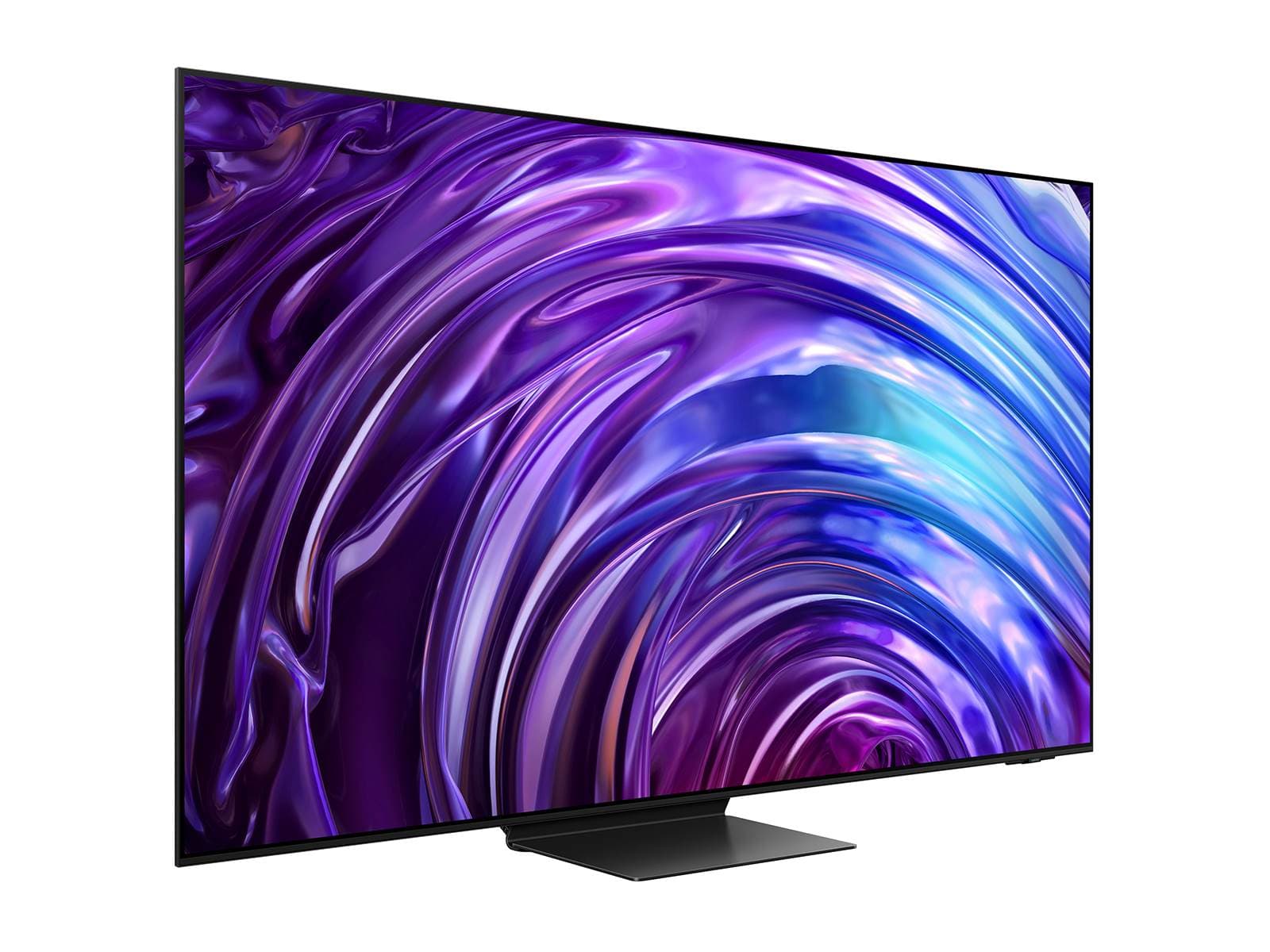
Samsung's third-generation QD-OLED combines the brightest OLED panel ever tested (~1,600 nits) with an anti-glare matte coating that kills reflections without raising black levels.
Gavler Meta-Score
“The S95D is the TV to beat for bright-room viewing and mixed-use living rooms. The anti-glare coating solves a real problem that plagues every competitor, and the brightness puts it at the top of the OLED class. The missing Dolby Vision is a trade-off cinephiles will notice, but for most buyers the combination of brightness, color accuracy, and glare resistance is unmatched. Samsung's strongest TV in years.”
The Gavler Verdict
Samsung S95D QD-OLED Review: The Brightest OLED Trades Away Dolby Vision
The Samsung S95D ranks number five on Gavler's Best TVs list with a 9.2, and it earns that spot by solving a problem almost every other OLED simply lives with: glare. RTINGS called it "class-leading QD-OLED brightness and superb color," and Tom's Guide went further, describing it as "one of the first TVs to almost completely eliminate glare without sacrificing brightness or color — one of the best-designed TVs in years." Buy it if your living room gets real daylight and you've written off OLED as a dark-room-only technology. Skip it if you already watch in a controlled, dim environment and don't want to pay a premium for brightness headroom you won't use — or if Dolby Vision content matters to you, since Samsung doesn't support it.
The S95D is Samsung's third-generation QD-OLED panel, and the headline number is brightness: roughly 1,628 nits of peak HDR output in RTINGS' 10% window test, about 30% brighter than the outgoing S95C. That's genuinely rare for an OLED — brightness has historically been the technology's weak point relative to Mini-LED — and it's paired with 87% coverage of the BT.2020 HDR color gamut, among the widest color gamuts on any consumer TV currently sold.
The real innovation, though, isn't the brightness number by itself. It's the anti-reflective matte coating layered over the panel, which Samsung engineered to kill glare without the washed-out, milky black levels that have doomed every previous attempt at matte OLED finishes. Four HDMI 2.1 ports with VRR up to 144Hz make it a strong gaming display too, and the set comes in 55-, 65-, and 77-inch sizes at prices starting around $2,399 for the 65-inch model.
The omission that draws the most criticism is Dolby Vision. Samsung has never licensed it, backing its own HDR10+ format instead. That's a deliberate, longstanding company decision rather than an oversight specific to the S95D, but it means buyers with a Dolby Vision-heavy library — certain Netflix and Apple TV+ originals, for instance — are watching a lower-fidelity HDR pass than owners of an equivalent LG or Sony panel.
The anti-glare coating is the feature that actually changes how you use this TV day to day. Digital Trends called it "a genuine breakthrough, though the matte finish is a love-it-or-hate-it look in a dark room" — a fair characterization of the trade-off. In a bright living room with windows behind the seating area, the S95D simply doesn't wash out the way a glossy OLED panel does; reflections that would normally sit on top of the picture are diffused instead of mirrored. That's a real, immediately visible difference if you've ever tried to watch an OLED TV during the day with the blinds open.
RTINGS' one documented caveat is worth taking seriously: "the matte anti-glare coating can slightly raise black levels in a brightly lit room." In other words, the coating trades a small amount of absolute black-level performance for a much larger reduction in visible glare — a trade most buyers in bright rooms will take gladly, but one that purists chasing reference-level black levels in a blacked-out theater room should know about going in.
Gaming performance holds up well too. Four HDMI 2.1 ports and VRR up to 144Hz put it on par with the best gaming TVs on the market, even if the S95D isn't marketed primarily as a gaming set the way LG's C- and G-series are.
The S95D is a specific answer to a specific problem — ambient light — and buyers without that problem should think twice before paying its premium.
Within Samsung's own lineup and against the field, the S95D sits in a crowded top tier of Gavler's Best TVs list. The LG C5 OLED at rank two is the value benchmark most reviewers reach for first — RTINGS and Wirecutter both call it the best all-around OLED for the price, though it lacks the S95D's anti-glare advantage in bright rooms. One rank up, the LG G5 OLED chases a similar goal — brightness for daylight viewing — via a different route: a brighter evo panel rather than a glare-fighting coating, at a materially higher price. Just below the S95D, the Hisense U9N takes the opposite approach entirely, using Mini-LED to push nearly 4,000 nits of raw brightness for around $400 less, at the cost of OLED's per-pixel black levels.
A 9.2, and one of the more specialized recommendations on Gavler's TV list — not because the S95D is a flawed product, but because its central innovation, the anti-glare coating, only matters if you actually have a glare problem to solve. For buyers in bright, sunlit living rooms who've been told OLED "doesn't work" in their space, this is the TV that proves that advice outdated. For everyone watching in a dim room and counting dollars, the LG C5 OLED remains the smarter buy. The missing Dolby Vision support is the one caveat that applies regardless of room lighting, and it's worth checking your streaming habits before you commit.
Yes, if you watch TV in a room with real ambient light. It ranks fifth on Gavler's Best TVs list with a 9.2, and Tom's Guide called it 'one of the first TVs to almost completely eliminate glare without sacrificing brightness or color — one of the best-designed TVs in years.' At around $2,399 for the 65-inch, it's a premium purchase, but the combination of ~1,628-nit peak brightness and a working anti-glare coating is still hard to find anywhere else.
No. Samsung has never supported Dolby Vision on its TVs, backing HDR10+ instead. The S95D handles HDR10, HDR10+, and HLG, which covers the large majority of streaming content, but if your movie collection or a specific streaming service leans heavily on Dolby Vision mastering, you'll be watching a technically inferior HDR pass on this set.
Buy the S95D if your room gets real daylight or lamp glare and you want the brightest, most glare-resistant OLED panel available. Buy the LG C5 OLED if you watch mostly in a dim or dark room and want to save roughly $1,000 — RTINGS and Wirecutter both rate the C5 as the best value OLED on the market, and in controlled lighting it holds up close to the S95D for a fraction of the price.
Prices checked regularly
90-day price history
Steady at $2,399 for the entire 90-day tracking window — no increases, no discounts, across 90 tracked days.
Tracked daily across retailers. Vote Want itabove and we’ll alert you the moment the price drops.
Some links are affiliate links — Gavler may earn a commission. This never affects rankings or scores. Learn more.
The brightest OLED panel ever tested — 30% brighter than the S95C predecessor.
Innovative anti-reflective finish kills glare without raising black levels in ambient lighting.
Outstanding HDR color accuracy — among the widest color gamuts in any consumer TV.
Record-setting brightness and innovative anti-glare coating. No Dolby Vision is the one notable gap.
Do you think Samsung S95D QD-OLED deserves the #5 spot in Best TVs?
“One of the first TVs to almost completely eliminate glare without sacrificing brightness or color — one of the best-designed TVs in years.”
“Class-leading QD-OLED brightness and superb color, but the matte anti-glare coating can slightly raise black levels in a brightly lit room.”
“The glare-free screen is a genuine breakthrough, though the matte finish is a love-it-or-hate-it look in a dark room.”
Watch
Hand-picked from creators we trust — playable inline.
Samsung S95F vs S90F OLED — Which One Should You REALLY Buy? (Review)
THIS is the SAMSUNG TV You Should Get! (S95D QD-OLED Review)
Before You Buy: Samsung S95D OLED 4K Gaming TV Review (2025)
Samsung S95D OLED TV Review | The Most Versatile OLED TV?
Samsung S95D OLED Review: High-End TV With A Polarizing Feature
Samsung S95D Series QD OLED TV Overview: The Ultimate Anti-Glare TV
See how other top picks compare in this category.
Reference OLED contrast or the brightest TV you can buy? The two best-value TVs of Prime Big Deal Days 2026 solve opposite problems — here's how to choose.
Prime Big Deal Days runs October 6-7, 2026. The OLED, mini-LED, and budget TV picks worth watching, what they actually discount to, and which to buy anyway.
Most Labor Day TV deals are doorbuster bait. Here's how to spot a real record low versus a marketing banner — and which sets are actually worth buying now.
Samsung's 2026 flagship QD-OLED gets brighter and glare-free, solving OLED's one real weakness. A divisive new frame and steep price complicate the pick.
Sony's QD-OLED Bravia 8 II costs nearly twice as much as the LG C5. Here's exactly what the extra money buys — and when it isn't worth it.
OLED, QD-OLED, Mini-LED, and the new RGB Mini-LED — what each technology actually delivers in 2026, what to pay, and which one matches your room.
The two flagship OLED TVs every home theater buyer cross-shops. Here's how Samsung's QD-OLED S95H and LG's G6 actually compare.
Sony, LG, Samsung, Hisense. Gavler's home theater community ranks the TVs worth watching — OLED, QD-OLED, and Mini-LED, by votes not ad spend.