It's finally time for Wi-Fi 7 - TP Link Deco 7 Pro
ShortCircuit
Tri-band WiFi 6E with 2.5 Gbps ports on every node, full HomeShield without a subscription, and the strongest spec-per-dollar in the mid-tier.
Gavler Meta-Score
“The mid-tier mesh with the strongest performance-per-dollar of any WiFi 6E system in 2026. The app is denser than Eero's but the trade-off is real: HomeShield without a subscription, 2.5 Gbps on every node, and throughput numbers that hold up against systems twice the price. Buy the XE75 Pro if you'd rather spend the $100 you'd save on a better access point or two.”
The Gavler Verdict
TP-Link Deco XE75 Pro Review: The WiFi 6E Value Benchmark
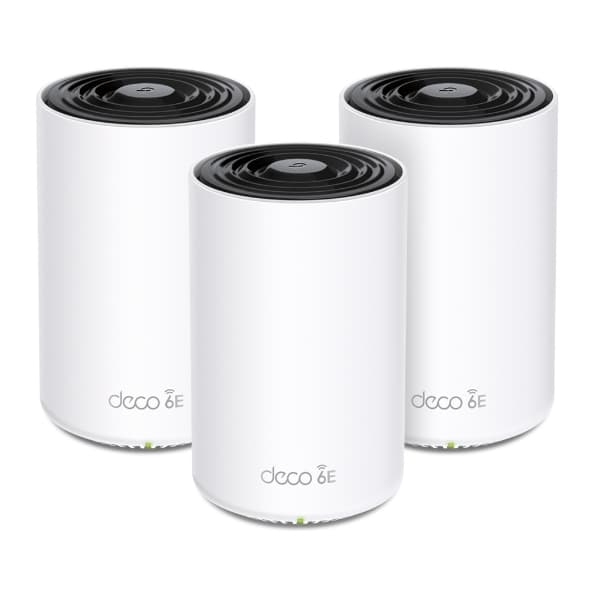
The TP-Link Deco XE75 Pro ranks number 7 on Gavler's Best Mesh WiFi Systems list with an 8.2, and it earns that spot on value alone. TweakTown measured 1,163 Mbps on the 6 GHz band during testing — within shouting distance of WiFi 7 systems costing twice as much — and Tom's Guide clocked 579.1 Mbps at 40 feet from the router, "more than three times the Orbi RBKE963 and five times the Atlas Max 6E at the same range." It's built for households upgrading to WiFi 6E who want a 2.5 Gbps port on every node and free security software, not the simplest possible app experience. The trade-off is real: TP-Link's Deco app is denser and more configuration-heavy than Eero's, which is the whole reason the $100-more-expensive Eero Pro 6E still exists as a legitimate alternative.
Each of the XE75 Pro's three nodes carries a tri-band AXE5400 radio spanning 2.4 GHz, 5 GHz, and 6 GHz, plus a 2.5 Gbps multi-gig Ethernet port and three 1 Gbps ports. The meaningful spec here isn't the radio class — plenty of WiFi 6E mesh systems hit AXE5400 — it's that the 2.5 Gbps port sits on every node, not just the router. That means any unit in the three-pack can serve as the gateway, and any unit can backhaul to a 2.5 Gbps switch if you're running wired backhaul through the house. A three-pack covers up to 7,200 sq ft, which beats the Eero Pro 6E's 6,000 sq ft footprint at a price point that's $100 lower.
The included HomeShield suite bundles parental controls, IoT device isolation, and threat detection without a subscription wall — a genuine point of separation from Eero, whose comparable Eero Plus tier is a recurring cost. PCMag called it "a solid and user-friendly Wi-Fi 6E mesh system, with easy setup, sleek design, and the ability to use Ethernet ports on all nodes for wired connections," and HighSpeedInternet named it "one of the best mesh systems tested to date."
The throughput numbers above aren't marketing claims — they're third-party measurements from two separate outlets, and they land in a category most WiFi 6E mesh systems don't reach at this price. For households running multi-gig fiber (2 Gbps-class plans and above), the 2.5 Gbps WAN-capable port on every node means you're not bottlenecked at the gateway the way you would be on a 1 Gbps-port system.
Where the experience gets more mixed is the app. TP-Link's Deco software exposes more configuration surface than Eero's — VLAN-adjacent settings, more granular QoS controls, deeper HomeShield rule-building. For a power user, that's a feature; the density is where the actual value lives, since it's what lets HomeShield ship without a subscription in the first place. For a buyer who wants a mesh system that essentially configures itself and never asks a follow-up question, that same density reads as friction. It's the single biggest fork in who should buy this system versus who should spend the extra hundred dollars on the Eero Pro 6E.
Directly above it on the list, the Eero Pro 6E ranks 6th with an 8.4 at $699 — the same WiFi 6E generation, the same tri-band radio class, but Eero's simpler, more guided app experience and TrueMesh routing engine in exchange for $100 more and a subscription-gated security tier. It's the right call for buyers who've never wanted to open a router's advanced settings page in their life.
One rank below, the Netgear Orbi RBK863 is the outgoing WiFi 6 flagship, now repositioned as a value coverage play in large, dense-construction homes. It lacks the 6 GHz band entirely, but its dedicated 5 GHz backhaul channel gives it stronger far-room signal than either 6E mesh in tricky multi-story builds — at the cost of being a generation behind on raw bandwidth.
An 8.2, with expert consensus at 82 running a touch behind the 85 community score — a pattern that tracks with real-world satisfaction outpacing critics' reservations about the Deco app's density. The scoreNote is direct about it: this is a frequent value pick in review roundups precisely because the underlying performance holds up against systems twice the price, and the app complaint is a UI quibble, not a functional one. If you want the strongest WiFi 6E throughput-per-dollar on the market and free security software, the Deco XE75 Pro is the mesh to buy — spend the saved $100 on a better access point, or just keep it in your pocket.
Yes, for buyers who want the best throughput-per-dollar in WiFi 6E mesh. It ranks 7th on Gavler's Best Mesh WiFi Systems list with an 8.2, and Tom's Guide measured 579.1 Mbps at 40 feet from the router — over three times the Orbi RBKE963 and five times the Atlas Max 6E at the same range, on one of the least expensive systems in its class.
No. HomeShield's parental controls, threat detection, and IoT network isolation are included at no recurring cost, which is the system's core differentiator against Eero's Plus-gated security tier.
Buy the Deco XE75 Pro if you want the strongest spec-per-dollar and free security features, and don't mind a denser configuration app. Buy the Eero Pro 6E if you'd pay $100 more for the simplest possible setup and app experience — TP-Link's Deco app has more visible configuration surface than Eero's guided interface.
Prices checked regularly
90-day price history
Steady at $599 for the entire 90-day tracking window — no increases, no discounts, across 91 tracked days.
Tracked daily across retailers. Vote Want itabove and we’ll alert you the moment the price drops.
Some links are affiliate links — Gavler may earn a commission. This never affects rankings or scores. Learn more.
Adds the 6 GHz band for reduced congestion in dense homes — class-leading 6 GHz throughput per dollar.
Multi-gig Ethernet on every node — rare at this price, and the meaningful upgrade vs the standard XE75.
Security, parental controls, and IoT network isolation included without recurring subscription.
Frequent value pick in review roundups. Community scores reflect strong real-world satisfaction; expert reservations focus on the dense Deco app UI relative to Eero, not the underlying performance.
Do you think TP-Link Deco XE75 Pro deserves the #7 spot in Best Mesh WiFi Systems?
“Delivered 579.1 Mbps at 40 feet from the router — more than three times the Orbi RBKE963 and five times the Atlas Max 6E. The two-part mesh kit holds the record for data flow and is one of the least expensive systems in its class.”
“Both units are WiFi 6E platforms, but the largest difference is the 2.5 Gbps Ethernet on the XE75 Pro — in 6 GHz band testing we saw 1,163 Mbps from the Pro model.”
“A solid and user-friendly Wi-Fi 6E mesh system, with easy setup, sleek design, and the ability to use Ethernet ports on all nodes for wired connections.”
“One of the best mesh systems tested to date, with a 2.5 Gbps Ethernet port on each node supporting internet packages exceeding gigabit speeds.”
Watch
Hand-picked from creators we trust — playable inline.
It's finally time for Wi-Fi 7 - TP Link Deco 7 Pro
See how other top picks compare in this category.
Gbps hangtags are the wrong first question. Wi-Fi 7 vs 6E vs 6 is the generation to buy. Then shop Gavler's live ranking.
TP-Link showed the first Wi-Fi 8 routers at IFA 2026. But the standard isn't final until 2028 and no client devices exist yet. Here's what to actually buy.
Is Wi-Fi 7 worth it? What MLO actually does, when 6 GHz matters, what to pay in 2026, and the buyers who should honestly skip the upgrade.
The two flagship Wi-Fi 7 mesh systems most worth comparing. Updated July 2026 with current pricing, corrected firmware-support terms, and the Wi-Fi 8 timeline.
Eero Max 7, Orbi 970, Deco BE95. Gavler's networkers rank the Wi-Fi 7 mesh systems worth buying — for whole-home coverage at speed.