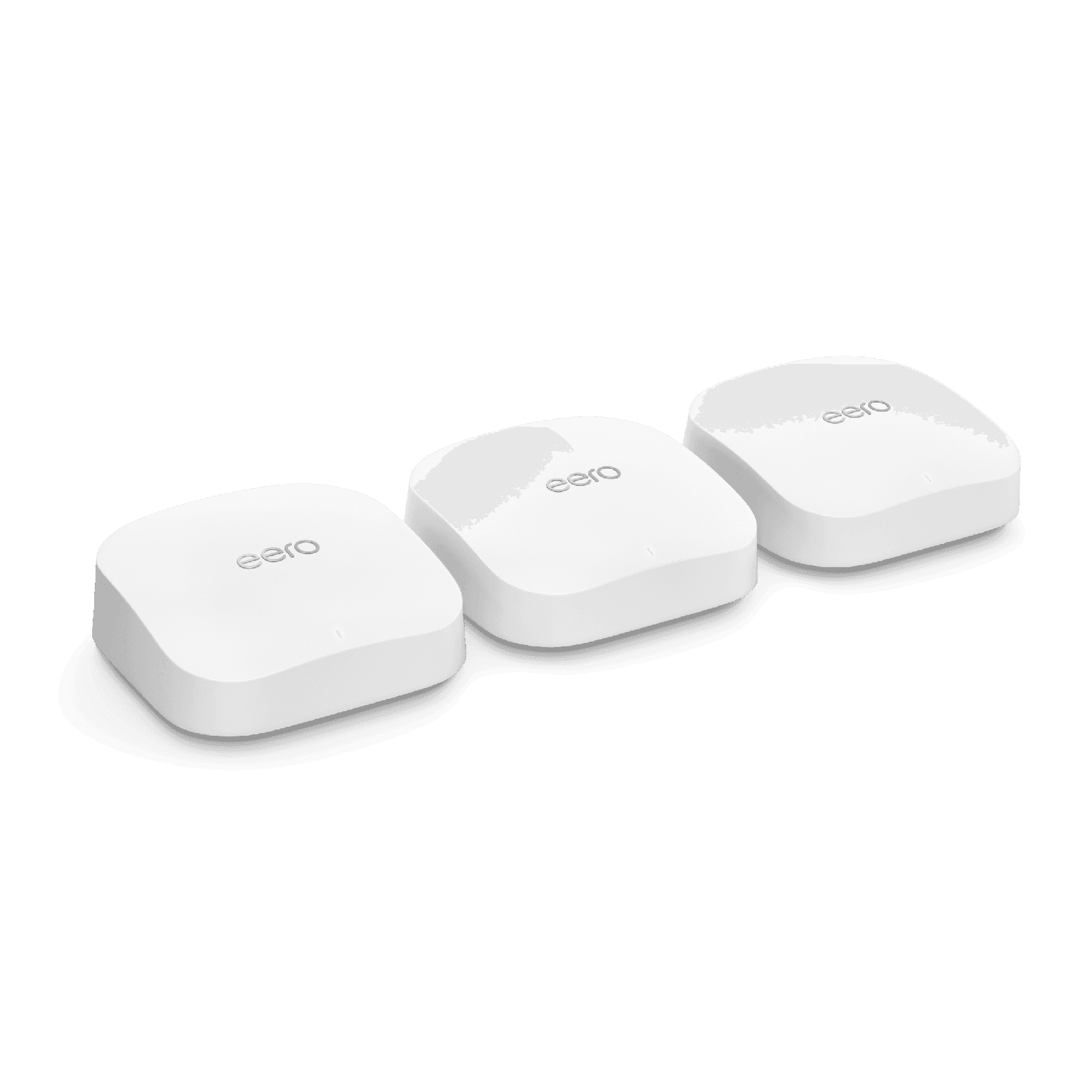
Amazon Eero Pro 6E.
Tri-band WiFi 6E with the signature Eero setup experience and robust handling of dozens of devices, at half the cost of a WiFi 7 flagship.
The Verdict.
Gavler Meta-Score
“The right Eero for most homes that aren't ready to spend WiFi 7 money. Unless you have a 2+ Gbps ISP plan, a closet full of WiFi 7 clients, or 80+ devices on your network, the Pro 6E delivers the Eero experience at a price that respects your budget. The one honest caveat: if you'd resent paying Eero Plus for security features other meshes include free, look at the Deco XE75 Pro before buying.”
The Gavler Verdict
The Gavler Review.
Amazon Eero Pro 6E Review: WiFi 6E at the Price Most Homes Actually Need
The Amazon Eero Pro 6E ranks number 6 on Gavler's Best Mesh WiFi Systems list with an 8.4, and its pitch is refreshingly honest for a category that constantly pushes buyers toward the newest standard: most homes don't need WiFi 7 yet. PCWorld's testing backs that up directly — "Eero's new mesh system is fast enough, reliable, and cheaper than other big mesh WiFi 6E systems." Buy it if you want the reliable Eero setup experience without paying WiFi 7 flagship prices. Skip it if you specifically want subscription-free security features, in which case the TP-Link Deco XE75 Pro undercuts it by $100 with more included.
What it is
The Eero Pro 6E adds the 6 GHz band to the Eero platform at a price that undercuts WiFi 7 flagships by more than half. Each node carries a tri-band radio (2.4 GHz, 5 GHz, and 6 GHz), a 2.5 Gbps WAN port, and the second-generation Eero TrueMesh routing engine, which has spent four years quietly fixing rough edges in client handoff and band steering. A three-pack covers up to 6,000 sq ft — right-sized for households whose smart-home device counts are growing faster than their ISP speeds.
The honest case for the Pro 6E in 2026 is that very few client devices actually use the 6 GHz band yet — most laptops, phones, and smart-home gear top out at WiFi 6 on the 5 GHz band. The 6 GHz radio's real value is congestion relief: the handful of devices that can use it — newer iPhones, MacBooks, gaming PCs — get a clean lane while the rest of the network shares the busier 5 GHz band more comfortably. That makes the Pro 6E the right buy for homes with roughly 30-60 active clients, where a WiFi 7 mesh would be overkill and a WiFi 6-only mesh would already be a generation behind. Ecosystem context matters too: Eero Plus gates advanced security and parental controls the same way it does on the Max 7 and Pro 7, so buyers who want those features free should price the Deco XE75 Pro instead.
In use
The Verge's testing found the generational jump was real: "Significantly faster speeds over the previous-generation Eero Pro 6, with the kind of generally hassle-free network experience Eero is known for." PCWorld's setup experience was similarly frictionless — "the entire setup process was guided through the app and online in under 15 minutes" — and its framing of the product's overall character is the most useful line in this review: "More family sedan than sports car — but for most homes, that's exactly the right shape."
Tom's Guide's assessment ties the value proposition together clearly: "Adds Wi-Fi 6E to the Eero formula at a price that finally makes the upgrade math work for ordinary households." That's the core argument for the Pro 6E over both the cheaper WiFi 6-only Eero tiers and the pricier WiFi 7 flagships — it's positioned at the point where the upgrade cost actually matches what most households will use, not what the spec sheet allows for.
Strengths
- TrueMesh routing is a mature, four-year-refined product, not a first-generation feature — client handoff and band steering issues that plagued early mesh systems are largely solved here.
- 2.5 Gbps WAN on every node supports ISP plans up to 2.3 Gbps, with any node usable as the gateway — meaningful flexibility for a mid-tier system.
- 6 GHz congestion relief is a real, if modest, benefit even with few 6E-capable clients today, easing pressure on the busier 5 GHz band for everyone else on the network.
- Setup remains genuinely fast and guided, continuing Eero's reputation as the category's simplicity benchmark even outside its flagship tier.
The trade-offs — who should skip it
- You want subscription-free advanced security. Eero Plus paywalls deeper parental controls and threat protection; the TP-Link Deco XE75 Pro includes HomeShield's equivalent features at no ongoing cost, and it's $100 cheaper.
- You have a 2-plus Gbps ISP plan or 80-plus devices. That's the territory where a WiFi 7 flagship like the Amazon Eero Max 7 actually pays for its premium; the Pro 6E's ceiling is lower by design.
- Very few of your devices actually support 6 GHz. If your household skews toward older phones, laptops, and smart-home gear, much of the Pro 6E's headline feature will go unused — a standard WiFi 6 mesh may be the more honest spend.
How it compares
The TP-Link Deco XE75 Pro at rank 7 on the same list is the direct value alternative — the same WiFi 6E tier, 2.5 Gbps ports on every node, and HomeShield security included without a subscription, all for $599 versus the Pro 6E's $699. TweakTown measured the XE75 Pro at 1,163 Mbps on the 6 GHz band, within range of systems costing twice as much, which makes the $100 premium for the Eero genuinely a payment for app polish and ecosystem trust rather than raw throughput. Stepping up within Eero's own lineup, the Amazon Eero Max 7 at rank 1 adds WiFi 7 and 10 Gbps ports for $1,699 — the right move only for households that will actually use that headroom.
The Gavler verdict
An 8.4, with an 85 expert consensus and an 87 community rating — Gavler's own scoreNote calls it "widely recommended as the best balance of features and price in the Eero lineup," with expert reservations centered on the subscription gate and the practical scarcity of WiFi 6E client devices in 2026, not on reliability. That's a fair summary. The Pro 6E isn't the most capable mesh system Gavler has reviewed, and it isn't trying to be — it's the right Eero for most homes that aren't ready to spend WiFi 7 money, and for the vast majority of households shopping this category, that's exactly the right call.
Common Questions
Yes, for most homes that aren't ready to spend WiFi 7 money. It ranks sixth on Gavler's Best Mesh WiFi Systems list with an 8.4. PCWorld called it 'fast enough, reliable, and cheaper than other big mesh WiFi 6E systems,' with setup 'guided through the app and online in under 15 minutes.'
Buy the Deco XE75 Pro at $599 if you want HomeShield's parental controls and IoT network isolation without a subscription, plus 2.5 Gbps ports on every node for $100 less. Buy the Eero Pro 6E at $699 if you'd rather pay for the Eero app's simpler setup experience and don't mind Eero Plus gating advanced security features.
Only if congestion relief matters more than raw client speed. Gavler's own product analysis is candid: very few client devices actually use the 6 GHz band yet, so the Pro 6E's real value is giving newer devices a clean lane while the rest of the network shares 5 GHz more comfortably — not dramatically faster speeds for most users.
Households with a 2-plus Gbps ISP plan, a closet full of WiFi 7 clients, or 80-plus connected devices, where the extra headroom of a WiFi 7 flagship like the Eero Max 7 actually gets used. For everyone else, per Gavler's own verdict, the Pro 6E 'delivers the Eero experience at a price that respects your budget.'
Where to Buy.
Prices checked regularly
90-day price history
Price History
Steady at $699 for the entire 90-day tracking window — no increases, no discounts, across 90 tracked days.
Tracked daily across retailers. Vote Want itabove and we’ll alert you the moment the price drops.
Some links are affiliate links — Gavler may earn a commission. This never affects rankings or scores. Learn more.
Precision Engineering
Tri-Band WiFi 6E
Adds the 6 GHz band to the Eero platform — congestion relief in device-dense homes for capable clients.
2.5 Gbps WAN per Node
Multi-gig WAN supports ISP plans up to 2.3 Gbps, with each node usable as the gateway.
TrueMesh + Thread Border Router
Eero's dynamic mesh routing steers clients automatically, and every Pro 6E node doubles as a Thread border router for Matter smart-home devices.
Technical Specifications
The Scoreboard
Widely recommended as the best balance of features and price in the Eero lineup. Community scores reflect strong real-world reliability; expert reservations focus on the subscription gate and the practical scarcity of WiFi 6E client devices in 2026.
Cast Your Vote
Do you think Amazon Eero Pro 6E deserves the #6 spot in Best Mesh WiFi Systems?
Global Critique
“Significantly faster speeds over the previous-generation Eero Pro 6, with the kind of generally hassle-free network experience Eero is known for.”
“Eero's new mesh system is fast enough, reliable, and cheaper than other big mesh WiFi 6E systems — the entire setup process was guided through the app and online in under 15 minutes.”
“More family sedan than sports car — but for most homes, that's exactly the right shape.”
“Adds Wi-Fi 6E to the Eero formula at a price that finally makes the upgrade math work for ordinary households.”
More from Best Mesh WiFi Systems.
See how other top picks compare in this category.

Do You Need Wi-Fi 7 Mesh, or Will 6E Do?
Gbps hangtags are the wrong first question. Wi-Fi 7 vs 6E vs 6 is the generation to buy. Then shop Gavler's live ranking.
Wi-Fi 8 Just Showed Up at IFA — Here's Why You Shouldn't Wait for It
TP-Link showed the first Wi-Fi 8 routers at IFA 2026. But the standard isn't final until 2028 and no client devices exist yet. Here's what to actually buy.
Wi-Fi 7 Buying Guide 2026: Who Actually Needs It, Who Doesn't, and How to Not Overpay
Is Wi-Fi 7 worth it? What MLO actually does, when 6 GHz matters, what to pay in 2026, and the buyers who should honestly skip the upgrade.
eero Pro 7 vs Netgear Orbi 970: The Wi-Fi 7 Mesh Decision That Actually Matters in 2026
The two flagship Wi-Fi 7 mesh systems most worth comparing. Updated July 2026 with current pricing, corrected firmware-support terms, and the Wi-Fi 8 timeline.
The Best Mesh WiFi Systems in 2026, Ranked by People Who Actually Cover Their Whole House
Eero Max 7, Orbi 970, Deco BE95. Gavler's networkers rank the Wi-Fi 7 mesh systems worth buying — for whole-home coverage at speed.