Netgear Orbi RBK863.
Tri-band WiFi 6 with a dedicated 5 GHz wireless backhaul, AX6000 speeds, and 8,000+ sq ft of coverage at a price that has dropped sharply from its original MSRP.
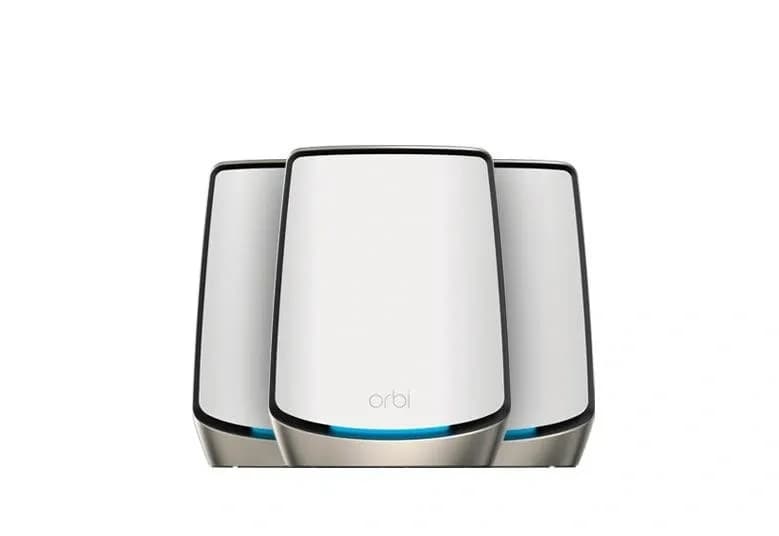
The Verdict.
Gavler Meta-Score
“Buy the RBK863 only at a discount, and only for the specific use case it serves: a large home with dense construction where mid-tier mesh systems develop dead zones and you don't have WiFi 6E or 7 client devices to take advantage of newer mesh hardware. At $999 list price the value math is weak. At $700 with a sale tag, it's the strongest coverage-per-dollar play in the WiFi 6 segment.”
The Gavler Verdict
The Gavler Review.
Netgear Orbi RBK863 Review: A Coverage King That Only Makes Sense on Sale
The Netgear Orbi RBK863 ranks number 8 on Gavler's Best Mesh WiFi Systems list with an 8.0, and the honest way to describe it in 2026 is a strong coverage story wearing an outdated price tag. Tom's Guide called it "a great system for anyone with a large house or for anyone who struggles getting a wireless signal everywhere," but the same publication was blunt about where the category has moved: it "can't hope to keep up with WiFi 6E meshes such as the TP-Link Deco XE75." Buy it only at a discount, and only for the specific job it's built for — large, dense-construction homes where mid-tier mesh systems develop dead zones. At full list price, the math doesn't work.
What it is
The RBK863 is a late-cycle WiFi 6 Orbi built around the architectural idea that made the original Orbi famous: a dedicated 5 GHz wireless backhaul channel that keeps node-to-node mesh traffic completely separate from client traffic. Cheaper mid-tier mesh systems typically share bandwidth between backhaul and client connections, which degrades performance as the mesh grows. A three-pack covers up to 8,000 sq ft and supports up to 100 simultaneous devices, and the router node carries a 10 Gbps WAN port — the only WiFi 6 mesh on Gavler's list that can ingest a multi-gig fiber connection without bottlenecking at the gateway.
That combination is what makes the RBK863 genuinely strong in a specific scenario: large multi-story homes, brick or plaster-and-lath construction, concrete sub-levels — the environments where a mid-tier mesh's smaller antenna array and shared backhaul channel start dropping signal in far rooms. Netgear's bigger antenna array and dedicated backhaul consistently deliver stronger far-room signal in those conditions than a comparable Eero Pro 6E or Deco XE75 Pro.
In use
What the RBK863 doesn't do is keep pace with the current WiFi generation. There's no 6 GHz band at all, so any WiFi 6E or WiFi 7 client device in the house simply has no faster band to connect to — it falls back to 5 GHz like everything else. There's no Multi-Link Operation. The AX6000 aggregate class was a genuinely impressive number in 2022; in 2026, it's mid-pack against the WiFi 6E and WiFi 7 systems that have since become standard at similar prices. ITPro's assessment lands squarely on this point: "A fine mesh three years ago, but the technology has moved on — this remains a solid coverage story that asks too much at full price."
Security software follows a now-familiar pattern in the category: Netgear's Bitdefender-powered Armor suite comes included for the first year, then moves behind a subscription — the same structure Eero uses with Eero Plus. It's not a unique downside, but it's worth budgeting for if you plan to keep the threat-detection and parental-control features active past year one.
Strengths
- Dedicated 5 GHz backhaul channel keeps client traffic and mesh traffic separate — a real architectural advantage over shared-band competitors, especially as device count grows.
- 10 Gbps WAN port is the only mesh on Gavler's list at this price tier that can actually ingest a true multi-gig fiber connection without becoming the network's bottleneck.
- Genuinely stronger far-room coverage in dense-construction homes than comparable WiFi 6E systems, per Tom's Guide's testing across large and multi-story properties.
The trade-offs — who should skip it
- You want WiFi 6E or WiFi 7. There's no 6 GHz band and no MLO on this system — it's a hard technology ceiling, not a firmware limitation that gets fixed later.
- You live in a standard-construction home under 4,000 sq ft. The dedicated-backhaul advantage matters most in large, signal-hostile buildings; in a typical home, a cheaper WiFi 6E system like the TP-Link Deco XE75 Pro will outperform it on raw throughput for less money.
- You're paying list price. T3's framing is the right one: "High-end Wi-Fi at a high-end price — buy at a discount or step up to the WiFi 7 generation." At $999-$1,099, this isn't a competitive purchase against current-generation mesh systems.
How it compares
One rank up on the list, the TP-Link Deco XE75 Pro is the system most buyers should default to — WiFi 6E, a 2.5 Gbps port on every node, HomeShield security with no subscription, and a $599 price that undercuts the Orbi's list price by $400. It wins on throughput and value in nearly every scenario except the specific large-dense-home coverage case the Orbi is built for.
One rank down, the Linksys Velop Pro 7 jumps a full generation ahead to WiFi 7 with Multi-Link Operation, at roughly the Orbi's list price — the more future-proof buy for anyone not anchored to Orbi's specific backhaul architecture.
The Gavler verdict
An 8.0, with an 80 expert consensus trailing an 84 community rating — the scoreNote is explicit that this gap "depends entirely on current discounting," with owners rating real-world coverage highly while experts ding the WiFi 6E/7 gap and the high list price. That's the correct read: this is a mesh system whose grade should move with the sale tag. Check current pricing before buying — at $700, it's the strongest coverage-per-dollar system in the WiFi 6 segment; at $999 or more, spend the money on a WiFi 6E or WiFi 7 system instead.
Common Questions
Only at a discount. It ranks 8th on Gavler's Best Mesh WiFi Systems list with an 8.0, and Tom's Guide praised its 'very reliable connection speeds, even at range,' but the same outlet noted it 'can't hope to keep up with WiFi 6E meshes such as the TP-Link Deco XE75.' At its $999-$1,099 list price the value case is weak; at the roughly $700 it has sold for through 2026, it's the strongest coverage-per-dollar play in the WiFi 6 segment.
No. It's a WiFi 6 (802.11ax) system with no 6 GHz band and no Multi-Link Operation, which means newer WiFi 6E and WiFi 7 client devices won't get any benefit from bands the router simply doesn't have. Its aggregate AX6000 class was competitive in 2022 and is mid-pack in 2026.
Buy the Deco XE75 Pro if you want WiFi 6E throughput and don't have a large, dense-construction home creating dead zones — it beats the Orbi on raw speed and costs less at list price. Buy the Orbi RBK863, and only at a discount, if you have a large multi-story home with brick, plaster, or concrete construction where mid-tier mesh systems have historically struggled with range.
Where to Buy.
Prices checked regularly
90-day price history
Price History
Steady at $999 for the entire 90-day tracking window — no increases, no discounts, across 90 tracked days.
Tracked daily across retailers. Vote Want itabove and we’ll alert you the moment the price drops.
Some links are affiliate links — Gavler may earn a commission. This never affects rankings or scores. Learn more.
Precision Engineering
Tri-Band WiFi 6 with Dedicated Backhaul
Reserved 5 GHz channel for node-to-node mesh traffic — clients never compete with backhaul for bandwidth.
10 Gbps WAN + Gigabit LAN
Multi-gig WAN port on the router node ingests fiber plans up to 10 Gbps without gateway bottleneck.
Netgear Armor (1 yr included)
Bitdefender-powered threat protection and parental controls included for the first year, subscription thereafter.
Technical Specifications
The Scoreboard
A value play that depends entirely on current discounting. Community scores reflect strong real-world coverage. Expert scores ding the lack of WiFi 6E/7 in 2026 and the high list price relative to comparable mid-tier WiFi 6E systems — check sale prices before buying.
Cast Your Vote
Do you think Netgear Orbi RBK863 deserves the #8 spot in Best Mesh WiFi Systems?
Global Critique
“Very reliable connection speeds, even at range — this is a great system for anyone with a large house or for anyone who struggles getting a wireless signal everywhere.”
“Takes what was good about the original WiFi 6 mesh system and gives it a speed boost — but the RBK863S can't hope to keep up with WiFi 6E meshes such as the TP-Link Deco XE75 or Netgear's own RBKE963.”
“A fine mesh three years ago, but the technology has moved on — this remains a solid coverage story that asks too much at full price.”
“High-end Wi-Fi at a high-end price — buy at a discount or step up to the WiFi 7 generation.”
More from Best Mesh WiFi Systems.
See how other top picks compare in this category.
Do You Need Wi-Fi 7 Mesh, or Will 6E Do?
Gbps hangtags are the wrong first question. Wi-Fi 7 vs 6E vs 6 is the generation to buy. Then shop Gavler's live ranking.
Wi-Fi 8 Just Showed Up at IFA — Here's Why You Shouldn't Wait for It
TP-Link showed the first Wi-Fi 8 routers at IFA 2026. But the standard isn't final until 2028 and no client devices exist yet. Here's what to actually buy.
Wi-Fi 7 Buying Guide 2026: Who Actually Needs It, Who Doesn't, and How to Not Overpay
Is Wi-Fi 7 worth it? What MLO actually does, when 6 GHz matters, what to pay in 2026, and the buyers who should honestly skip the upgrade.
eero Pro 7 vs Netgear Orbi 970: The Wi-Fi 7 Mesh Decision That Actually Matters in 2026
The two flagship Wi-Fi 7 mesh systems most worth comparing. Updated July 2026 with current pricing, corrected firmware-support terms, and the Wi-Fi 8 timeline.
The Best Mesh WiFi Systems in 2026, Ranked by People Who Actually Cover Their Whole House
Eero Max 7, Orbi 970, Deco BE95. Gavler's networkers rank the Wi-Fi 7 mesh systems worth buying — for whole-home coverage at speed.