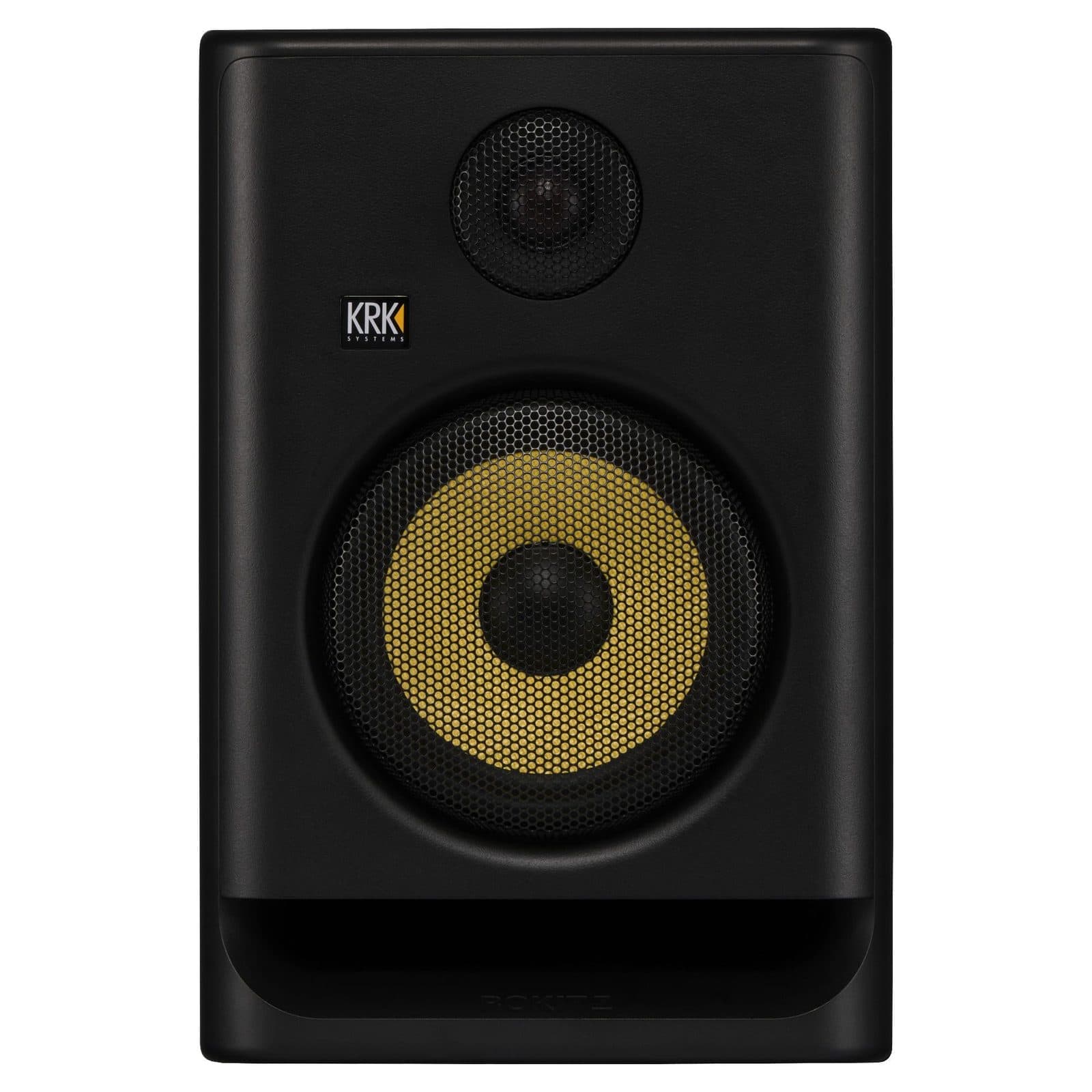
KRK Rokit 7 G5.
The fifth-generation Rokit brings app-based room correction and a warm voicing that makes long mixing sessions comfortable.
The Verdict.
Gavler Meta-Score
“The Rokit 7 G5 finally gives KRK a competitive edge beyond price — the app-based room correction is a genuine differentiator that makes these monitors sound far better than their cost suggests. The warm voicing remains, but it is now a conscious design choice rather than a limitation. For budget-conscious producers, these are the monitors to beat under $400.”
The Gavler Verdict
The Gavler Review.
KRK Rokit 7 G5 Review: Room Correction That Actually Earns Its Keep Under $400
The KRK Rokit 7 G5 ranks number 4 on Gavler's Best Studio Monitors list with a 9.2, and it earns that spot on the strength of a feature nobody expected at $349: legitimate, app-driven room correction. This is a monitor for home producers and bedroom-studio owners whose acoustics are compromised by comic-book-shaped rooms, hard walls, and a desk pushed into a corner — not for engineers chasing a flat, honest reference for a treated control room. As Mix Online put it, the Rokit 7 G5's "combination of an updated cabinet, refined DSP, and the KRK app-based room correction is a meaningful generation-on-generation upgrade for project studios at this price." The trade-off is baked into the design: KRK voices these warm rather than flat, which is exactly the choice that makes long sessions comfortable and occasionally masks what a truly neutral monitor would reveal.
What it is
KRK has sold more entry-level studio monitors than almost any other brand, largely on the strength of low price and an unmistakable yellow-Kevlar look. The fifth-generation Rokit line is the first to meaningfully change the formula. Instead of just tweaking the crossover and calling it a day, KRK built a companion app that connects to the monitor's onboard DSP over Bluetooth, walks you through a room measurement using your phone's microphone, and applies corrective EQ to compensate for the room modes and boundary reflections that wreck accuracy in untreated spaces. That's the headline feature, and it is the reason the G5 generation scores meaningfully higher with experts than the G4 it replaced.
Underneath the software story is a fairly conventional two-way design: a 7-inch Kevlar woofer paired with a 1-inch soft dome tweeter, driven by 145W of Class-D power across a 42 Hz–40 kHz frequency response. The cabinet is front-ported, which lets KRK sell a monitor that can sit closer to a wall than a rear-ported design would tolerate — a real consideration for anyone working at a cramped desk. Sound On Sound's coverage of the generation-five relaunch noted the whole Rokit range picked up "new MDF cabinets with moulded front baffles and rounded cabinet sides, removable protection grilles for both the woofer and tweeter, and an enhanced set of DSP functions accessed from a small screen on the rear panel to aid setup" — in other words, this is a top-to-bottom refresh, not a repaint.
In use
The voicing is where opinions split, and it's worth being precise about why. KRK tunes the Rokit line warm on purpose, favoring a fuller low end and a slightly forward midrange that stays comfortable across long mixing sessions rather than fatiguing your ears the way a ruthlessly flat monitor can. Reviewer Brandon Schock at Higher Hz, who tests monitors professionally, measured the practical consequence of the front port directly: "there is a fairly notable resonance and cancellation at about 680-700 Hz — which is not uncommon for monitors with front ports." That's a real, measurable flaw, not a subjective gripe. But Schock's follow-up matters more: "Once correcting the main resonance at 680 Hz with parametric EQ, however, I found that the speakers sounded phenomenal." The room correction app is solving a problem the hardware itself creates, and by most accounts it solves it well.
Where the G5 clearly isn't for everyone is genre and workflow. Schock's conclusion was blunt about who benefits most: "The KRK Rokit 7 G5 monitors are best suited for producers who specialize in hip-hop, EDM, and more modern styles of music where bass heaviness is preferable." If you mix acoustic jazz, orchestral work, or anything where midrange truthfulness is the whole job, that bass-forward personality is a bigger obstacle than the DSP can fully correct away.
Strengths
The room correction is the headline, but the rest of the package holds up its end. The 145W Class-D amplifier has real headroom for a monitor in this price bracket, and the Kevlar woofer's stiffness-to-weight ratio produces the kind of fast, controlled cone behavior that keeps low-distortion bass tight rather than boomy once the app has done its job. The front-firing port is a genuinely practical design choice for anyone whose "studio" is a desk against a wall — it sidesteps the port compression and boundary cancellation that plague rear-ported monitors crammed into the same space. Build quality punches above the price too: KRK's new MDF cabinet with a molded front baffle feels considerably more finished than the G4 generation it replaces, and the rear-panel LCD screen with 25 preset EQ curves gives you manual control if you'd rather skip the app entirely.
The trade-offs — who should skip it
Skip the Rokit 7 G5 if you need a monitor you can trust without correction. The warm voicing is a deliberate choice, but it means the out-of-the-box sound is not neutral — you are relying on either the app or your own parametric EQ to get to something resembling flat, and that's an extra step some engineers won't want to take. The 680–700 Hz port resonance Higher Hz measured is real and audible before correction. And while the app-based workflow is a genuine differentiator, it does mean pairing a $349 monitor with a phone, a Bluetooth connection, and a setup process — friction that a monitor like the JBL 308P MkII's wide, waveguide-driven sweet spot avoids by simply not needing correction to sound reasonable in an imperfect room.
How it compares
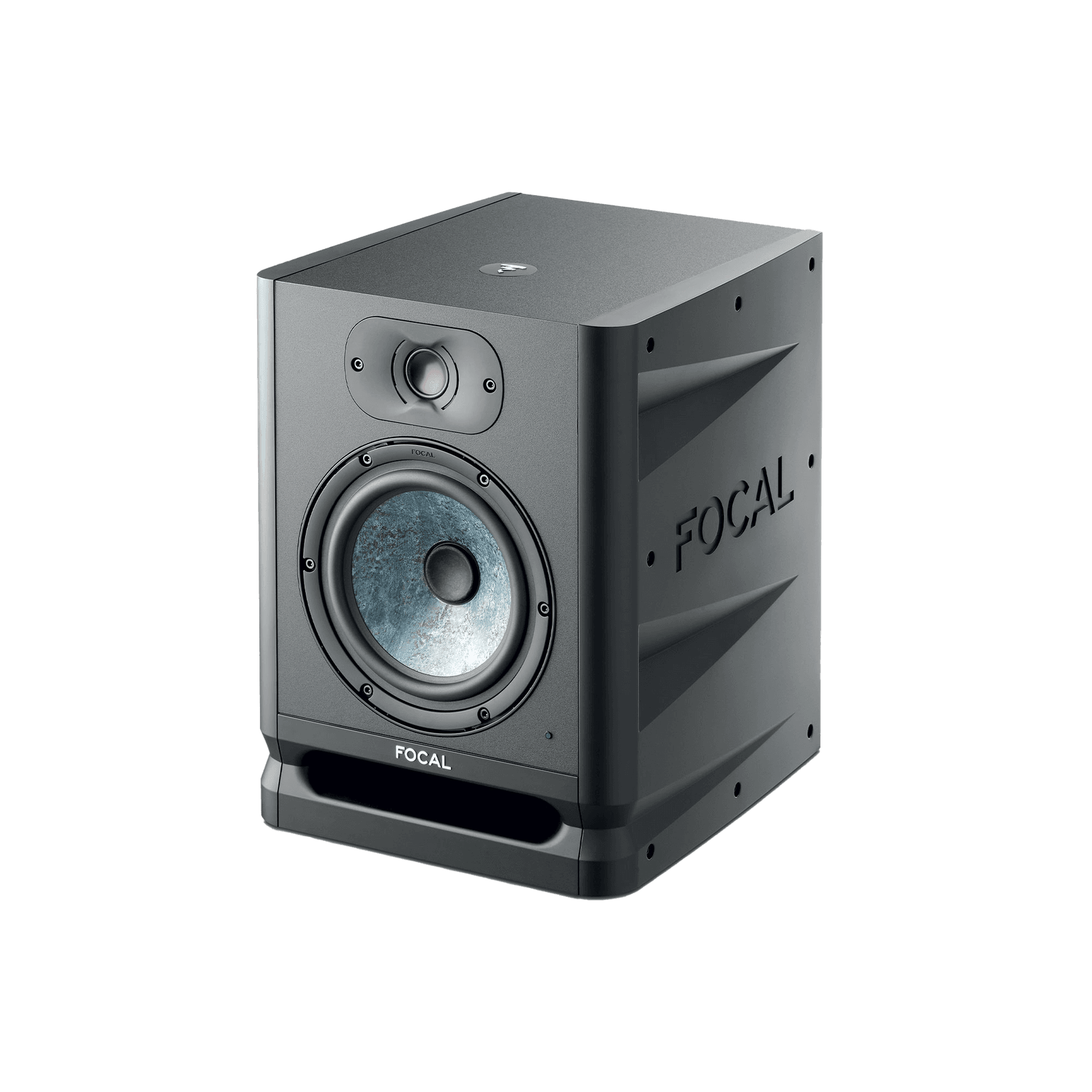
Against the Focal Alpha 65 Evo, the comparison is really about philosophy. The Focal's Slatefiber cone delivers natural midrange accuracy without any DSP intervention at all — it's simply a better-engineered driver for $549. If your work leans vocal- or acoustic-heavy and your room is already reasonably treated, the Alpha 65 Evo is the more honest tool. The Rokit 7 G5 wins when the room, not the driver, is the bigger problem, and $200 less matters. Against the JBL 308P MkII, the contrast is about how each brand solves the sweet-spot problem: JBL's Image Control Waveguide widens the listening area passively, while KRK corrects the room actively through software. Both land at a similar price and score, so the decision comes down to whether you'd rather trust a waveguide or a phone app to compensate for a less-than-ideal room.
The Gavler verdict
The KRK Rokit 7 G5 is a 9.2 because it does something no other monitor near $350 does credibly: it measures your room and actually fixes what it finds. That's not Genelec GLM or Sonarworks-grade calibration, but for a budget monitor it is a real differentiator, not a marketing bullet point. Buy it if your studio is a bedroom with hard walls and a limited budget. Skip it if you need flat, uncorrected accuracy out of the box — in that case, look further up the list.
Common Questions
Yes, for the buyer it's built for. At $349, it ranks number 4 on Gavler's Best Studio Monitors list with a 9.2, and Mix Online called the app-based room correction 'a meaningful generation-on-generation upgrade for project studios at this price.' If you need a flatter reference monitor, look higher on the list; if you need help taming an untreated bedroom studio on a budget, the G5 earns its price.
Independent testing backs it up. Higher Hz measured 'a fairly notable resonance and cancellation at about 680-700 Hz' from the front port, but found that 'once correcting the main resonance at 680 Hz with parametric EQ... the speakers sounded phenomenal' — evidence the DSP addresses a real acoustic problem rather than acting as a marketing checkbox.
Choose the Rokit 7 G5 if your room is untreated and your budget tops out near $350. Choose the Focal Alpha 65 Evo if you mix a lot of vocals and can stretch to $549 for its Slatefiber midrange clarity. The KRK is bass-forward and DSP-corrected; the Focal is naturally balanced without needing correction in the first place.
Where to Buy.
Prices checked regularly
90-day price history
Price History
Steady at $349 for the entire 90-day tracking window — no increases, no discounts, across 91 tracked days.
Tracked daily across retailers. Vote Want itabove and we’ll alert you the moment the price drops.
Some links are affiliate links — Gavler may earn a commission. This never affects rankings or scores. Learn more.
Precision Engineering
DSP Room Correction
KRK App connects via Bluetooth to measure your room and apply corrective EQ — legitimate room correction at a budget price.
7-Inch Kevlar Woofer
Kevlar's stiffness-to-weight ratio produces fast, controlled cone behavior with low distortion and tight bass response.
Front-Firing Port
Front bass port allows placement closer to walls without port compression, ideal for desk-mounted setups.
Technical Specifications
The Scoreboard
The app-based room correction elevated expert scores significantly over the G4. Community loves the value proposition, though purists note the voicing is warmer than truly flat reference monitors.
Cast Your Vote
Do you think KRK Rokit 7 G5 deserves the #4 spot in Best Studio Monitors?
Global Critique
“All three models have common features such as new MDF cabinets with moulded front baffles and rounded cabinet sides, removable protection grilles for both the woofer and tweeter, and an enhanced set of DSP functions accessed from a small screen on the rear panel to aid setup.”
“The Rokit 7 G5's combination of an updated cabinet, refined DSP, and the KRK app-based room correction is a meaningful generation-on-generation upgrade for project studios at this price.”
“Premium features inspired by our flagship studio monitors, including a brick-wall limiter, advanced graphic EQ, and 25 unique visual graphic EQ settings via the LCD screen.”
More from Best Studio Monitors.
See how other top picks compare in this category.
Before You Buy Studio Monitors, Size the Room
Driver hangtags are the wrong first question. Nearfield vs midfield, room, and mix vs hi-fi come first. Then shop Gavler's live ranking.
The Best Studio Monitors in 2026, Ranked by the Engineers Who Mix on Them
Yamaha, Adam Audio, Genelec, Neumann, Focal. Gavler's community ranks the reference monitors worth buying — from $179 starters to $1,999 midfields.