Sony's NEW 100-400mm lens! Could this replace my 200-600mm?
Tony & Chelsea Northrup
The wildlife and sports super-telephoto for E-mount. Compatible with both 1.4x and 2x teleconverters for serious reach.
Gavler Meta-Score
“The E-mount wildlife zoom that gets almost everything right except the price: near-flawless autofocus, GM sharpness to 400mm, and 1.4x/2x teleconverter support that reaches 800mm with AF intact. Buy it if you shoot Alpha bodies and want one travel-light reach lens for life; skip it if the cheaper 200-600 G's extra 200mm matters more than compactness, since this is the priciest lens in its focal range.”
The Gavler Verdict
Sony FE 100-400mm f/4.5-5.6 GM OSS Review: Near-Perfect AF, Premium Price
The Sony FE 100-400mm f/4.5-5.6 GM OSS ranks fourth on our Best Telephoto Zoom Lenses list with a 9.2, and it's the lens Alpha shooters reach for when autofocus reliability matters more than anything else. At $2,498, Dustin Abbott called the AF "pretty close to perfect. Fast, silent, and accurate. I have zero reservations on this front." The single biggest trade-off is cost — Abbott flagged it as "easily the most expensive lens with this focal range" — with Sony's own 200-600mm G offering more reach for less money if compactness isn't the priority.
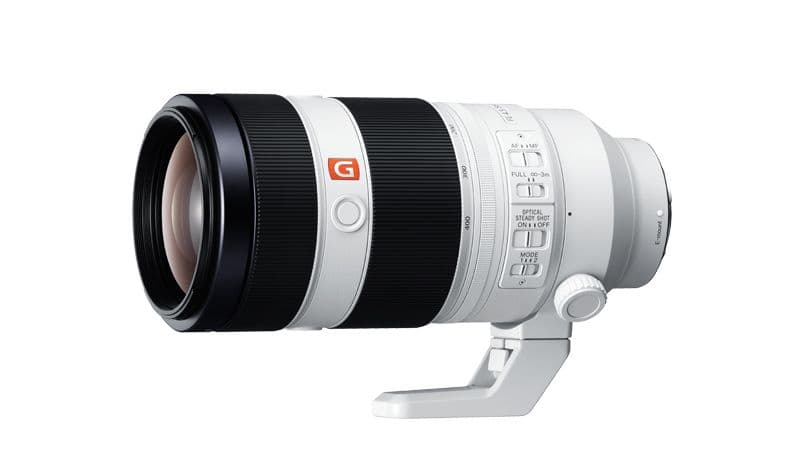
This is Sony's G Master super-telephoto zoom for E-mount, covering 100-400mm at a variable f/4.5-5.6 aperture in a 22-element, 16-group optical design that includes one Super ED and two ED elements. At 1,395 grams, it's genuinely light for a lens reaching 400mm at f/5.6 — Photography Life measured it balancing "incredibly well" on the compact A9 and A7R III bodies, calling the combination "much more maneuverable than the likes of the Canon 1Dx and Canon 100-400 lens," a pairing that weighs over a kilogram more.
A distinguishing handling detail: the zoom ring sits toward the rear of the barrel, behind the focus ring, rather than at the front like most 100-400mm designs. Photography Life called this placement "a differentiator in this class of lens" that lets you zoom without accidentally nudging focus. A twistable torque-adjustment ring lets you dial zoom-ring resistance between Smooth and Tight to manage zoom creep. Full compatibility with Sony's 1.4x and 2x teleconverters extends the lens to 560mm or 800mm with autofocus retained — unusual flexibility for a lens in this class.
Autofocus is where this lens separates itself from the rest of the category. Abbott's assessment leaves little room for debate: "Autofocus is pretty close to perfect here. Fast, silent, and accurate." That performance holds up tracking erratic subjects on Sony's fastest bodies, which is the entire reason this lens shows up in so many birding and sports kits despite its price. Abbott also praised the build-to-weight ratio directly: "you are getting a professional grade lens with a premium build and feature set at a remarkably low weight overall."
Weather sealing is the one area where field experience diverges from the spec sheet. Photography Life tested the lens extensively in Mexico and found it handled light drizzle without issue, but ran into a bigger problem in high humidity: "quite significant problems arose with the Sony FE 100-400mm f/4.5-5.6 GM lens along with the Sony FE 2x Teleconverter when I used them in very high humidity conditions... a significant amount of condensation built up on the lens." Critically, the condensation wasn't limited to the front element — it reached internal glass and took, in the reviewer's words, "over 30 minutes" to dissipate. Their conclusion was blunt: "My experience with the quality of the weather sealing... makes me suspect that Sony's weather sealing isn't up to the same standard I am used too from my Canon gear." The reviewer also noted this may have been an isolated bad copy, since other testers reported no such issue — but it's a real data point for anyone shooting in tropical or highly humid climates.
Price is the most consistent criticism across every review of this lens. Abbott's framing is direct: this is "priced like a premium lens — easily the most expensive lens with this focal range." Sony's own 200-600mm f/5.6-6.3 G OSS covers 200mm more reach for roughly $500 less, and if maximum reach-per-dollar is the priority over a compact, fast-focusing package, that's the better buy.
The humidity-related condensation issue is the second honest caveat. It's not clear how representative one field test is — Photography Life themselves noted uncertainty about whether they received an unusual copy — but it's a documented real-world result, not a hypothetical, and buyers who shoot regularly in tropical or coastal-humid conditions should factor it in. Bokeh quality is also merely good rather than exceptional by GM standards; nothing wrong with it, just not the category's rendering leader.
Buy this lens if you want one do-everything reach lens that travels light and focuses flawlessly on Alpha bodies. Skip it if raw reach-per-dollar or bulletproof weather sealing matters more to your shooting than compactness and AF speed.
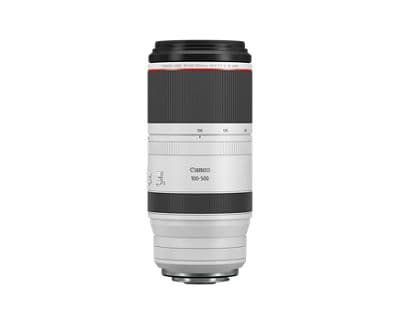
Within the same list, the Canon RF 100-500mm f/4.5-7.1L IS USM at rank five is the closest cross-brand equivalent — 100mm more reach at 500mm, but a narrower f/7.1 maximum aperture at the long end that forces higher ISOs in low light, and teleconverter support restricted to the 300-500mm range only. The Sony FE 200-600mm f/5.6-6.3 G OSS at rank six, mentioned above as the value alternative within Sony's own lineup, trades this lens's compactness and faster GM-tier AF for 200mm of extra native reach at a lower price.
For Alpha shooters who prioritize a light, fast-focusing kit over maximum focal length, the 100-400mm GM remains the lens Gavler recommends first.
A 9.2, with expert and community scores tracking closely because the only consistent knock — premium pricing relative to the 200-600 G — is a value complaint, not a performance one. This is the E-mount wildlife zoom that gets almost everything right: near-flawless autofocus, GM sharpness across the range, and teleconverter support that reaches 800mm with AF intact. Buy it if you shoot Alpha bodies and want one travel-light reach lens for life; buy the 200-600 G instead if the cheaper lens's extra 200mm matters more than the weight and AF advantage this one offers.
For Alpha shooters who want one travel-light reach lens with excellent autofocus, yes. It ranks fourth on Gavler's Best Telephoto Zoom Lenses list with a 9.2, and Dustin Abbott rated the AF 'pretty close to perfect.' The main catch is price — Abbott called it 'easily the most expensive lens with this focal range' — and Photography Life's testing raised real questions about the weather sealing.
The 200-600mm G costs about $500 less and reaches 200mm further, per Gavler's verified pricing. The 100-400mm GM is roughly 300 grams lighter, has faster and more refined GM-tier autofocus, and takes teleconverters up to 800mm with AF intact. Buy the 100-400 if size and AF speed matter most; buy the 200-600 if raw reach-per-dollar matters more than compactness.
Sony markets it as fully weather sealed with a rubber mount gasket, but Photography Life's field test in high humidity found condensation reaching the internal elements, not just the front glass, writing that the experience left them 'doubting the lens's ability to be a workhorse in challenging shooting environments.' Light rain and drizzle were not an issue in the same test.
Prices checked regularly
90-day price history
Steady at $2,498 for the entire 90-day tracking window — no increases, no discounts, across 91 tracked days.
Tracked daily across retailers. Vote Want itabove and we’ll alert you the moment the price drops.
Some links are affiliate links — Gavler may earn a commission. This never affects rankings or scores. Learn more.
Dustin Abbott rated the AF "pretty close to perfect" — fast, silent, and accurate enough to track wildlife and sports on the Alpha 1 and A9 III without reservation.
Fully compatible with Sony's 1.4x and 2x teleconverters — reaches 560mm or 800mm while retaining autofocus, unusual flexibility for a 400mm zoom.
A 22-element/16-group design (1 Super ED + 2 ED) that stays light for a 400mm f/5.6 GM, making it genuinely hand-holdable for a full day in the field.
Expert 91 / community 92 track closely: pros and owners agree the autofocus and cross-range sharpness are class-leading, and the near-tie reflects that the only consistent knock — premium pricing versus the 200-600 G — is a value complaint, not a performance one.
Do you think Sony FE 100-400mm f/4.5-5.6 GM OSS deserves the #4 spot in Best Telephoto Zoom Lenses?
“Autofocus is pretty close to perfect here. Fast, silent, and accurate. I have zero reservations on this front.”
“you are getting a professional grade lens with a premium build and feature set at a remarkably low weight overall.”
“Overall, my experience leaves me doubting the lens's ability to be a workhorse in challenging shooting environments.”
“the 100-400GM is priced like a premium lens – easily the most expensive lens with this focal range.”
Watch
Hand-picked from creators we trust — playable inline.
Sony's NEW 100-400mm lens! Could this replace my 200-600mm?
See how other top picks compare in this category.
A 70-200 hangtag is the wrong first question. Events at f/2.8, or wildlife at 500–600mm, is the reach you work. Then shop Gavler's live ranking.
Samyang's AF 60-180mm f/2.8 FE gives Sony a constant-aperture telephoto for about $1,000 and 730g — a third the price of the 70-200mm GM atop our list.