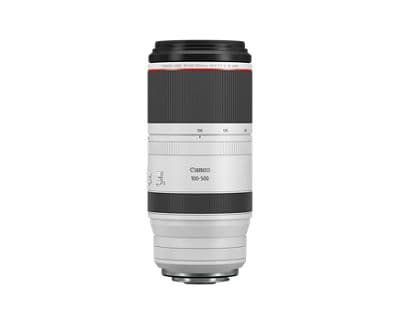
Canon RF 100-500mm f/4.5-7.1L IS USM.
500mm of reach in a hand-holdable package. The default super-telephoto for R5 and R3 wildlife shooters.
The Verdict.
Gavler Meta-Score
“Canon's go-to RF wildlife zoom: corner-to-corner sharp across the whole range and light enough at 1,370g to carry all day, with weather-sealed L build. The catch is the f/7.1 long end — you'll ride ISO to freeze action at 500mm, and the teleconverters only mount past 300mm. Ideal for daylight wildlife and sports; look elsewhere if you routinely shoot in low light.”
The Gavler Verdict
The Gavler Review.
Canon RF 100-500mm L IS USM Review: 500mm You Can Actually Hand-Hold
The Canon RF 100-500mm f/4.5-7.1L IS USM ranks number 5 on Gavler's Best Telephoto Zoom Lenses list with a 9.0, and it's the lens most R5 and R3 wildlife shooters reach for first. The-Digital-Picture's testing found it "extremely sharp" from full-frame corner to corner across the entire focal range, even wide open — an unusually strong result for a variable-aperture super-telephoto reaching 500mm. The catch, and it's a real one, is that f/7.1 long end: OpticalLimits warned you'll "need a lot of light and/or boost your ISO settings" to freeze fast action at 500mm.
What it is
The RF 100-500 replaced the EF 100-400mm f/4.5-5.6L IS II as Canon's go-to daylight super-telephoto zoom, and the redesign for RF mount brought real, measurable benefits. At 1,370 grams, it's roughly 200 grams lighter than the EF lens it succeeds, built around a 20-element, 14-group optical formula with one Super UD and six UD elements to control chromatic aberration at long focal lengths. Optical stabilization is rated to 5 stops on its own, climbing to 6 stops when paired with in-body stabilization on the R5 or R6.
Ken Rockwell's testing highlighted an underappreciated capability: close-focus distance drops to 1.2 meters even at 500mm, close enough that he argued "this lens can replace the RF 70-200/2.8" for many shooters, since "I never miss the range from 70-100mm" and the ability to zoom straight to 500mm without swapping lenses proved more useful in practice than the shorter range would suggest.
In use
Sharpness is where this lens earns its reputation most consistently across independent testers. The-Digital-Picture's assessment was unambiguous: "the Canon RF 100-500mm F4.5-7.1 L IS USM Lens creates extremely sharp images from full-frame corner to full-frame corner, including at wide-open apertures, over the entire focal length range." Amateur Photographer's field testing with the R5 reinforced the autofocus side of that equation: "on test I was impressed by the speed of autofocus when shooting sport with the AF operation of the EOS R5 set to Servo AF."
Ken Rockwell's independent review reached a similarly enthusiastic overall conclusion — "this is a great do-it all telephoto. Super sharp and super flexible" — while noting the bokeh quality lands in the "neutral to good" range rather than exceptional, a fair assessment for a zoom of this reach and variable aperture rather than a dedicated prime.
Strengths
- Corner-to-corner sharpness across the entire zoom range, even wide open. This is the standout result independent testers agree on — most variable-aperture superzooms show real softness at the edges, and this one largely doesn't.
- Close-focus performance that rivals a macro lens. The 0.33x maximum magnification at 500mm gives genuine flexibility for insects, flowers, and detail shots that most telephoto zooms can't touch.
- 200 grams lighter than its EF predecessor, in a genuinely weather-sealed, fluorine-coated L-series build — Ken Rockwell noted the tripod collar removes cleanly with "no big indentation where it mates," a small but real ergonomic detail.
The trade-offs — who should skip it
The f/7.1 maximum aperture at 500mm is the defining limitation, and it shapes who this lens works for. OpticalLimits' direct warning is the clearest framing: "in order to freeze fast action at 500mm f/7.1, you will either need a lot of light and/or boost your ISO settings." Diffraction also caps peak sharpness at the long end, compounding the low-light challenge.
The teleconverter restriction is the second major caveat, and it's more absolute than many buyers expect. Ken Rockwell explained the mechanism directly: "it works with either of the Canon RF 1.4× Extender or Canon RF 2× Extender, but only in the range from 300mm to 500mm... there is a mechanical device in the back of this lens that gets pushed-in by the extender and mechanically limits the zoom range." Below 300mm, teleconverters simply won't mount — this isn't a soft recommendation but a hard mechanical limit.
A few smaller notes for context:
- No always-responsive manual-focus override on some EOS R bodies without a menu setting change, per Ken Rockwell's testing.
- The lens is genuinely expensive at $2,899 — Ken Rockwell's one-word criticism in his "bad" list was simply "Expensive."
- Low-light and shadow shooters should look elsewhere. Dawn, dusk, and indoor sports shooters will find the f/7.1 long end limiting compared to a faster prime or an f/6.3-class 200-600mm zoom.
How it compares
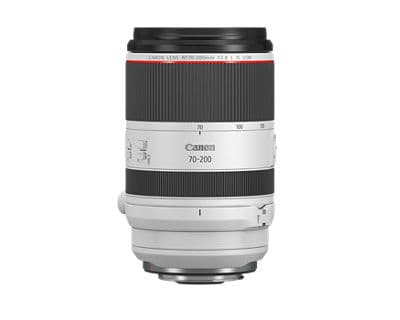
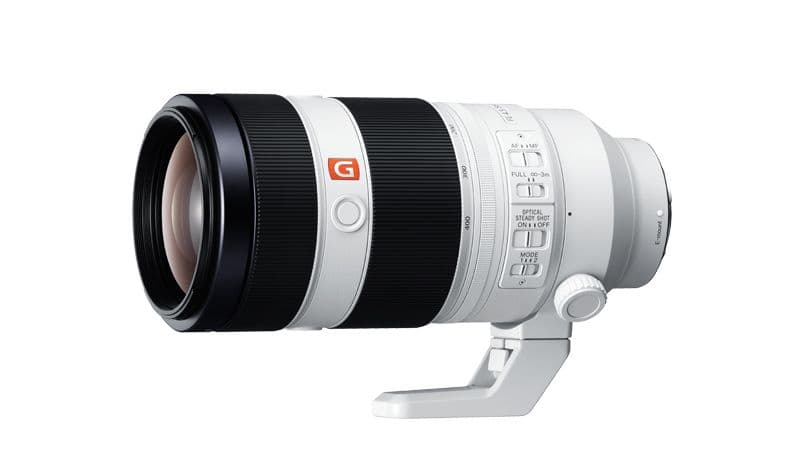
On the same list, the Canon RF 70-200mm f/2.8L IS USM sits at rank 2, trading reach for a constant f/2.8 aperture and a genuinely portable, collapsing design — the better choice for portrait, wedding, and event photographers who need speed and portability over maximum telephoto range. The Sony FE 200-600mm f/5.6-6.3 G OSS at rank 6 shows the E-mount equivalent of this lens's value proposition, reaching a true 600mm with internal zoom for under $2,000, though Photography Life rated its 600mm sharpness as trailing "Sony's sharpest glass."
Against both, the RF 100-500's case is specific: for Canon shooters who need genuine 500mm reach with corner-to-corner sharpness and don't mind riding ISO at the long end, nothing else in Canon's native lineup matches it without stepping up to a much heavier, more expensive prime.
The Gavler verdict
A 9.0 for a lens that delivers exactly what its reputation promises: reference-quality sharpness across an enormous focal range, in a body light enough to hand-hold through a full day of shooting. Expert consensus sits two points above community sentiment in Gavler's data, and the reason is clear from the reviews — testing labs reward the exceptional cross-range sharpness, while owners feel the practical sting of the f/7.1 aperture and the 300mm teleconverter cutoff in ways a lab chart doesn't capture. For daylight wildlife and outdoor sports shooters, this remains Canon's default RF super-telephoto. Anyone who regularly shoots in low light should budget for a faster alternative instead.
Common Questions
For R5 and R3 wildlife and sports shooters who work primarily in daylight, yes. The-Digital-Picture found it 'extremely sharp' from corner to corner across the entire focal range, even wide open, and Ken Rockwell called it 'a great do-it all telephoto. Super sharp and super flexible.' It ranks number 5 on Gavler's Best Telephoto Zoom Lenses list with a 9.0.
Only partially. Both the 1.4x and 2x RF extenders work, but only from 300mm to 500mm — Ken Rockwell explained bluntly that 'there is a mechanical device in the back of this lens that gets pushed-in by the extender and mechanically limits the zoom range.' Below 300mm, teleconverters won't physically mount at all.
It's the lens's most consistent criticism. OpticalLimits warned that 'in order to freeze fast action at 500mm f/7.1, you will either need a lot of light and/or boost your ISO settings' — a real consideration for dawn, dusk, or indoor sports shooters, though daylight wildlife and outdoor sports shooters rarely notice it.
Where to Buy.
Prices checked regularly
90-day price history
Price History
Steady at $2,899 for the entire 90-day tracking window — no increases, no discounts, across 91 tracked days.
Tracked daily across retailers. Vote Want itabove and we’ll alert you the moment the price drops.
Some links are affiliate links — Gavler may earn a commission. This never affects rankings or scores. Learn more.
Precision Engineering
Sharp Corner-to-Corner at 500mm
The-Digital-Picture found it "extremely sharp" from full-frame corner to corner, wide open, across the entire range — a 20-element/14-group design with 1 Super UD and 6 UD elements.
1,370g, ~200g Lighter Than the EF 100-400 II
The retractable L-series barrel keeps a 500mm reach genuinely hand-holdable, undercutting the EF 100-400mm f/4.5-5.6L IS II by roughly 200g.
5-Stop IS, Up to 6 With IBIS
Optical stabilization rated to 5 stops climbs to 6 on the R5/R6, and Servo AF on the R5 impressed reviewers tracking sports.
Technical Specifications
The Scoreboard
Expert 91 sits two points above community 89: testing labs reward the exceptional cross-range sharpness and AF, while owners dock it slightly for the practical sting of the f/7.1 aperture at 500mm and the 300mm teleconverter restriction — real-world frustrations a lab chart doesn't capture.
Cast Your Vote
Do you think Canon RF 100-500mm f/4.5-7.1L IS USM deserves the #5 spot in Best Telephoto Zoom Lenses?
Global Critique
“Succinctly stated, the Canon RF 100-500mm F4.5-7.1 L IS USM Lens creates extremely sharp images from full-frame corner to full-frame corner, including at wide-open apertures, over the entire focal length range.”
“On test I was impressed by the speed of autofocus when shooting sport with the AF operation of the EOS R5 set to Servo AF.”
“In order to freeze fast action at 500mm f/7.1, you will either need a lot of light and/or boost your ISO settings.”
“Given its L-class designation, the lens is targeting professional users thus it's not surprising that the build quality is superb.”
More from Best Telephoto Zoom Lenses.
See how other top picks compare in this category.

Is This a 70-200 Day, or a 600mm Day?
A 70-200 hangtag is the wrong first question. Events at f/2.8, or wildlife at 500–600mm, is the reach you work. Then shop Gavler's live ranking.
Samyang's 60-180mm f/2.8 Is the Cheapest Way Into Sony's f/2.8 Telephoto Club
Samyang's AF 60-180mm f/2.8 FE gives Sony a constant-aperture telephoto for about $1,000 and 730g — a third the price of the 70-200mm GM atop our list.