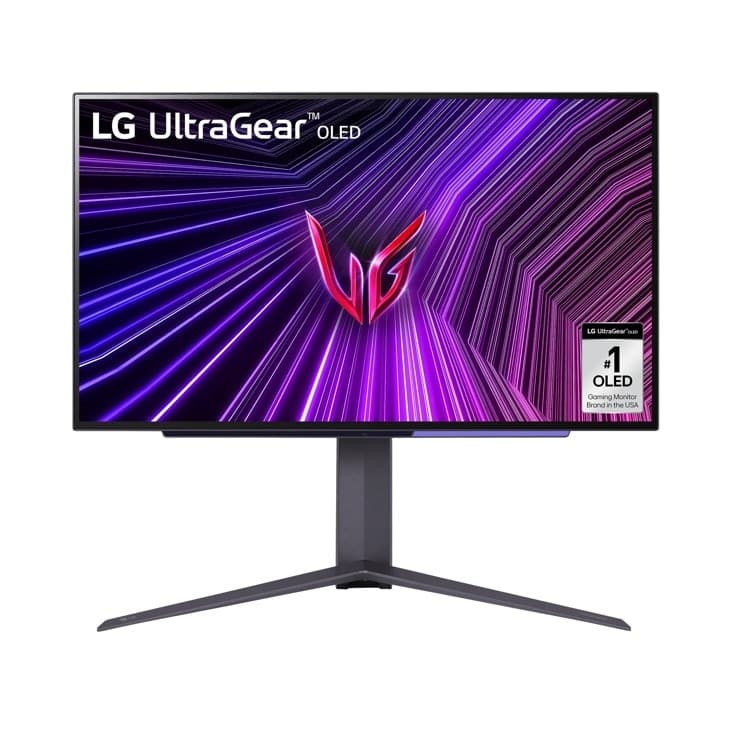
LG UltraGear 27GS95QE-B.
LG UltraGear 27GS95QE-B — 27" 1440p @ 240Hz WOLED, 275-nit typical / 1000-nit HDR peak (vs predecessor's 200-nit), 0.03ms response, DisplayHDR True Black 400.
The Verdict.
Gavler Meta-Score
“The right 1440p OLED alternative to the ASUS ROG PG27AQDM for buyers who prefer LG's tone calibration over ROG's. Same panel, same price, different chassis aesthetic.”
The Gavler Verdict
The Gavler Review.
LG UltraGear 27GS95QE-B Review: The Other Side of the Same OLED Panel
The LG UltraGear 27GS95QE-B ranks seventh on our Best Gaming Monitors list with an 8.6, sharing a technical foundation with the higher-ranked ASUS ROG Swift PG27AQDM down to the panel supplier. This is LG's current 27-inch, 1440p, 240Hz WOLED — the brighter successor to the 27GR95QE that helped define the 1440p OLED gaming category through 2024 and 2025. Buy it if you want everything the OLED-monitor category promises — near-instant response, per-pixel contrast, a meaningfully brighter HDR peak than its own predecessor — and you prefer LG's tone calibration and UltraGear design language over ASUS ROG's gaming aesthetic. The choice against its closest rival really is that simple.
What it actually is
The headline upgrade over the outgoing 27GR95QE is brightness: 275-nit typical output and up to 1,000-nit HDR peak, against the predecessor's 200-nit typical figure. That's a real, usable difference — daylight room visibility on OLED monitors has historically been the category's weak point relative to bright LCD panels, and this generation closes a meaningful chunk of that gap without giving up the per-pixel self-emissive blacks that make OLED distinct in the first place.
Everything else traces back to a shared panel supply. The 27GS95QE-B uses the same LG WOLED panel as the ASUS ROG Swift PG27AQDM, which means the underlying 0.03ms grey-to-grey response time, up to 98.5% DCI-P3 color coverage, and 240Hz refresh ceiling all match between the two monitors. What differs is calibration and industrial design — LG's out-of-box tone runs cooler and more restrained, in keeping with the UltraGear line's understated look, against ROG's warmer tuning and gaming-RGB visual language. At $799, the two monitors also share a price floor for this panel generation, so the decision genuinely comes down to taste rather than performance.
In use
RTINGS' assessment of the panel doesn't hedge: "the LG 27GS95QE-B is incredible for PC gaming" — language that lines up with what OLED is supposed to deliver at this tier. The 240Hz refresh rate paired with a 0.03ms response keeps fast-moving content clear in a way LCD panels, even fast ones, still can't fully match, and the per-pixel contrast means dark scenes hold detail that would otherwise crush to black or bloom with backlight glow on an LCD.
LG's own materials make a specific, verifiable claim about the HDR experience: "the LG UltraGear OLED 27-inch display lets you explore HDR content the way it was meant to be seen with up to 98.5% coverage of DCI-P3." That figure matches what the ASUS-branded sibling panel delivers, which reinforces the point that this is a shared-panel category more than a differentiated one at this price point. The practical upshot: whichever chassis you buy, the actual gaming and HDR experience is close to identical, and DisplayHDR True Black 400 certification plus dual FreeSync Premium Pro and G-Sync Compatible support round out a spec sheet built for a wide range of GPU setups.
Strengths
- A genuinely brighter HDR experience than its own predecessor. Going from 200-nit typical to 275-nit typical, with a 1,000-nit HDR peak, meaningfully improves daylight usability without sacrificing OLED's core contrast advantage.
- Panel performance that matches the category's best at this price. Shared LG WOLED sourcing with the ASUS ROG Swift PG27AQDM means 0.03ms response and up to 98.5% DCI-P3 coverage, not a cut-down version of those specs.
- Mature panel-protection firmware. Pixel Cleaning and Screen Move features address the long-term burn-in question that still gives some buyers pause about OLED ownership.
- A calibration tone that suits buyers who find ROG's warmer tuning too aggressive. LG's cooler, more neutral out-of-box color is a real differentiator for anyone who's tried both and has a preference.
The trade-offs — who should skip it
- It doesn't beat its closest rival on performance, only on preference. If you're expecting a technical edge over the ASUS ROG Swift PG27AQDM for the same $799, there isn't one — this is a taste decision, not a specs decision.
- QD-OLED rivals elsewhere on this list offer brighter, more saturated HDR. Reviewers are consistent that WOLED panels like this one, while excellent, don't match the peak brightness and saturation of the QD-OLED monitors ranked above it here.
- The value tier below it undercuts the price meaningfully. If pure OLED-tier response time and color at the lowest possible cost is the goal rather than brand polish, a cheaper option on this same list gets most of the way there for hundreds less.
How it compares
The direct comparison isn't a rank neighbor — it's the ASUS ROG Swift PG27AQDM at rank six, which uses the identical LG WOLED panel at the identical $799 price. Every core performance spec matches: 240Hz, 0.03ms response, roughly 99% DCI-P3 coverage. The only real differences are calibration tone — LG's cooler versus ASUS's warmer — and chassis design, LG's restrained UltraGear look against ROG's gaming-forward RGB styling. Neither is the "better" monitor in a technical sense; the right pick is whichever aesthetic and color tuning you'd rather live with.
For buyers priced out of both $799 options, the KTC G27P6S at rank eight uses the same panel-tech generation at roughly $499 with routine coupon pricing — a real value alternative that trades brand reputation, warranty depth, and chassis finish for meaningful savings, without giving up the core OLED performance this category is built around.
The Gavler verdict
An 8.6, with an 88 expert consensus built on genuinely strong reviews of the underlying panel technology this monitor shares with its closest rival. The trade-off here isn't a technical one — it's a preference for calibration tone and industrial design, and both are legitimate reasons to pick the LG over the ASUS or vice versa. Buy the 27GS95QE-B if you want a meaningfully brighter HDR experience than LG's own outgoing model and you prefer LG's cooler, more understated look. If price is the deciding factor rather than brand, the KTC G27P6S further down this list delivers the same underlying panel generation for hundreds less.
Common Questions
Yes, if you want 1440p OLED gaming and prefer LG's calibration tone or UltraGear design over ASUS ROG's. It ranks seventh on Gavler's Best Gaming Monitors list with an 8.6, built on the same LG WOLED panel as the higher-ranked ASUS ROG Swift PG27AQDM — 240Hz, 0.03ms response, and DisplayHDR True Black 400 — at the same 799 dollar price. The main upgrade over its own predecessor is real: a brighter 1,000-nit HDR peak versus the outgoing model's 200-nit typical brightness.
Both use the identical LG WOLED panel at the identical 799 dollar price, so the technical performance — 240Hz, 0.03ms grey-to-grey response, roughly 99% DCI-P3 coverage — is the same either way. The real difference is calibration tone and chassis design: LG's out-of-box tuning runs slightly cooler and follows the more understated UltraGear aesthetic, while ASUS's ROG chassis runs slightly warmer with gaming-focused RGB styling. Choose based on preference, not specs.
Brightness is the headline change. The 27GS95QE-B is rated at roughly 275-nit typical brightness with up to 1,000-nit HDR peak, versus the 27GR95QE's 200-nit typical figure — a meaningful upgrade for daylight room usability that doesn't come at the cost of the per-pixel-black contrast that defines OLED image quality. The response time, refresh rate, and panel sourcing carry over unchanged from the model that established this category.
Buy the LG if brand reputation, a stronger burn-in warranty, and finished chassis quality matter to you — it costs 300 dollars more for those things on top of an equivalent panel-tech generation. Buy the KTC G27P6S if getting OLED-tier response time and color volume at the lowest possible price is the priority; it uses the same underlying panel technology at roughly 499 dollars with routine coupon pricing, trading brand polish and warranty depth for a real savings.
Where to Buy.
Prices checked regularly
90-day price history
Price History
Steady at $799 for the entire 90-day tracking window — no increases, no discounts, across 91 tracked days.
Tracked daily across retailers. Vote Want itabove and we’ll alert you the moment the price drops.
Some links are affiliate links — Gavler may earn a commission. This never affects rankings or scores. Learn more.
Precision Engineering
27" 1440p WOLED
A 26.5" LG WOLED panel delivers per-pixel self-emissive lighting, so blacks are perfect and contrast is effectively infinite in dark scenes.
240Hz, 0.03ms
The 240Hz refresh rate with a 0.03ms grey-to-grey response keeps fast motion clear and input lag low, which matters most for competitive shooters.
Brighter HDR Peak
DisplayHDR True Black 400 with ~275-nit typical and up to 1,000-nit HDR peak gives this OLED meaningfully brighter highlights than its 27GR95QE predecessor.
Technical Specifications
The Scoreboard
Reviewers call it incredible for PC gaming for its 240Hz speed and OLED contrast, though QD-OLED rivals offer brighter, more saturated HDR; the choice versus the PG27AQDM comes down to tone and chassis preference.
Cast Your Vote
Do you think LG UltraGear 27GS95QE-B deserves the #8 spot in Best Gaming Monitors?
Global Critique
“The LG 27GS95QE-B is incredible for PC gaming.”
“The LG UltraGear OLED 27" display lets you explore HDR content the way it was meant to be seen with up to 98.5% coverage of DCI-P3.”
More from Best Gaming Monitors.
See how other top picks compare in this category.
How to Choose a Gaming Monitor: 1080p, 1440p, or 4K
A 540Hz hangtag is the wrong first question. Start with 1440p vs 4K, then IPS vs OLED vs size. Then shop Gavler's live ranking.
TCL Is Coming for OLED Monitors — and the Prices Should Follow
TCL just unveiled its 32X3B and 27X3B OLED monitors and is building a fab to crack the panel duopoly. Here's what it means for OLED monitor prices.
4K OLED Gaming Just Crossed Under $650. The Cheapest One Ranks #9 for a Reason.
The Gigabyte MO27U2 is a 27-inch 4K 240Hz QD-OLED for $649 — a panel class that debuted above $1,300. A real price-floor moment, with trade-offs to match.
27-Inch vs 32-Inch 4K OLED: The ASUS PG27UCDM Is the Better Monitor, and the MSI 321URX Just Made That Stop Mattering
Two 4K 240Hz QD-OLED gaming monitors, same resolution, very different sizes — and a price gap that blew open in 2026. Here's which one to buy.
The Best Gaming Monitors in 2026: Pick the Tier, Not the Spec Sheet
ASUS ROG, MSI, Alienware, Samsung, LG. Gavler ranks the best gaming monitors of 2026 — 4K OLED, 1440p OLED, ultrawide, and budget picks, by tier.