KTC G27P6S.
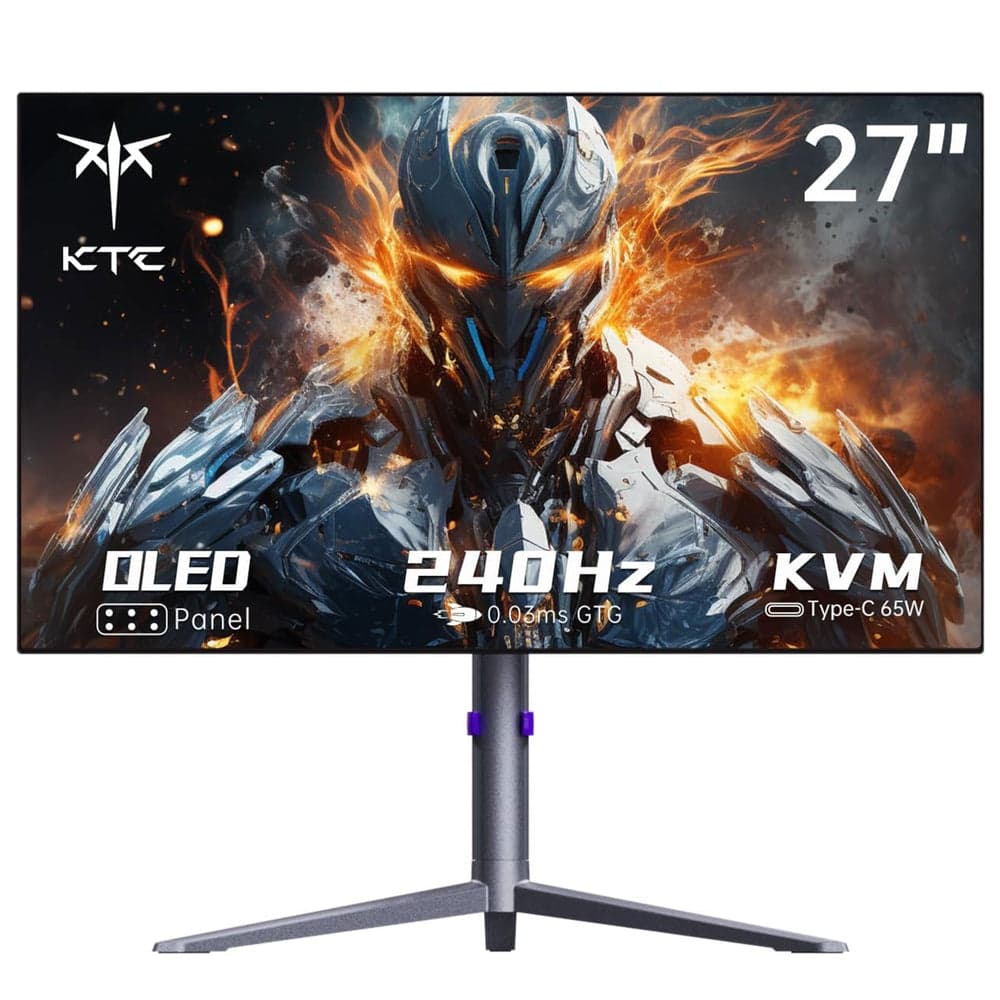
KTC G27P6S — 27" 1440p @ 240Hz MLA+ W-OLED, 0.03ms response, KVM, USB-C 65W PD. The value OLED gaming pick.
The Verdict.
Gavler Meta-Score
“The value OLED gaming pick. Same panel-tech generation as the $799 branded picks at $499 with a coupon. KTC's chassis-finish trade-off is fair for the price savings.”
The Gavler Verdict
The Gavler Review.
KTC G27P6S Review: The OLED Gaming Monitor Under $500
The KTC G27P6S is proof that the OLED gaming monitor price war has a real winner: the buyer. For roughly $499, this 27-inch 1440p panel delivers the same LG MLA+ W-OLED technology found in monitors selling for $799 — and does it with a feature set (built-in KVM, USB-C 65W charging, integrated speakers) that used to be a premium add-on, not a budget-tier default. Windows Central called it "the ultimate value OLED gaming monitor," and after cross-referencing the panel specs against its pricier siblings, that's not marketing hyperbole. The one honest catch is brand: KTC is a newer name in the US enthusiast market, with less generous burn-in warranty terms than ASUS or LG. If that trade-off doesn't bother you, this is the best OLED-per-dollar on Gavler's list.
What it is
Eighteen months ago, the specs on this monitor — 0.03ms grey-to-grey response time, over 99% DCI-P3 color coverage, a 240Hz refresh rate, and self-emissive OLED contrast — lived exclusively in IPS-tier pricing territory or above. The KTC G27P6S is part of a wave of monitors built around LG Display's MLA+ (Meta Lens Array) W-OLED panel, the same generation used in the ASUS ROG Swift PG27AQDM and the LG UltraGear 27GS95QE-B, both of which sell for roughly $799. KTC, a Chinese display manufacturer expanding aggressively into the US market, builds around that same panel and prices it to undercut the established brands by nearly $300.
This isn't a stripped-down monitor built to hit a price point. It ships with a built-in KVM switch (so one keyboard and mouse can control two connected source devices without a physical switch box), USB-C with 65W Power Delivery (enough to charge most gaming laptops off a single cable), integrated speakers, and dual FreeSync and G-Sync compatibility for tear-free gaming regardless of whether the connected GPU is AMD or Nvidia.
In use and performance
The core experience is what OLED gaming monitors are known for: near-instant pixel response (0.03ms GtG means motion blur essentially disappears), deep true blacks from per-pixel self-emission, and wide, accurate color that DisplayNinja measured at an average Delta E of 1.33 in the panel's "Normal" color mode — a genuinely accurate result, not a marketing number. HDR performance carries DisplayHDR True Black 400 certification, with small-window brightness peaks reported above 1,200 nits, which is squarely in line with what the pricier ASUS and LG models deliver from the same underlying panel tech.
The 240Hz refresh rate at 1440p is the right resolution-to-refresh pairing for the GPUs most buyers in this price bracket are running — high enough for competitive shooters, sharp enough that most modern graphics cards can actually push meaningful frame rates without dropping to a lower resolution. Connectivity is generous for the price: two HDMI 2.1 ports, a DisplayPort 1.4 input, and the USB-C port doing double duty as a video input and laptop charger.
The one recurring criticism across independent reviews, and one that applies to this OLED generation broadly rather than to KTC specifically, is text fringing — a faint color separation around the edges of small text, a known characteristic of current-generation OLED subpixel layouts. It shows up in productivity use (browsing, spreadsheets, code editors) more than in gaming, where it's essentially invisible.
Strengths
The headline strength is straightforward: OLED-tier response time, contrast, and color volume at roughly 62% of the price of the branded alternatives using the same panel generation. The feature density backs that up rather than undercutting it — a built-in KVM switch alone often costs $50-plus as a standalone accessory, and USB-C 65W charging means a gaming laptop can run off a single cable to the monitor instead of a separate charging brick. DisplayNinja's color-accuracy testing (1.33 average Delta E, 2.5 maximum) confirms the panel isn't just fast — it's accurate enough for content work, not just gaming.
Trade-offs — who should skip it
Buyers who prioritize brand reputation and long-term support terms should look elsewhere. KTC's burn-in warranty coverage is less generous than what ASUS and LG back their OLED monitors with, and as a newer entrant in the US market, KTC doesn't carry the same decades of retail-support infrastructure. The chassis and stand are functional but noticeably less refined in finish than the PG27AQDM or 27GS95QE-B — this is a monitor built to spend its budget on the panel, not the bezel. And the text-fringing quirk, while shared across this OLED generation, is worth knowing about if the monitor will do double duty as a work display for long text-heavy sessions.
How it compares
Against the ASUS ROG Swift PG27AQDM and LG UltraGear 27GS95QE-B — both ranked ahead of it on Gavler's Best Gaming Monitors list — the KTC G27P6S runs the same panel generation for meaningfully less money. The ASUS and LG both win on warranty terms and brand-name resale value; the KTC wins on pure value-per-dollar. For a buyer choosing between all three with no brand loyalty and a firm budget under $550, the G27P6S is the rational pick.
The Gavler verdict
Score: 8.4/10. The KTC G27P6S earns its place as the value-tier anchor of the OLED gaming monitor category — not because it's the best monitor on the list, but because it delivers roughly 95% of what the $799 models offer at 62% of the price. Buy it if the panel technology is what you're actually paying for; step up to the ASUS or LG if brand support and chassis polish matter as much as the screen itself.
Common Questions
Yes, if you want OLED-tier response time and contrast without paying ASUS or LG prices. At around $499 it delivers roughly the same panel generation as monitors selling for $799, with a real feature set — KVM, USB-C 65W charging, built-in speakers. The trade-offs are brand reputation and warranty terms, not core image quality.
Both use LG's MLA+ W-OLED panel technology, so core specs — response time, color volume, contrast — land in the same neighborhood. The ASUS costs roughly $300 more for a more established brand, a more generous burn-in warranty, and a more refined chassis. The KTC is the value play for buyers who care most about the panel.
Yes. Text fringing (color separation around fine text edges) is a known characteristic of current OLED subpixel layouts, not a KTC-specific flaw — it shows up on the ASUS and LG models at this panel generation too. It's a minor readability quirk in productivity use, not a gaming issue.
Where to Buy.
Prices checked regularly
90-day price history
Price History
Steady at $499 for the entire 90-day tracking window — no increases, no discounts, across 91 tracked days.
Tracked daily across retailers. Vote Want itabove and we’ll alert you the moment the price drops.
Some links are affiliate links — Gavler may earn a commission. This never affects rankings or scores. Learn more.
Precision Engineering
MLA+ WOLED Panel
It uses LG's MLA+ W-OLED panel — the same self-emissive panel generation as pricier branded OLEDs — delivering per-pixel contrast at a sub-$500 price.
KVM, USB-C 65W
A built-in KVM, USB-C with DisplayPort Alt Mode and 65W power delivery, and dual speakers add desktop and laptop versatility uncommon at this price.
240Hz, 0.03ms
The 240Hz refresh rate and 0.03ms grey-to-grey response, plus FreeSync and G-Sync compatibility, keep motion clean and tear-free for fast-paced play.
Technical Specifications
The Scoreboard
Reviewers praise it as standout value — the same LG OLED panel and extras like a KVM and speakers for far less — with the main caveats a slightly weaker HDR punch and a less-established brand and burn-in warranty.
Cast Your Vote
Do you think KTC G27P6S deserves the #10 spot in Best Gaming Monitors?
Global Critique
“I can't get over how good this cheaper OLED monitor is.”
“The 'Normal' color gamut mode has more accurate DCI-P3 results – 1.33 average and 2.5 maximum Delta E.”
More from Best Gaming Monitors.
See how other top picks compare in this category.
How to Choose a Gaming Monitor: 1080p, 1440p, or 4K
A 540Hz hangtag is the wrong first question. Start with 1440p vs 4K, then IPS vs OLED vs size. Then shop Gavler's live ranking.
TCL Is Coming for OLED Monitors — and the Prices Should Follow
TCL just unveiled its 32X3B and 27X3B OLED monitors and is building a fab to crack the panel duopoly. Here's what it means for OLED monitor prices.
4K OLED Gaming Just Crossed Under $650. The Cheapest One Ranks #9 for a Reason.
The Gigabyte MO27U2 is a 27-inch 4K 240Hz QD-OLED for $649 — a panel class that debuted above $1,300. A real price-floor moment, with trade-offs to match.
27-Inch vs 32-Inch 4K OLED: The ASUS PG27UCDM Is the Better Monitor, and the MSI 321URX Just Made That Stop Mattering
Two 4K 240Hz QD-OLED gaming monitors, same resolution, very different sizes — and a price gap that blew open in 2026. Here's which one to buy.
The Best Gaming Monitors in 2026: Pick the Tier, Not the Spec Sheet
ASUS ROG, MSI, Alienware, Samsung, LG. Gavler ranks the best gaming monitors of 2026 — 4K OLED, 1440p OLED, ultrawide, and budget picks, by tier.