Hoka Mach 7.
The versatile tempo-and-daily pick that fixes the Mach 6's rough edges without touching what worked. RunRepeat found the upper and outsole meaningfully upgraded while the supercritical-EVA midsole keeps the same light, lively feel — a genuine do-a-bit-of-everything trainer at $145. Honest limits: it is not plush and the fit runs narrow, so max-cushion runners and wide feet should look at the Clifton 11 or Ghost 18 instead.
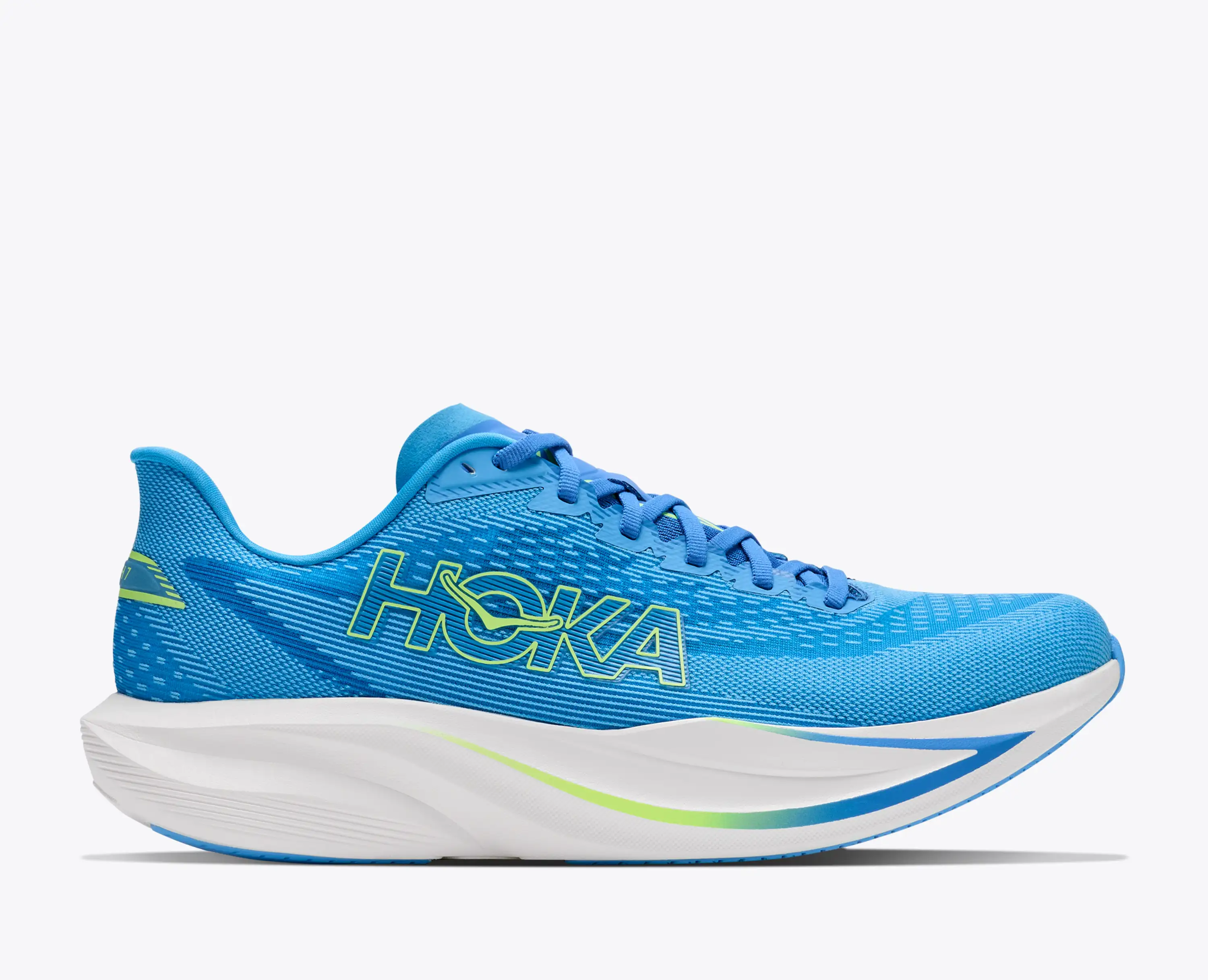
The Verdict.
Gavler Meta-Score
“Hoka's versatile do-everything trainer, sharpened. Buy it as one light shoe that covers easy days and picks up honestly for tempo work at $145 — RunRepeat calls the Mach 7 a fix of the Mach 6's flaws that keeps the fun DNA. Two honest caveats carried over: it is not a plush shoe, and the midfoot runs narrow — max-cushion runners and wide feet should look at the Clifton 11, Ghost 18, or Vomero 18 instead.”
The Gavler Verdict
The Gavler Review.
Hoka Mach 6 Review: The Best the Mach Has Felt, Now on Clearance
The Mach 6 was, by every independent account, the best the Mach line has ever felt — and it's now a clearance-rack shoe. Hoka swapped the old two-part ProFly+ midsole for a single slab of supercritical EVA, and reviewers were nearly unanimous that the upgrade gave this value daily trainer real bounce for the first time. It sits at rank 15 on our Best Running Shoes list with an 8.3, a strong score for a shoe now selling below its original $140 price because Hoka has already moved on to the Mach 7. That combination — genuinely good shoe, actively being phased out — is the whole story here, and it's a better deal for it, not a worse one.
What it is
The Mach has always been Hoka's do-everything daily trainer: not a race shoe, not a max-cushion cruiser, but the shoe you reach for on ordinary training days that occasionally need to move a little faster. The Mach 6's single change was swapping ProFly+ for supercritical EVA, a manufacturing process that infuses the foam with supercritical gas during molding to make it lighter and springier than standard EVA. On a moderate 37mm heel / 32mm forefoot stack, that foam stays light and nimble rather than tall and mushy — the shoe still feels like a trainer, just a noticeably better one underfoot.
Hoka has since released the Mach 7, which launched in March 2026 at $145 and keeps the same supercritical EVA midsole, stack height, and stated drop, while updating the upper to a Creel Jacquard weave and reworking the outsole. RunRepeat's lab testing found the Mach 7's outsole grips meaningfully better in its traction test than the Mach 6 (0.73 versus 0.49), a real improvement, but not one that changes the fundamental ride most runners will notice mile to mile.
In use
Reviewers who put real miles on the Mach 6 came away impressed with exactly the thing Hoka was chasing. Believe in the Run's Chad Zimmermann called out the new foam directly: "the switch to Supercritical foam gives the Mach 6 a bounce and response that I absolutely love." That's a meaningful upgrade from a shoe line that had previously been solid but unremarkable underfoot.
The honest ceiling is what supercritical EVA is not. RunRepeat's lab team put it plainly: "Although this isn't just your cheap EVA but a supercritical formulation that feels quite good and better than ever in the series—it's still EVA. And regardless of enhancements, EVA can only achieve so much performance." Push the pace into a real tempo or speed session and the Mach 6 lacks the propulsive pop a plated or PEBA-foam shoe delivers — it's a daily-miles shoe that can dabble in faster running, not a workout specialist that should replace one.
Durability held up well in testing, too. Zimmermann noted the outsole was "definitely ready to handle the elements," even through less-than-ideal winter running conditions, and Believe in the Run's Ryan Haines specifically credited the switch to a "durabrasion rubber" outsole with fixing a wear issue that dogged earlier Mach models — he didn't expect the Mach 6 to show the compression and stretching that plagued past versions.
Strengths
The supercritical-EVA midsole is the review's headline, and it earns that spot — genuine bounce and response in a $140 trainer, verified independently across multiple outlets rather than assumed from Hoka's marketing copy. At 8.2 oz (232g), it stays light for a cushioned daily shoe, so it doesn't feel like a slog on easy days the way some max-cushion trainers do. The durable, grippy outsole is a real, tested strength too — reviewers found it handled wet and wintry conditions without complaint, and the updated rubber compound appears to have solved a genuine wear problem from prior Mach generations. And on fit: Believe in the Run's Caryn Just found it ran true to size with a roomy toe box, useful guidance for anyone deciding between sizes.
The trade-offs — who should skip it
Two honest caveats keep this from being an unqualified top pick. First, the foam ceiling: supercritical EVA is a genuine upgrade over the old ProFly+, but it's still EVA, not a PEBA super-foam, so runners chasing real tempo-day snap will feel the difference against a plated racer or a PEBA-cushioned trainer. Second, fit: the midfoot runs narrow. Just's own sizing note doubles as the caveat — "the toe box has a decent amount of space, though, like most Hoka models, the Mach feels a bit narrow through the midfoot" — so wide-footed runners should expect to size up or look elsewhere. Lab measurements also found the actual drop closer to 9.6mm than Hoka's stated 5mm, a small but real gap between spec sheet and bench test.
The bigger practical caveat for 2026 shoppers: Hoka itself has moved on. Its own site lists the Mach 6 as unavailable and points buyers to the Mach 7 instead, meaning full-price, first-party stock is effectively gone. What's left is discounted residual inventory at third-party retailers — good news for your wallet, but worth knowing you're buying out old stock, not Hoka's current model.
How it compares
Two ranks up this list, the Asics Magic Speed 4 trades the Mach 6's daily-trainer identity for a genuine full-length carbon plate and a PEBA forefoot insert — heavier at 8.5 oz and pricier, but built for tempo days and budget racing in a way the Mach 6 was never meant to do. One rank up, the New Balance FuelCell Rebel v4 is the closer comparison: also $140, also PEBA-infused, and at roughly 7.5 oz it's light enough to double as a workout shoe without a plate — the trade-off there is a wider, boxier fit that cost it some of its predecessor's locked-in feel. Runners who want maximum daily-mile comfort and durability should lean Mach 6; runners who want one shoe that can also handle a tempo day should look at the Rebel v4 instead.
The Gavler verdict
An 8.3, built on an 84 expert consensus that tracks closely with an 81 community score — reviewers and owners agree the supercritical-EVA upgrade is real, and agree on the narrow midfoot as the shoe's one recurring complaint. Buy it now, at clearance pricing, for a genuinely improved, durable, lightweight daily trainer that happens to be on its way out of Hoka's own lineup — just size true-to-size rather than down, and expect it to top out well short of true speed-day performance. Skip it if you have wide feet or need a shoe with real tempo-day pop; the Rebel v4 or Magic Speed 4 will serve those needs better.
Common Questions
Yes, especially now that it's discounted. Hoka has moved to the Mach 7 as its current model, and the Mach 6 is selling as clearance stock — often 25-30% off its original $140 — while remaining a genuinely well-reviewed daily trainer. RunRepeat and Believe in the Run both praised the supercritical-EVA midsole as the best the Mach line has felt, so buying out remaining Mach 6 stock at a discount is a legitimate value play, not a compromise pick.
Functionally, yes. Hoka's own site lists the Mach 6 as unavailable and routes shoppers to the Mach 7, which launched in March 2026 at $145. Third-party retailers still carry residual Mach 6 stock at discounted prices, so it's findable, just not Hoka's current model.
In the midfoot, yes — reviewers at Believe in the Run specifically flag it as tight through the midfoot even though the toe box has decent room. Buy true to size rather than sizing down, but wide-footed runners should consider a different last or size up.
If you can find Mach 6 stock at a real discount, it's the better value: the core ride (supercritical EVA, 37mm/32mm stack, 5mm drop) is unchanged in the Mach 7, which mainly updates the upper material and outsole traction. Pay full Mach 7 price only if the improved traction or updated upper specifically matters to you.
Where to Buy.
Prices checked regularly
90-day price history
Price History
Steady at $140 for the entire 90-day tracking window — no increases, no discounts, across 91 tracked days.
Tracked daily across retailers. Vote Want itabove and we’ll alert you the moment the price drops.
Some links are affiliate links — Gavler may earn a commission. This never affects rankings or scores. Learn more.
Precision Engineering
Supercritical EVA Midsole
The same light, lively single-density supercritical-EVA foam from the Mach 6 — RunRepeat found the ride "keeps the same familiar feel" while the surrounding shoe improved.
8.4 oz / 237 g (men's 9)
Light for a cushioned daily trainer, which is what lets the Mach 7 double as a tempo shoe.
Upgraded Upper & Outsole
RunRepeat rated the upper and outsole as the meaningful upgrades over the Mach 6 — better ventilation and a new forefoot rubber compound for wet-road grip.
Technical Specifications
The Scoreboard
The 8.6 reflects a strong reviewer consensus that the Mach 7 fixed the Mach 6's weak points (upper, outsole) while keeping the light, versatile supercritical-EVA ride, at a competitive $145. It is held below the plush flagships by two consistent limits rather than preferences: it is firm rather than cushioned, and the fit runs narrow — both repeat criticisms across reviews, which is why max-cushion and wide-footed runners are pointed elsewhere.
Cast Your Vote
Do you think Hoka Mach 7 deserves the #12 spot in Best Running Shoes?
Global Critique
“HOKA made a smart move with the Mach 7 by fixing key flaws from the previous version while keeping the same lightweight and fun DNA.”
“We found in the lab that the upper and outsole bring meaningful upgrades, while the midsole keeps the same familiar feel.”
“It still won't suit runners seeking a plush ride or a roomy fit, but in our experience, the Mach 7 performs really well as a versatile daily trainer that can also handle faster-paced runs.”
More from Best Running Shoes.
See how other top picks compare in this category.
What Kind of Running Shoe Do Your Miles Actually Need?
A carbon plate is the wrong first question. Daily trainer vs max-cushion vs stability vs race-day super shoe is the job. Then shop Gavler's live ranking.
Superblast 3 vs Vomero 18 vs Novablast 6: The Best Daily Trainer of 2026 Costs $155, and It Isn't the Nike
Three shoes dominate every 2026 daily-trainer list: one's a recovery shoe in a trainer's badge, one costs $55 too much, one spec sheet won't survive a caliper.
The $500 Running Shoe Is Not the Fastest One. A $300 Shoe Is Lighter, and a $170 Shoe Is the Smart Buy.
Adidas broke the super-shoe price ceiling at $500. Every outlet that tested it says buy cheaper — and the lab data says the benefit was never about price.
The Best Running Shoes in 2026, Ranked by Runners Who Actually Race Them
Nike, Asics, Hoka, Saucony. Gavler's running community ranks the shoes worth lacing — from $140 daily trainers to $285 marathon weapons.