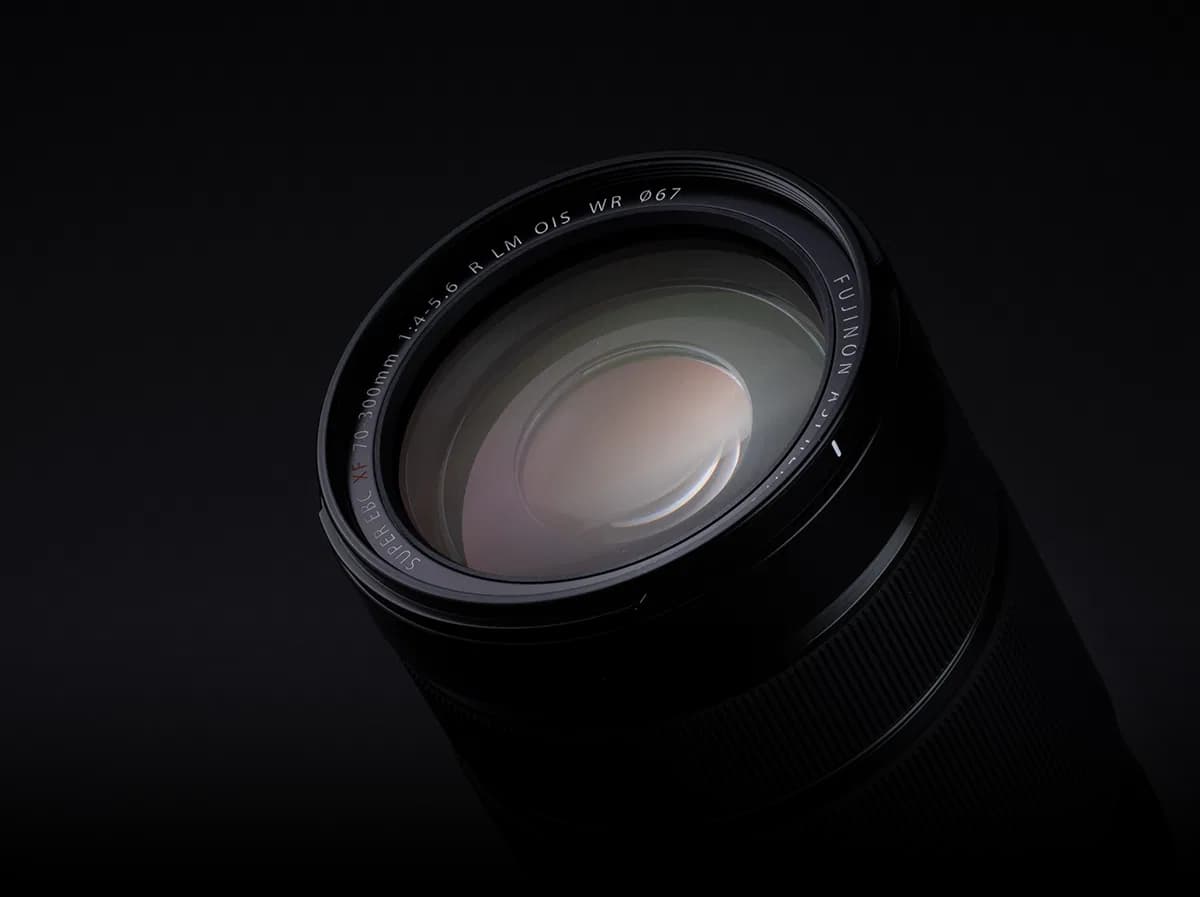
Fujifilm XF 70-300mm f/4-5.6 R LM OIS WR.
Compact APS-C super-telephoto with built-in OIS. Equivalent to 105-450mm — the X-system shooter's wildlife and sports kit.
The Verdict.
Gavler Meta-Score
“The X-system's value reach lens: consistently sharp to 300mm, a genuinely useful 5.5-stop OIS, weather sealing, and 1.4x/2x teleconverter support — all at 580g and under $800. The compromises are a plasticky build, a slow f/4-5.6 aperture, and real softness with the 2x TC. Buy it for X-mount wildlife and travel in good light; move up to the 100-400 for demanding action.”
The Gavler Verdict
The Gavler Review.
Fujifilm XF 70-300mm Review: The X-Mount Reach Lens That Knows Its Limits
The Fujifilm XF 70-300mm f/4-5.6 R LM OIS WR ranks number 10 on Gavler's Best Telephoto Zoom Lenses list with a 8.2. It's built for X-mount shooters who want genuine wildlife-and-sports reach without spending $1,800 on the XF 100-400mm, and the trade-off is exactly what you'd expect from a lens this size and price: a polycarbonate barrel DPReview politely called "quite plasticky," and image quality that starts to fray at the very top of the zoom range. As DPReview put it, sharpness stays "nice and consistent throughout the zoom range," which "is very good news" because 300mm is "likely where you'll most want it."
What it is
This is Fuji's affordable super-telephoto for the X-series: a 70-300mm f/4-5.6 zoom that becomes a 105-450mm equivalent on APS-C, aimed squarely at the photographer who wants birds, kids' soccer games, or distant landscapes without carrying a lens the size of a thermos. It's built around 17 elements in 12 groups (one aspherical, two ED), weighs a genuinely light 580 grams, and pairs a linear autofocus motor with 5.5 stops of optical image stabilization. It's weather-sealed and freezeproof to -10°C, and — unusually for a lens in this price bracket — it accepts Fujifilm's own 1.4x and 2x teleconverters while retaining phase-detect autofocus.
At $799, it undercuts the competition by a wide margin. There's no direct twin in Fuji's own lineup; the closest alternative is the far more expensive XF 100-400mm, which most casual telephoto shooters simply don't need.
In use
Where this lens earns its rank is in the middle of the zoom range and right at the long end, which is exactly where cheaper telephotos usually fall apart. DPReview's testers found the sharpness held up "all the way out to 300mm," and Amateur Photographer's real-world shooting backed that up with numbers: "reliably sharp images at shutter speeds as low as 1/60sec" at full zoom, a direct result of the 5.5-stop OIS doing real work rather than just padding a spec sheet.
Handling is unfussy. The zoom ring has enough resistance for precise framing, there's a transport lock to keep the barrel from creeping at 70mm, and the focus limiter switch is genuinely useful when you're tracking something moving fast against a cluttered background. Minimum focus distance of 0.83m gets you to a 0.33x magnification — close to macro territory for a telephoto zoom, and handy for insects or small details without swapping lenses.
Strengths
- Sharp where it counts. DPReview and Amateur Photographer both singled out 300mm — the focal length a telephoto zoom is bought for — as holding up rather than degrading.
- Real stabilization. 5.5 stops of OIS is a meaningful number in practice, not just on a spec chart, and it's what makes handheld 300mm shots at 1/60sec possible.
- Light and weather-sealed. At 580g with sealing rated to -10°C, it disappears into a travel kit in a way that competing super-telephotos don't.
- Teleconverter compatibility. Few lenses at this price accept teleconverters at all, let alone retain autofocus with them attached.
The trade-offs — who should skip it
The build quality is the most obvious concession to price. DPReview's blunt assessment — "there's no getting around the fact that it's quite plasticky" — is fair; that's how Fuji kept the weight down, but it also means this doesn't feel like a professional-grade lens in hand, and the manual focus ring, in particular, has been criticized by lab testers as barely usable due to light action and poor response.
The more important caveat surfaced when OpticalLimits tested the lens formally rather than just shooting with it. On a 26-megapixel body, they found sharpness "fine in the 70mm to 200mm range" and "decent" at 300mm in the center, "less so at the borders." But on a 40-megapixel body like the X-H2, they concluded the lens "didn't fully convince us," with corner performance at 300mm turning "rather mediocre" — a reminder that a $799 telephoto has real optical limits once you pair it with Fuji's highest-resolution sensors. The same testing flagged lateral chromatic aberration "rather poor for a modern lens" at 300mm f/5.6, correctable in software but present in every RAW file.
Then there's the 2x teleconverter. DPReview's warning is direct: "a very noticeable drop in sharpness" and "chromatic aberrations significantly magnified," with color fringing that can survive correction. The 1.4x TC is fine; the 2x is a last resort, not a feature to plan a purchase around.
If you shoot fast action in low light, the f/4-5.6 variable aperture will frustrate you — this isn't a lens for indoor sports or dim, overcast wildlife outings. And if you've already invested in a 40MP body and demand corner-to-corner bite at full zoom, this lens will show you its price tag.
How it compares
The closest ranked competitor on Gavler's telephoto list is the Tamron 70-180mm f/2.8 Di III VXD G2 at rank 9 — though it's worth noting upfront that the Tamron is a Sony E-mount and Nikon Z lens, not X-mount, so the two aren't cross-shoppable for the same camera system. What the comparison does illustrate is the difference in philosophy: the Tamron trades reach (180mm vs. 300mm) for a constant f/2.8 aperture and newly added VC stabilization, at nearly double the Fuji's price. If you're an X-mount shooter who occasionally considers a system switch for faster glass, that's the trade you'd be making. Within Fuji's own catalog, the honest alternative is the XF 100-400mm — sharper at long focal lengths and more expensive, the lens OpticalLimits themselves recommend stepping up to for serious reach on high-resolution bodies.
The Gavler verdict
The XF 70-300mm earns its rank 10 spot by doing the one thing a budget telephoto has to do — stay sharp out to 300mm — while keeping weight, price, and weather sealing in check. It is not a lens that flatters a 40-megapixel sensor at the extreme long end, and its plastic build and slow variable aperture are the honest cost of the $799 price tag. Buy it for X-mount wildlife, travel, and sports in good light where 580 grams and real reach matter more than lab-chart perfection; save up for the XF 100-400mm if you're shooting a high-resolution body and need the corners to hold up under scrutiny.
Common Questions
For X-mount shooters, yes. DPReview found sharpness 'nice and consistent throughout the zoom range' and 'strong all the way out to 300mm,' and Amateur Photographer got 'reliably sharp images at shutter speeds as low as 1/60sec' at 300mm thanks to the 5.5-stop OIS. At under $800 and 580g, it is the value reach lens for the system, not the definitive one.
If you shoot a 40MP body like the X-H2, know that OpticalLimits' lab testing found the lens 'didn't fully convince' at that resolution, with borders and corners turning 'rather mediocre' at 300mm. On 26MP bodies the same reviewer called sharpness 'fine in the 70mm to 200mm range' and 'decent' at 300mm. If you need pixel-level bite at full reach on a high-resolution body, budget for the pricier XF 100-400mm instead.
It attaches and autofocus survives, but DPReview warns of 'a very noticeable drop in sharpness' with the 2x TC, 'while chromatic aberrations are significantly magnified.' The 1.4x TC is a much safer bet if you need the extra reach.
Where to Buy.
Prices checked regularly
90-day price history
Price History
Steady at $799 for the entire 90-day tracking window — no increases, no discounts, across 91 tracked days.
Tracked daily across retailers. Vote Want itabove and we’ll alert you the moment the price drops.
Some links are affiliate links — Gavler may earn a commission. This never affects rankings or scores. Learn more.
Precision Engineering
Sharp and Consistent to 300mm
DPReview found sharpness "nice and consistent throughout the zoom range" and strong "all the way out to 300mm" — a 17-element/12-group design (1 aspherical, 2 ED) reaching a 105-450mm full-frame equivalent.
5.5-Stop OIS at 580g
Built-in OIS rated to 5.5 stops let Amateur Photographer get "reliably sharp images at shutter speeds as low as 1/60sec" at 300mm — in a weather-sealed body weighing just 580g.
1.4x and 2x Teleconverter Support
Rare at this price: works with Fuji's XF 1.4x and 2x TCs (retaining phase-detect AF) to reach 900mm-equivalent, though the 2x costs noticeable sharpness.
Technical Specifications
The Scoreboard
Community 88 leads expert 86: owners value the reach-per-dollar, light weight, and effective OIS, while reviewers trim points for the plasticky polycarbonate build, the slow variable aperture, and the sharpness penalty when the 2x teleconverter is fitted.
Cast Your Vote
Do you think Fujifilm XF 70-300mm f/4-5.6 R LM OIS WR deserves the #10 spot in Best Telephoto Zoom Lenses?
Global Critique
“Sharpness remains nice and consistent throughout the zoom range. It's very good news that it remains strong all the way out to 300mm, as that's likely where you'll most want it on a telephoto zoom lens.”
“Here I've been impressed by its capabilities; at 300mm, I've been able to get reliably sharp images at shutter speeds as low as 1/60sec.”
“It's also nice and light, tipping the scales at 580g (1.3lb). That's doubtless been achieved in large part thanks to liberal use of plastic in the 70-300mm's design. There's no getting around the fact that it's quite plasticky.”
“With the 2x TC, there's a very noticeable drop in sharpness, while chromatic aberrations are significantly magnified. Color fringing can remain even after corrections with this combination.”
More from Best Telephoto Zoom Lenses.
See how other top picks compare in this category.

Is This a 70-200 Day, or a 600mm Day?
A 70-200 hangtag is the wrong first question. Events at f/2.8, or wildlife at 500–600mm, is the reach you work. Then shop Gavler's live ranking.
Samyang's 60-180mm f/2.8 Is the Cheapest Way Into Sony's f/2.8 Telephoto Club
Samyang's AF 60-180mm f/2.8 FE gives Sony a constant-aperture telephoto for about $1,000 and 730g — a third the price of the 70-200mm GM atop our list.