The Best E-Readers in 2026, Ranked by People Who Actually Read on Them
Kindle, Kobo, Boox. Gavler's readers rank the e-readers worth buying — by display, battery, library access, and which feel best in the hand.
E-readers are the rare tech category where the product has essentially perfected its core job. A modern e-reader displays text on a screen that looks like paper, lasts weeks on a charge, and weighs less than a paperback. The hard question isn't "do I need one?" — it's "which ecosystem do I want to live in?"
Because that's the real choice. Amazon or Kobo. Locked-in convenience or open-format flexibility. And increasingly, "just reading" or "reading plus writing." Gavler's e-reader rankings come from people who've committed to their devices — readers who've swiped through hundreds of books and formed real opinions about what matters. Their votes decide the rankings.
How We Rank: One Vote, One Reader
Every Gavler user gets a single vote on the Best E-Readers list. Pick the device you'd recommend above all others. Switched ecosystems? Move your vote. The result is a ranking built on the preferences of people who actually read.
The Top 3: What the Community Chose
1. Amazon Kindle Paperwhite (2025) — The Default for a Reason
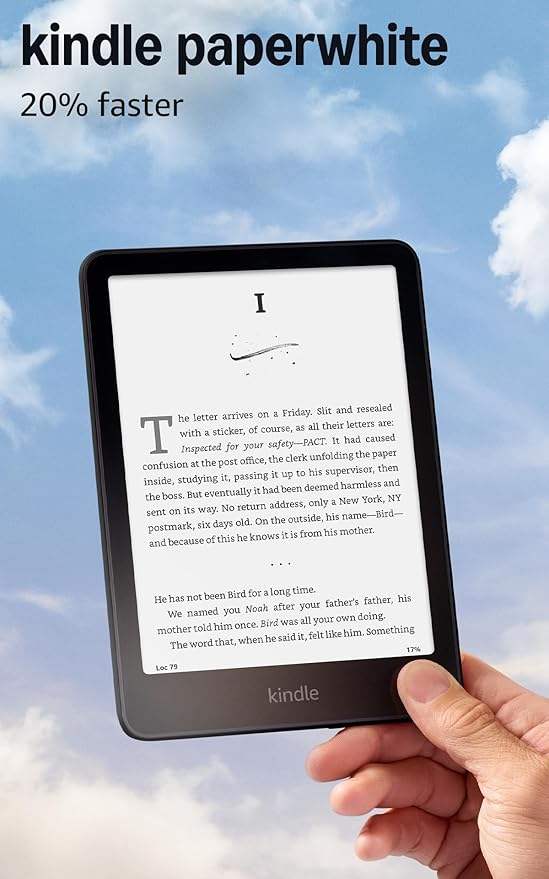
Amazon Kindle Paperwhite (2025)
A 7-inch, 300 ppi E Ink display with adjustable warm light, IPX8 waterproofing, and up to 12 weeks of battery life. The 2025 refresh is faster, sharper, and lighter than its predecessor, making it the easiest entry into e-reading.
Amazon affiliate · price subject to change
A 9.7 score for a device that costs under $170 is remarkable. The Paperwhite has earned its position through relentless iteration — the 2025 model brings a larger 7-inch display, improved cold-white-to-warm lighting, USB-C, and a battery that genuinely lasts weeks of daily reading. It's waterproof. It's thin. It disappears in your hands and lets the book take over.
The community votes for the Paperwhite because it nails the fundamentals better than anything else at the price. You charge it, you buy a book, you read. The Kindle ecosystem's scale means virtually every book is available instantly. It's not exciting — it's reliable, and for a reading device, reliable is the highest compliment.
2. Kobo Libra Colour — The Open Alternative
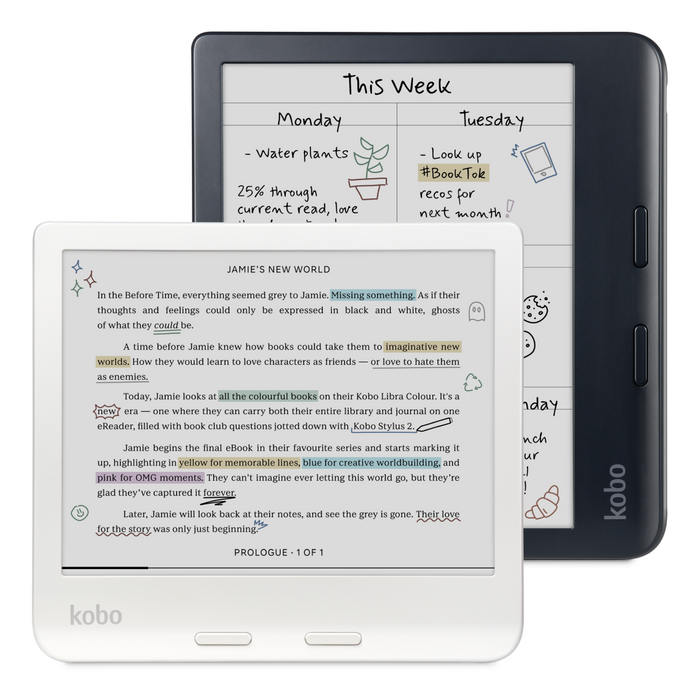
Kobo Libra Colour
A 7-inch Kaleido 3 display brings color to e-reading without sacrificing the crisp black-and-white experience. Physical page-turn buttons, IPX8 waterproofing, and open ecosystem support make this the best choice for readers who value flexibility.
The Libra Colour at 9.6 represents the community's strong appetite for an alternative to Amazon's grip on digital reading. Kobo's e-reader natively supports ePub — the open standard that Amazon deliberately doesn't support. It integrates with OverDrive for free library book lending. It doesn't show ads on your lock screen. And the colour E Ink display, while not tablet-grade, is genuinely useful for book covers, comics, and highlighted passages.
The physical page-turn buttons and ergonomic asymmetric design make one-handed reading effortless. The community that votes for the Libra Colour tends to care deeply about not being locked into a single company's bookstore — and Kobo rewards that stance with a genuinely excellent device.
3. Amazon Kindle Scribe (2025) — The Reader-Writer Hybrid
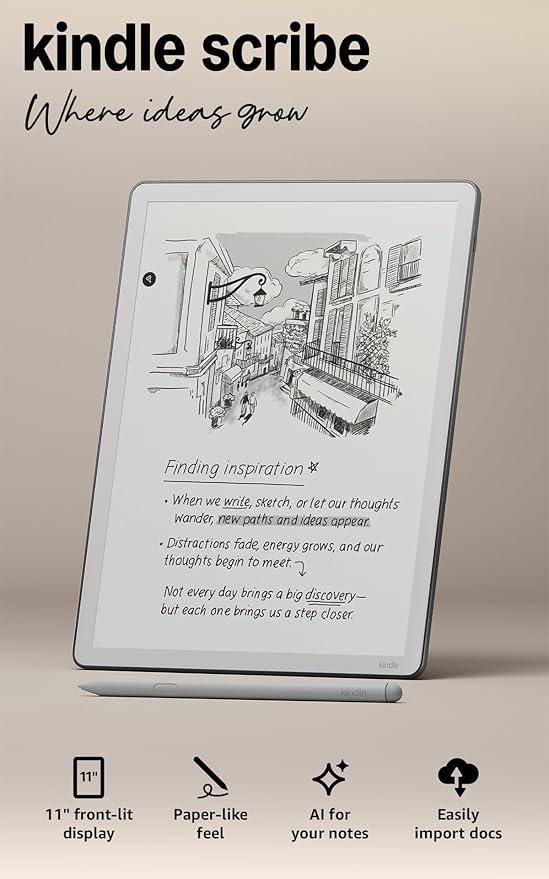
Amazon Kindle Scribe (2025)
A 10.2-inch display with a pressure-sensitive stylus lets you write directly on books, PDFs, and notebooks. The 2025 refresh added a faster processor and improved handwriting-to-text conversion, making it the definitive device for note-takers.
Amazon affiliate · price subject to change
The Scribe occupies a unique space: it's an e-reader that's also a notebook. The 10.2-inch E Ink display is large enough for comfortable PDF reading and handwritten notes. The included premium pen has improved latency in the 2025 model, making writing feel close to natural. And it still does everything a Kindle does — access the full Kindle store, sync across devices, adjust lighting.
At 9.5, the community views the Scribe as the best option for readers who annotate heavily, students who want to consolidate textbooks and notes, or anyone who journals and wants to keep everything on one distraction-free device. It's not for everyone, but for its audience, nothing else comes close.
The Ecosystem Question
The most interesting pattern in the community data is the Kindle-vs-Kobo divide. It's not about hardware — both companies make excellent devices. It's about philosophy. Kindle voters value the massive bookstore, Whispersync across devices, and Amazon's ecosystem convenience. Kobo voters value format freedom, library integration, and independence from Amazon.
Neither side is wrong. But the choice is more meaningful than in most tech categories, because your purchased books are tied to the platform. Switching ecosystems later means leaving your library behind — or resorting to DRM-removal tools the companies would rather you didn't use.
Buying Guide: What Actually Matters
Screen size is the new differentiator. With display technology essentially equal across the top devices, size is what separates the tiers. Six inches is fine for novels. Seven inches (Paperwhite, Libra Colour) is noticeably more comfortable. Ten inches (Scribe) is necessary for PDFs and note-taking but too large for one-handed casual reading.
Ads vs. no ads is a real consideration. Kindle's "with ads" models save $20 but display advertisements on your lock screen. Kobo devices never show ads. If the lock screen matters to you, either buy the ad-free Kindle variant or go Kobo.
Library lending is a Kobo advantage. If you borrow ebooks from your public library, Kobo's native OverDrive integration is seamless. Kindle works with Libby but the experience is clunkier. Avid library users consistently favor Kobo in the community data.
Waterproofing matters more than you think. The Paperwhite and Libra Colour are both IPX8 rated. Reading in the bath, by the pool, or at the beach without anxiety is a small luxury that the community overwhelmingly appreciates once they have it.
Architecture first — dedicated E Ink vs a tablet, then B&W vs color vs stylus, then which store you will live in. The full decision tree is in our E-Reader Buying Guide. Then buy from the live Best E-Readers ranking.
What's New Since January
Two developments since this list was first published are worth flagging without disturbing the community ranking above.
The Kindle Scribe Colorsoft is the most significant launch of the year. Per TechCrunch's review and Tom's Guide, it is the first device that combines the Scribe's 10.2-inch writing surface with a Kaleido 3 color E-Ink display, and it ships with on-device generative-AI features (note summarization, handwriting-to-text). The trade-off is the price — the Scribe Colorsoft is meaningfully more expensive than the standard Scribe — and the color saturation, like every Kaleido 3 panel, is muted compared to LCD tablets. For students annotating textbooks, researchers marking up PDFs, or readers who want highlights to actually look highlighted, it's the strongest single device in the Kindle lineup. It doesn't dislodge the standard Scribe (rank #3) at the price tier the community votes on, but if budget isn't the constraint, it's the better device.
The Kindle Colorsoft has dropped to its first real sale prices. The original $279 launch made it a hard sell against the $169 Paperwhite for most readers — which is why the community list still ranks the Paperwhite at #1. Since January, Gizmodo and others have flagged bundle pricing that effectively brings the Colorsoft into the Paperwhite Signature Edition's price band, which is the price at which color stops being a luxury and starts being a coin-flip. If you read comics, manga, or anything where color highlights matter, this is the moment to consider it. Kaleido 3 isn't going to compete with an iPad — it's not supposed to — but at sale pricing the value proposition becomes real.
What This Doesn't Change
The community ranking above is unchanged. The Paperwhite is still the e-reader most readers should buy first; the Libra Colour is still the right Kobo answer for anyone who values format freedom and library lending; the standard Scribe is still the right choice for note-takers at its price tier. Nothing in the past four months has changed the structural logic of the list — Amazon vs. Kobo is still a philosophy choice, not a hardware one. For an in-depth side-by-side of the two top picks, our Kindle Paperwhite vs Kobo Libra Colour head-to-head is the deeper walkthrough.
See all 10 products ranked by the community
Best E-Readers
See Full Rankings →242 community votes cast
Common Questions
According to Gavler's community of readers, the Amazon Kindle Paperwhite (2025) is the top-ranked e-reader in 2026 with a 9.7 score. Its combination of a sharp display, excellent lighting, weeks-long battery life, and a reasonable price makes it the e-reader the community recommends most.
It depends on your priorities. Kindle has the larger bookstore and tighter ecosystem integration. Kobo supports more file formats natively (including ePub), doesn't show ads, works with library lending services like OverDrive, and doesn't lock you into Amazon. The Kobo Libra Colour at 9.6 ranks just behind the Paperwhite — the community respects both approaches.
If you want to annotate books and PDFs, write in notebooks, and read on the same device — yes. The Scribe's writing experience has improved significantly in the 2025 model with lower latency and better palm rejection. It's not a full tablet replacement, but as a combined reader and notebook, the community rates it 9.5.
Yes, significantly. E-ink displays reflect ambient light like paper rather than projecting light at your eyes like LCD or OLED screens. This reduces eye strain during long reading sessions and doesn't suppress melatonin production the way backlit screens do, making e-readers far better for bedtime reading.
Rankings are determined entirely by community votes. Each user gets one vote on the Best E-Readers list — pick the one e-reader you'd recommend above all others. No affiliate commissions or sponsorships influence the rankings.
Products Mentioned
Jump to the full ranking and community verdict for each pick named above.