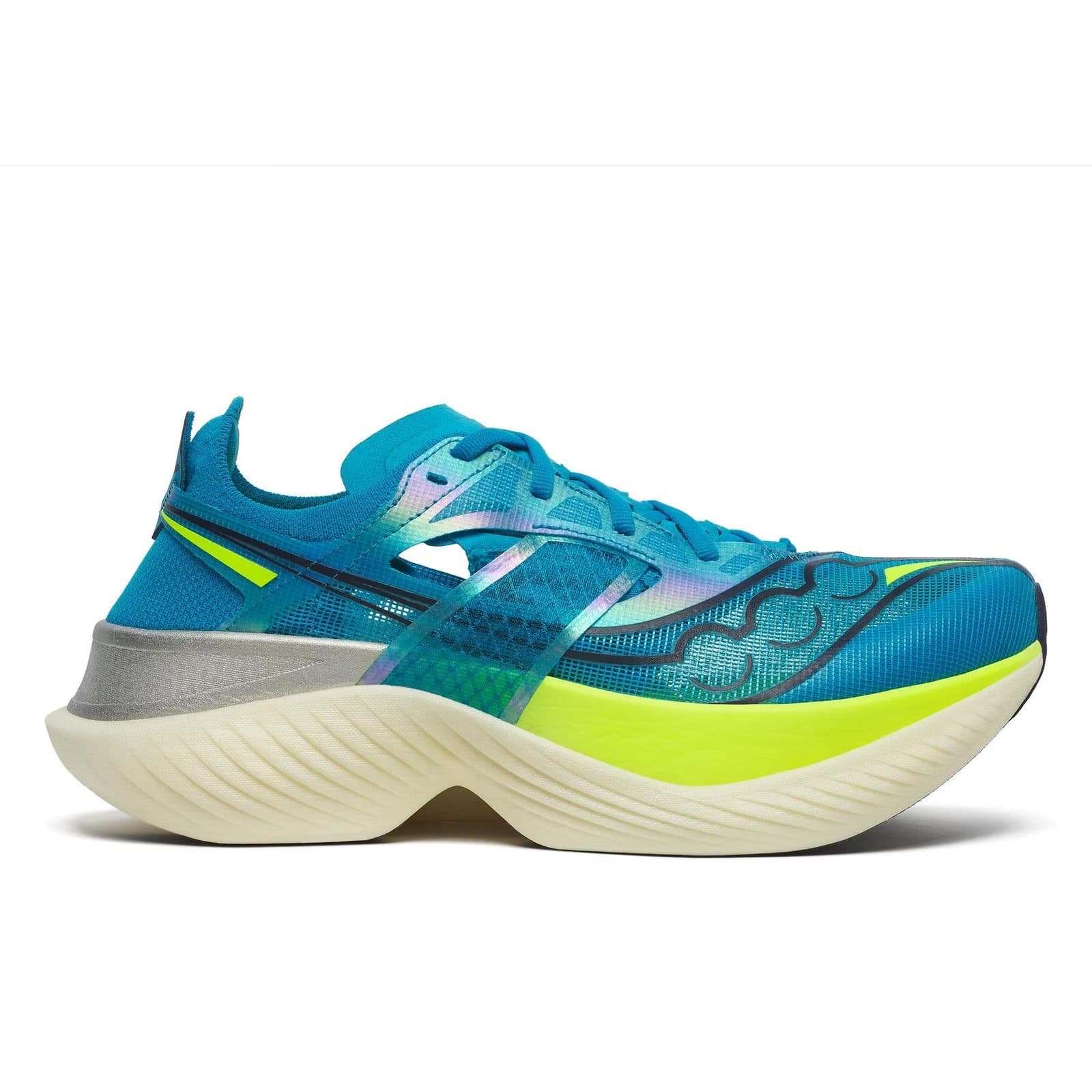
Saucony Endorphin Elite.
Saucony's PWRRUN HG foam is one of the lightest super foams on the market, and the S-curve carbon plate adds snap through toe-off. The Elite is the dark-horse pick that consistently surprises runners switching from Nike.
The Verdict.
Gavler Meta-Score
“Saucony's most aggressive racer and a genuine Vaporfly rival. Buy it if you want a firm, max-cushion marathon shoe that stays composed in the final miles and you'll treat it as a race-day tool; the catches are a thin, less durable outsole and energy-return numbers that trail the very best, so it is not the shoe for everyday training.”
The Gavler Verdict
The Gavler Review.
Saucony Endorphin Elite Review: The Firm, Late-Race Vaporfly Rival
The Saucony Endorphin Elite sits at number five on our Best Running Shoes list with a 9.1 — Saucony's most aggressive racer and a genuine rival to the shoes that get more of the marketing attention. Buy it if you want a firm, max-cushion marathon shoe that stays composed when other shoes start to fade in the final miles, and you're willing to treat it as a dedicated race-day tool rather than a training shoe. Skip it if outright lab-measured energy return or long-term durability matters more to you than late-race feel — reviewers are candid that this shoe trails the category leaders on both.
What it actually is
The Endorphin Elite is Saucony's all-out answer to the Nike Vaporfly, and it swings hard at the top of the category. The midsole is PWRRUN HG, a PEBA-based foam that reviewers describe as an evolution of the well-regarded PWRRUN PB — firmer underfoot, but with better energy return — wrapped around a stiff, full-length carbon plate slotted at the forefoot for an aggressive rocker and strong torsional rigidity.
The numbers back up the positioning: a near-max 39.9mm heel stack packed into just 7.2 ounces, which undercuts the New Balance SC Elite v4 by roughly an ounce while still delivering serious cushion. The toe box is also roomier than Saucony's own Endorphin Pro, which matters for anyone who's found the Pro line's fit too locked-down for race day.
In use
RunRepeat's testing frames the Endorphin Elite as a direct descendant of a shoe runners already trust: "This is an evolution of the highly-praised PWRRUN PB. We found that it offers even better energy return, though it's a bit firmer underfoot." That firmness isn't incidental — it's the whole design thesis. Softer foams can feel great fresh but pack out and lose responsiveness over 20-plus miles; a firmer, more resilient foam holds its character deep into a race, which is exactly when a marathoner needs it most.
The plate delivers on the propulsion side too. RunRepeat again: "Naturally, being a top-tier super shoe, the Elite features a stiff carbon plate embedded in the midsole. This not only provides a bouncy feel but also gives top-notch torsional rigidity." Torsional rigidity is an under-discussed quality in super shoes — it's what keeps the plate from twisting underfoot on uneven road cambers, and it's part of why runners describe the Endorphin Elite as composed rather than wild late in a race.
Where it shines
- A firm ride that holds up when it matters most. The PWRRUN HG foam is tuned to stay resilient in the final 10K of a marathon, which is precisely when softer, bouncier shoes can start to feel flat — this is why so many marathoners specifically reach for it in the closing miles.
- Genuine torsional rigidity from the carbon plate. RunRepeat calls out the plate's rigidity as top-notch in the category, which translates to a more composed, less twitchy ride on uneven road surfaces than shoes with a less stiff plate.
- A roomier fit than Saucony's own Endorphin Pro. For runners who've found the Pro line too locked-down for race-day comfort over 26.2 miles, the Elite's toe box is a real, tangible upgrade.
The trade-offs — who should skip it
Saucony's most aggressive racer is not without real, reviewer-documented weaknesses:
- The lab energy-return numbers trail the category leaders. RunRepeat's own ASTM F1976 lab test measured 69% heel energy return and didn't soften the verdict: "We can't deny we felt a bit let down when the Endorphin Elite posted just 69% energy return in the heel in our ASTM F1976 test. That's pretty underwhelming for a shoe nearing the $300 mark." If peak propulsion is your primary decision factor, this is the honest data point against the Endorphin Elite.
- The outsole is a durability concern. The thin race outsole is a known trade-off in this shoe — treat it as a race-day and key-workout tool rather than a shoe you put heavy weekly mileage on.
- It's a specialist purchase, not a value pick. At $275 with lab numbers that lag the field, this shoe makes the most sense for runners who specifically want its firm, late-race character rather than for anyone comparison-shopping purely on spec sheet.
How it compares
On its own list, the Endorphin Elite sits directly behind the Hoka Rocket X 2 at number four — both are stability-minded alternatives to the softer, bouncier shoes at the top of the list, though they get there differently. The Rocket X 2 achieves its composure through a lower 36mm stack and dual-density foam; the Endorphin Elite achieves it through a firmer PEBA compound at a taller, near-max stack. Runners who want height and cushion without sacrificing late-race stability should look at the Endorphin Elite first; runners who want a lower, more grounded feel should lean toward the Rocket X 2.
Against the category flagship, the Nike Alphafly 3, the trade is about character more than raw numbers: the Alphafly delivers a higher lab-measured energy return and a more propulsive, spring-loaded toe-off from its dual Air Zoom pods, but the Endorphin Elite's firmer foam is the more honest choice for a runner who has felt softer super shoes go flat in the final 10K of a marathon and wants a shoe engineered specifically to resist that fade.
The Gavler verdict
A 9.1, backed by a 92 expert consensus and an 89 community rating — strong regard for a shoe that does one thing, staying composed late in a race, better than almost anything else in the category. The narrow gap between the expert and community scores traces to two consistent, named critiques: outsole durability and lab energy-return figures that lag the leaders at a premium price. Buy the Endorphin Elite if you want a firm, max-cushion marathon shoe built to hold its character in the closing miles and you'll treat it as the race-day tool it's designed to be; look elsewhere in the category if raw lab-measured propulsion or long-term durability is your top priority.
Common Questions
For marathoners who want a firm, composed ride deep into the final miles, yes. It ranks fifth on Gavler's Best Running Shoes list with a 9.1, built on Saucony's PWRRUN HG foam at a near-max 39.9mm heel stack. The catch is the $275 price against RunRepeat's lab-measured 69% heel energy return, which trails the very top of the category, and a thin race outsole reviewers flag as a durability risk.
Honestly, it lags the category leaders. RunRepeat's ASTM F1976 lab test measured 69% heel energy return, which the outlet itself called 'pretty underwhelming for a shoe nearing the $300 mark.' The shoe's real strength is how that firm PWRRUN HG foam holds up late in a race rather than its peak lab number — reviewers reach for it specifically because it doesn't pack out in the final 10K the way softer foams can.
Treat it as a race-day and key-workout shoe, not a durable all-purpose trainer. Reviewers flag the thin race outsole as a genuine durability concern, which is standard for this weight class but worth knowing going in — this is a shoe you save for goal races rather than log heavy weekly mileage in.
Buy the Alphafly 3 if you want the category's highest energy return and the most propulsive toe-off; buy the Endorphin Elite if you specifically want a firmer ride that holds composure when foam in softer shoes has started to pack out late in a marathon. The Endorphin Elite is the dark-horse pick for runners switching from Nike who want a different, firmer feel underfoot.
Where to Buy.
Prices checked regularly
90-day price history
Price History
Steady at $275 for the entire 90-day tracking window — no increases, no discounts, across 91 tracked days.
Tracked daily across retailers. Vote Want itabove and we’ll alert you the moment the price drops.
Some links are affiliate links — Gavler may earn a commission. This never affects rankings or scores. Learn more.
Precision Engineering
7.2 oz (204 g)
One of the lighter max-stack racers, undercutting the New Balance SC Elite v4 by roughly an ounce.
PWRRUN HG PEBA Midsole
A firmer, higher-energy evolution of PWRRUN PB at a near-max 39.9 mm heel stack.
Forked Carbon Plate
A stiff full-length plate, slotted at the forefoot, that adds torsional rigidity and an aggressive rocker.
Technical Specifications
The Scoreboard
The 9.1 reflects strong expert and community regard for the aggressive, late-race ride. The narrow expert-versus-community gap stems from two consistent critiques — outsole durability and lab energy-return figures that lag the category leaders at a premium price.
Cast Your Vote
Do you think Saucony Endorphin Elite deserves the #20 spot in Best Running Shoes?
Global Critique
“This is an evolution of the highly-praised PWRRUN PB. We found that it offers even better energy return, though it's a bit firmer underfoot.”
“Naturally, being a top-tier super shoe, the Elite features a stiff carbon plate embedded in the midsole. This not only provides a bouncy feel but also gives top-notch torsional rigidity.”
“We can't deny we felt a bit let down when the Endorphin Elite posted just 69% energy return in the heel in our ASTM F1976 test. That's pretty underwhelming for a shoe nearing the $300 mark.”
More from Best Running Shoes.
See how other top picks compare in this category.
What Kind of Running Shoe Do Your Miles Actually Need?
A carbon plate is the wrong first question. Daily trainer vs max-cushion vs stability vs race-day super shoe is the job. Then shop Gavler's live ranking.
Superblast 3 vs Vomero 18 vs Novablast 6: The Best Daily Trainer of 2026 Costs $155, and It Isn't the Nike
Three shoes dominate every 2026 daily-trainer list: one's a recovery shoe in a trainer's badge, one costs $55 too much, one spec sheet won't survive a caliper.
The $500 Running Shoe Is Not the Fastest One. A $300 Shoe Is Lighter, and a $170 Shoe Is the Smart Buy.
Adidas broke the super-shoe price ceiling at $500. Every outlet that tested it says buy cheaper — and the lab data says the benefit was never about price.
The Best Running Shoes in 2026, Ranked by Runners Who Actually Race Them
Nike, Asics, Hoka, Saucony. Gavler's running community ranks the shoes worth lacing — from $140 daily trainers to $285 marathon weapons.