Samsung Odyssey OLED G9 (G95SD).
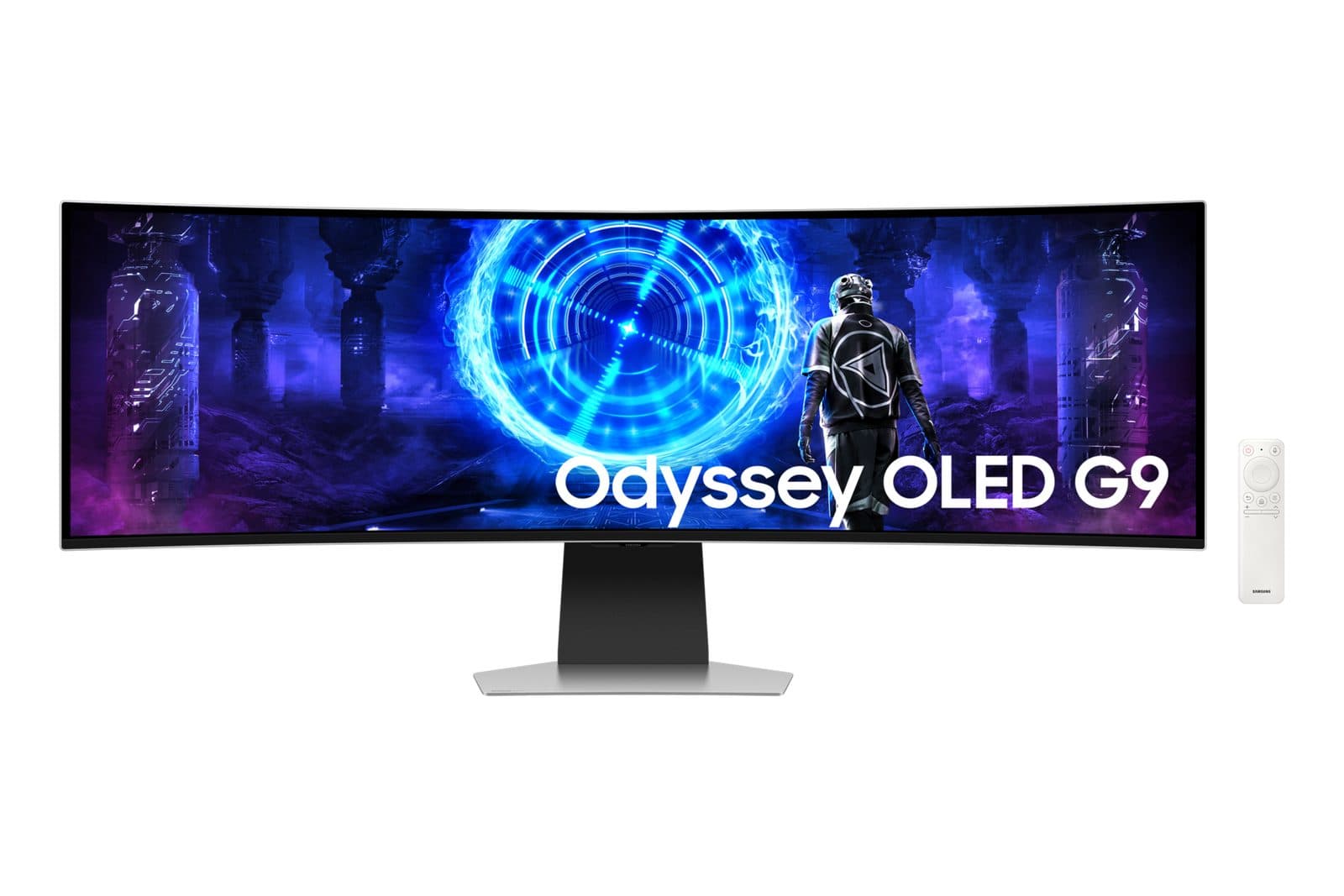
Samsung Odyssey OLED G9 (G95SD) — 49" 5120x1440 1800R curved QD-OLED @ 240Hz with Tizen smart platform. The "one monitor does everything" pick.
The Verdict.
Gavler Meta-Score
“The category-of-one 49" superultrawide QD-OLED — the right pick when sim racing + productivity multi-tasking + cloud gaming all matter to the same buyer. Not a 4K AAA-visuals pick.”
The Gavler Verdict
The Gavler Review.
Samsung Odyssey OLED G9 (G95SD) Review: The Only 49-Inch QD-OLED at 240Hz
The Samsung Odyssey OLED G9 (G95SD) sits at number five on our Best Gaming Monitors list with a 9.0 — the only 49-inch superultrawide QD-OLED gaming monitor on the market running at 240Hz, a genuine category of one. Buy it if sim racing, productivity multitasking, and console or cloud gaming all matter to your setup at once — that overlapping use case is exactly what this display is built to serve. Don't buy it expecting the sharpest single-screen 4K image; at 5120x1440, this is a wide-format display first and a pixel-density display second.
What it actually is
The G95SD earns its category-of-one positioning honestly: no other manufacturer is currently shipping a 49-inch QD-OLED gaming monitor at 240Hz refresh. The 5120x1440 resolution is best understood as 1440p stretched to triple width rather than a 4K panel — it is not 4K, and buyers coming from a 4K monitor should understand that distinction before they buy. The 1800R curve isn't a stylistic choice at this scale; it's mandatory. A flat 49-inch panel would put the edges more than 18 inches off-axis from center, which would make the display physically unusable for anything other than the center third of the screen.
The gaming spec sheet matches the smaller Samsung QD-OLED monitors in this lineup: 0.03ms grey-to-grey response, DisplayHDR True Black 400 certification, FreeSync Premium Pro variable refresh across a 48–240Hz range, and roughly 3ms input lag. Tizen OS is built in here too, running AirPlay 2, SmartThings, Xbox Cloud Gaming, GeForce Now, and native streaming apps — the same smart-platform layer found on the smaller G80SD, just wrapped around a fundamentally different form factor.
In use
Where the G95SD actually earns its keep is in overlapping use cases that no other single display handles as well. Sim racing and flight-sim titles — Forza Motorsport, Assetto Corsa, Microsoft Flight Simulator — benefit from a level of peripheral-vision immersion that no standard 16:9 or even ultrawide 21:9 monitor can match. Tom's Guide's assessment captures the appeal directly: "Though pricey, its gorgeous display quality, immersive field of view, and host of Samsung TV and gaming apps make this gaming monitor a winner." Gaming Gear Labs goes further on the format specifically, calling it "the king of super ultra-wides in 2026."
The productivity case is just as real. At 5120x1440, the G95SD offers roughly the desktop space of two 27-inch 1440p monitors stitched into one seamless panel — no bezel gap in the middle, no mismatched color calibration between two separate displays, and the same OLED per-pixel contrast on every inch of the workspace. For someone who currently runs dual monitors for trading, content creation, or general multitasking, that's a meaningful quality-of-life upgrade, not just a gaming feature.
Where it shines
- A category of one. No other 49-inch QD-OLED gaming monitor on the market currently matches its 240Hz refresh rate — if you specifically want this format at this speed, there is no alternative to compare it against.
- Immersion that standard aspect ratios can't replicate. For sim racing, flight simulation, and other peripheral-vision-dependent genres, the 32:9 curved QD-OLED delivers a field of view no 16:9 or 21:9 display can match, regardless of resolution.
- Genuine dual-monitor replacement for productivity. The seamless 5120x1440 canvas eliminates the bezel gap and calibration mismatch of a two-monitor setup while keeping OLED's per-pixel contrast across the entire width.
The trade-offs — who should skip it
The category-of-one positioning cuts both ways, and reviewers are specific about the honest limits:
- It is not a 4K display. 5120x1440 is a wide-format resolution, not a high-pixel-density one. If your priority is the sharpest possible single-screen AAA image, a 4K OLED in the same price range — like the ASUS ROG Swift PG27UCDM or the Samsung G80SD — will deliver more pixel density on the content that matters most to you.
- It demands real desk space. The mandatory 1800R curve and 49-inch width require a deep desk to sit at a comfortable, non-distorted viewing distance, and the format is genuinely hard to position for anything but a dedicated gaming or productivity setup — this isn't a display you casually fit into a small room.
- It's a premium purchase for a specific buyer. At $1,499, this is priced above the standard 32-inch 4K OLED tier, and the format only pays off if your actual use case — sim racing, multi-app productivity, or both — overlaps with what the superultrawide format specifically enables.
How it compares
Within Samsung's own lineup, the Samsung Odyssey OLED G8 (G80SD) at number four is the conventional counterpart — a standard 32-inch flat 4K panel with the same Tizen smart platform, built for a normal desktop footprint rather than the G95SD's immersive width. Anyone who isn't specifically drawn to the superultrawide format should start with the G80SD instead; it delivers sharper single-screen 4K visuals in a form factor that fits a standard desk.
Against the category flagship, the ASUS ROG Swift PG27UCDM at number one, the comparison isn't really apples to apples — the ASUS is a 27-inch 4K display optimized purely for pixel density and DisplayPort 2.1 future-proofing, while the G95SD trades that density for width and multitasking real estate. Choosing between them comes down to which problem you actually have: sharper AAA visuals in a compact footprint, or immersive width plus a genuine dual-monitor replacement.
The Gavler verdict
A 9.0, reflecting strong expert praise (91) for the immersive QD-OLED panel and genuinely versatile smart-TV feature set, with the community score (92) actually edging slightly higher — a sign that owners who chose this specific format are enthusiastic about the trade-offs they knowingly made. Buy the G95SD if sim racing, productivity multitasking, and console or cloud gaming genuinely overlap in how you'll use it; this is the unambiguous pick for that buyer. Skip it if you just want the sharpest 4K AAA gaming visuals in a conventional footprint — the G80SD or PG27UCDM will serve that use case better.
Common Questions
It depends entirely on your use case. It ranks fifth on Gavler's Best Gaming Monitors list with a 9.0 as the only 49-inch superultrawide QD-OLED on the market at 240Hz — a category of one. It's worth it if sim racing, productivity multitasking, and console or cloud gaming all matter to the same setup. It's not the pick if you just want the sharpest single-screen 4K image, since 5120x1440 is not 4K resolution.
No, and this is the most important thing to understand before buying. The 5120x1440 resolution is essentially 1440p stretched across a 32:9 superultrawide frame, not 4K. Single-screen AAA visual density won't match a 4K OLED in the same price range — the G95SD's strength is immersive width and desktop real estate, not pixel density.
Yes — this is a genuine, practical trade-off reviewers flag consistently. At 49 inches with a mandatory 1800R curve, the monitor needs roughly 32 inches or more of desk depth to sit at a comfortable viewing distance, and its size makes it hard to position for non-gaming use without dominating the room. Measure your desk before buying.
They're built for different jobs, not competing at the same one. The G80SD is a standard flat 32-inch 4K gaming monitor with the same Tizen smart platform. The G95SD trades resolution and a standard footprint for 49 inches of curved, immersive width that suits sim racing and multi-app productivity. Choose the G80SD for a conventional desktop gaming setup, and the G95SD only if the superultrawide format specifically matches how you'll use it.
Where to Buy.
Prices checked regularly
90-day price history
Price History
Steady at $1,499 for the entire 90-day tracking window — no increases, no discounts, across 91 tracked days.
Tracked daily across retailers. Vote Want itabove and we’ll alert you the moment the price drops.
Some links are affiliate links — Gavler may earn a commission. This never affects rankings or scores. Learn more.
Precision Engineering
49" Dual QHD QD-OLED
The 5120x1440 32:9 panel gives roughly the desktop space of two 27-inch 1440p monitors in one seamless display, ideal for sim racing and productivity.
240Hz, 0.03ms
A 240Hz refresh rate paired with QD-OLED's near-instant 0.03ms response keeps fast motion clear for competitive and high-frame-rate play.
Tizen Smart Platform
Built-in Tizen OS runs Xbox Cloud Gaming, GeForce Now, AirPlay 2 and streaming apps directly, so the monitor doubles as a TV without a connected PC.
Technical Specifications
The Scoreboard
Reviewers praise the immersive 32:9 QD-OLED panel and smart-TV versatility, calling it a category-of-one; the main caveats are the high price and the deep desk its 49-inch curve demands.
Cast Your Vote
Do you think Samsung Odyssey OLED G9 (G95SD) deserves the #6 spot in Best Gaming Monitors?
Global Critique
“Though pricey, its gorgeous display quality, immersive field of view, and host of Samsung TV and gaming apps make this gaming monitor a winner.”
“The Samsung Odyssey OLED G9 (G95SD) remains the king of super ultra-wides in 2026.”
More from Best Gaming Monitors.
See how other top picks compare in this category.
How to Choose a Gaming Monitor: 1080p, 1440p, or 4K
A 540Hz hangtag is the wrong first question. Start with 1440p vs 4K, then IPS vs OLED vs size. Then shop Gavler's live ranking.
TCL Is Coming for OLED Monitors — and the Prices Should Follow
TCL just unveiled its 32X3B and 27X3B OLED monitors and is building a fab to crack the panel duopoly. Here's what it means for OLED monitor prices.
4K OLED Gaming Just Crossed Under $650. The Cheapest One Ranks #9 for a Reason.
The Gigabyte MO27U2 is a 27-inch 4K 240Hz QD-OLED for $649 — a panel class that debuted above $1,300. A real price-floor moment, with trade-offs to match.
27-Inch vs 32-Inch 4K OLED: The ASUS PG27UCDM Is the Better Monitor, and the MSI 321URX Just Made That Stop Mattering
Two 4K 240Hz QD-OLED gaming monitors, same resolution, very different sizes — and a price gap that blew open in 2026. Here's which one to buy.
The Best Gaming Monitors in 2026: Pick the Tier, Not the Spec Sheet
ASUS ROG, MSI, Alienware, Samsung, LG. Gavler ranks the best gaming monitors of 2026 — 4K OLED, 1440p OLED, ultrawide, and budget picks, by tier.