Samsung Odyssey OLED G8 (G80SD).
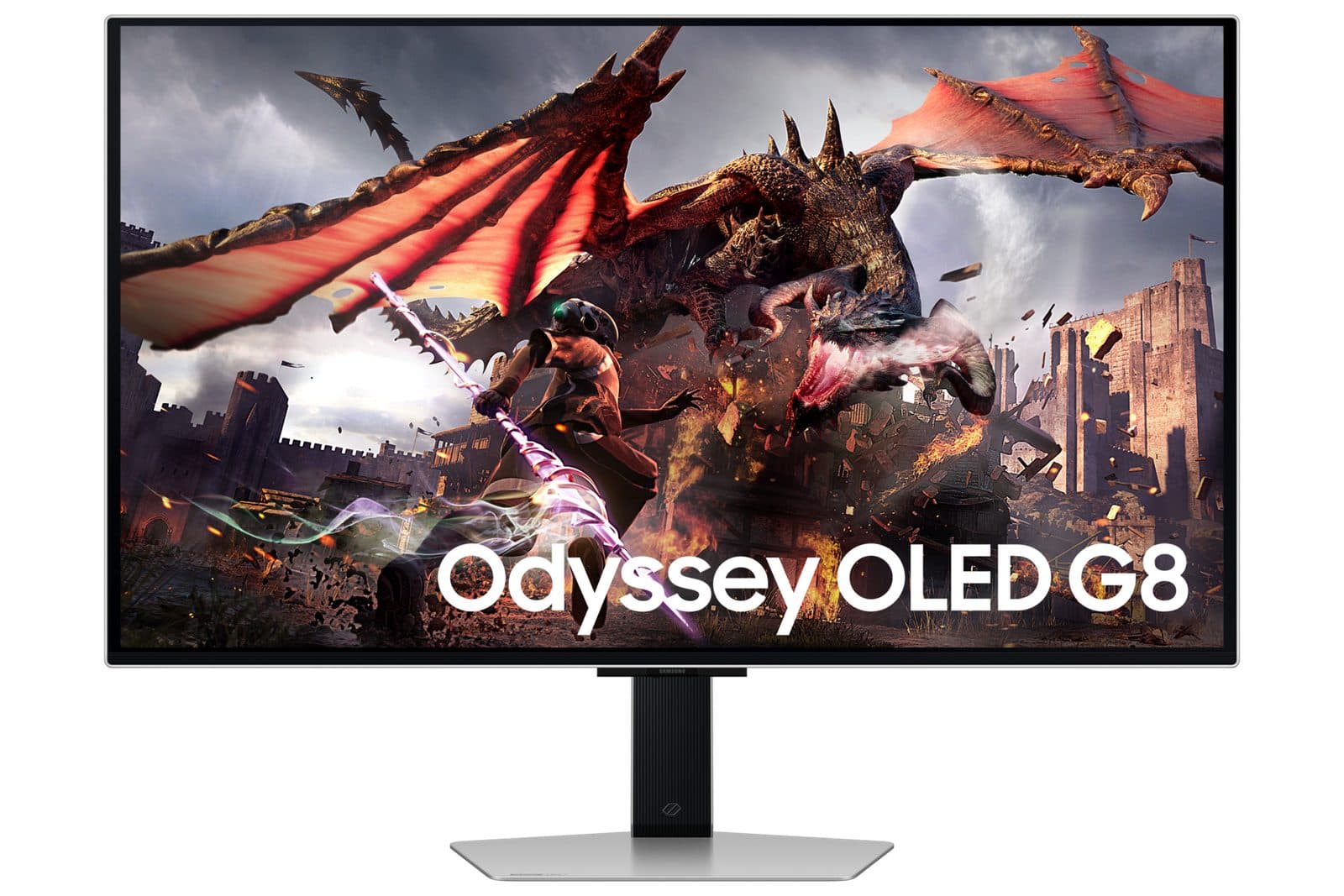
Samsung Odyssey OLED G8 (G80SD) — flat 32" 4K @ 240Hz QD-OLED with Tizen OS (AirPlay 2, SmartThings, Xbox Cloud Gaming, GeForce Now). The smart-platform flat alternative.
The Verdict.
Gavler Meta-Score
“The flat-panel alternative for buyers who specifically don't want a curve at 32". Tizen smart features add real value for media-room dual-use; pay the $200 premium over MSI only if you'll actually use them.”
The Gavler Verdict
The Gavler Review.
Samsung Odyssey OLED G8 (G80SD) Review: The Flat 4K OLED That's Also a Smart TV
The Samsung Odyssey OLED G8 (G80SD) sits at number four on our Best Gaming Monitors list with a 9.1 — the flat-panel alternative in Samsung's 32-inch 4K OLED lineup, built for buyers who specifically don't want a curve. Buy it if the built-in Tizen smart platform adds real value to your setup, whether that's a media room that doubles as a gaming space or a desk where you don't want a separate streaming device. Pay the roughly $200 premium over the MSI MPG 321URX only if you'll actually use those smart-TV features — on pure gaming performance, the specs are close to identical.
What it actually is
The G80SD is Samsung's flat answer to its own curved Odyssey lineup and to Dell's Alienware AW3225QF, and the panel sourcing is identical across all three: Samsung's 4th-generation QD-OLED supply at 32 inches and 4K resolution. The gaming spec sheet matches step for step — 0.03ms grey-to-grey response time, 240Hz refresh rate, DisplayHDR True Black 400 certification, and FreeSync Premium Pro plus G-Sync Compatible variable refresh support. What separates the G80SD from its siblings isn't the panel — it's the form factor and the operating system built into it.
That operating system is Tizen, and it unlocks a use case genuinely unique at this price tier: AirPlay 2 mirroring straight from an iPhone, iPad, or Mac; SmartThings integration for whole-home smart-device control; and Xbox Cloud Gaming, GeForce Now, and Amazon Luna running natively — no console or PC required. For a household where the gaming display doubles as a media-room screen, this is the only 4K 240Hz QD-OLED on the market that handles both jobs without a separate streaming stick plugged in.
In use
RTINGS' testing confirms the panel performs exactly as the spec sheet promises: a flat 32-inch 4K panel running a genuine 240Hz refresh rate, positioned as part of Samsung's broader Odyssey gaming lineup. On motion clarity specifically, the near-instantaneous OLED pixel response means fast-moving objects in competitive titles render without the ghosting or overshoot that even good LCD panels can show — a difference that's immediately visible once you've spent time on this panel and gone back to an LCD alternative.
The smart-platform layer is where the reviews get more nuanced. TFTCentral's testing found the input lag "nearly imperceptible, and there is no obvious smearing seen in many IPS or Mini LED alternatives" — confirming the core gaming performance holds up even with Tizen's smart-TV software running underneath it. But that same software layer is also the monitor's most-debated feature: it's genuinely useful for the AirPlay and cloud-gaming use cases, while also meaning day-to-day settings live in TV-style menus rather than the flat, PC-monitor-style OSD most gaming displays use.
Where it shines
- A genuinely useful smart platform, not a gimmick. AirPlay 2, SmartThings, and native cloud gaming (Xbox Cloud Gaming, GeForce Now, Amazon Luna) mean this display can function as a complete media and gaming hub without any other hardware plugged in — a real differentiator versus every other monitor on this list.
- Gaming performance that matches the flagship spec sheet. 240Hz refresh, 0.03ms response, and near-imperceptible input lag put it on par with the curved Alienware AW3225QF on the metrics that matter most for competitive and fast-paced play.
- A flat panel for buyers who specifically want one. At 32 inches, a curve is a personal preference, not a universal requirement — for desk setups or multi-monitor arrangements where a flat panel sits better, the G80SD is the only 4K 240Hz QD-OLED offering that choice at this size.
The trade-offs — who should skip it
The smart-platform advantage comes with real costs, and reviewers are specific about where they land:
- No Dolby Vision. The G80SD supports HDR10 and HLG plus DisplayHDR True Black 400, but the curved AW3225QF adds Dolby Vision on top of that. If you watch a lot of Dolby Vision-mastered content, that's the single clearest reason to choose the curved alternative.
- The smart-TV menu system fights PC conventions. Reviewers are blunt that the Tizen interface buries monitor-specific settings in TV-style submenus rather than the flat OSD most PC users expect, making routine adjustments more cumbersome than on a standard gaming monitor.
- It's the most expensive 32-inch 4K OLED in its class. At $1,299, the G80SD carries a roughly $200 premium over the MSI MPG 321URX for essentially the same core gaming performance. That premium buys the Tizen platform specifically — it doesn't buy meaningfully better gaming performance.
How it compares
Within Samsung's own lineup, the Samsung Odyssey OLED G9 (G95SD) at number five takes the smart-platform concept even further, pairing the same Tizen OS with a 49-inch superultrawide form factor built for sim racing and multi-tasking rather than a standard desktop footprint — a different use case entirely, not a straight upgrade.
Against the category leaders, the ASUS ROG Swift PG27UCDM at number one trades the G80SD's 32-inch scale for 27-inch pixel density and DisplayPort 2.1 future-proofing, while the MSI MPG 321URX at number two matches the G80SD's 32-inch 4K 240Hz spec sheet almost exactly at $300 less — without the Tizen platform. The G80SD's case rests entirely on whether that platform is worth the premium for your setup.
The Gavler verdict
A 9.1, reflecting strong expert praise (92) for the QD-OLED picture quality, 240Hz motion clarity, and an unusually complete smart-TV feature set for a gaming monitor, with a modest gap to the community score (89) tracing to the TV-style menu system and the price premium over cheaper 4K 240Hz alternatives. Buy the G80SD if the Tizen platform is a feature you'll genuinely use — media-room dual-duty, AirPlay mirroring, or console-free cloud gaming. If you just want the best 32-inch 4K OLED gaming performance for the money, the MSI MPG 321URX delivers nearly identical specs for $300 less.
Common Questions
Yes, for buyers who specifically want a flat 32-inch 4K OLED with built-in smart-TV features. It ranks fourth on Gavler's Best Gaming Monitors list with a 9.1, matching the curved Alienware AW3225QF on core gaming specs — 240Hz, 0.03ms response, DisplayHDR True Black 400 — while adding a Tizen OS platform that runs streaming apps and cloud gaming without a separate device. At $1,299 it's the most expensive of the 32-inch 4K OLED set, so it's worth the premium mainly if you'll actually use the smart-TV layer.
No — this is the key trade-off against the curved Alienware AW3225QF, which does support Dolby Vision. The G80SD is limited to HDR10 and HLG plus DisplayHDR True Black 400 certification. If Dolby Vision content matters to you, that's the clearest reason to look at the curved alternative instead.
It's a genuine differentiator, not a gimmick, but it comes with a real trade-off. RTINGS and other testers note the built-in AirPlay 2, SmartThings, and cloud-gaming apps make this the only 4K 240Hz QD-OLED that doubles as a full smart-TV without a separate streaming stick — but reviewers also flag that the TV-style menu system is buried in submenus and doesn't conform to normal PC monitor norms, so day-to-day PC settings adjustments are more cumbersome than on a standard gaming monitor.
Buy the MSI MPG 321URX if you just want the best 32-inch 4K 240Hz OLED gaming performance for $300 less. Buy the Samsung G80SD if the built-in Tizen smart platform — AirPlay 2 mirroring, SmartThings, native streaming apps, cloud gaming without a console — is a feature you'll use regularly, since the core gaming specs (240Hz, 0.03ms, DisplayHDR True Black 400) are essentially identical between them.
Where to Buy.
Prices checked regularly
90-day price history
Price History
Steady at $1,299 for the entire 90-day tracking window — no increases, no discounts, across 91 tracked days.
Tracked daily across retailers. Vote Want itabove and we’ll alert you the moment the price drops.
Some links are affiliate links — Gavler may earn a commission. This never affects rankings or scores. Learn more.
Precision Engineering
Flat 32" 4K QD-OLED
A flat 31.5" QD-OLED offers 3840x2160 with per-pixel contrast, for buyers who prefer a flat screen over the curved Alienware alternative.
Tizen Smart Platform
Built-in Tizen OS adds AirPlay 2, SmartThings, cloud gaming and streaming apps, letting the display work as a standalone smart TV without a PC.
240Hz, 0.03ms
A 240Hz refresh with 0.03ms grey-to-grey response and low input lag keeps fast motion clear, with FreeSync Premium Pro and G-Sync Compatible support.
Technical Specifications
The Scoreboard
Critics praise its QD-OLED picture quality, 240Hz motion and unusually complete smart-TV platform, but note the TV-style menus can frustrate PC users and that it carries a price premium while omitting Dolby Vision.
Cast Your Vote
Do you think Samsung Odyssey OLED G8 (G80SD) deserves the #5 spot in Best Gaming Monitors?
Global Critique
“The Samsung Odyssey OLED G8/G80SD S32DG80 is a flat 32-inch, 4k gaming monitor with a 240Hz refresh rate.”
“Input lag is nearly imperceptible, and there is no obvious smearing seen in many IPS or Mini LED alternatives.”
More from Best Gaming Monitors.
See how other top picks compare in this category.
How to Choose a Gaming Monitor: 1080p, 1440p, or 4K
A 540Hz hangtag is the wrong first question. Start with 1440p vs 4K, then IPS vs OLED vs size. Then shop Gavler's live ranking.
TCL Is Coming for OLED Monitors — and the Prices Should Follow
TCL just unveiled its 32X3B and 27X3B OLED monitors and is building a fab to crack the panel duopoly. Here's what it means for OLED monitor prices.
4K OLED Gaming Just Crossed Under $650. The Cheapest One Ranks #9 for a Reason.
The Gigabyte MO27U2 is a 27-inch 4K 240Hz QD-OLED for $649 — a panel class that debuted above $1,300. A real price-floor moment, with trade-offs to match.
27-Inch vs 32-Inch 4K OLED: The ASUS PG27UCDM Is the Better Monitor, and the MSI 321URX Just Made That Stop Mattering
Two 4K 240Hz QD-OLED gaming monitors, same resolution, very different sizes — and a price gap that blew open in 2026. Here's which one to buy.
The Best Gaming Monitors in 2026: Pick the Tier, Not the Spec Sheet
ASUS ROG, MSI, Alienware, Samsung, LG. Gavler ranks the best gaming monitors of 2026 — 4K OLED, 1440p OLED, ultrawide, and budget picks, by tier.