Hyperlite Mountain Gear Mid 1.
16.5 oz solo trekking-pole-supported pyramid with HMG's bombproof DCF construction and unfussy field reliability.
The Verdict.
Gavler Meta-Score
“Bombproof solo UL pyramid for experienced backpackers. Sleeping-and-waiting-out-weather-only — not a hangout tent. The right HMG product for someone who has already done the cottage learning curve.”
The Gavler Verdict
The Gavler Review.
Hyperlite Mountain Gear Mid 1 Review: Bombproof, Not Beginner-Friendly
The Hyperlite Mountain Gear Mid 1 ranks number 5 on Gavler's Best Backpacking Tents list with an 8.7, and it's built for a narrow but important job: keeping one experienced ultralighter dry and upright when the weather turns genuinely bad. At 16.5 oz, it's roughly half the weight of a freestanding solo tent, and OutdoorGearLab called it "bombproof in wind that would flatten lighter shelters." The trade-off is comfort — this is a tent for sleeping and waiting, not for hanging out in, and Gavler's own verdict is blunt that "it's not a starter tent."
What it is
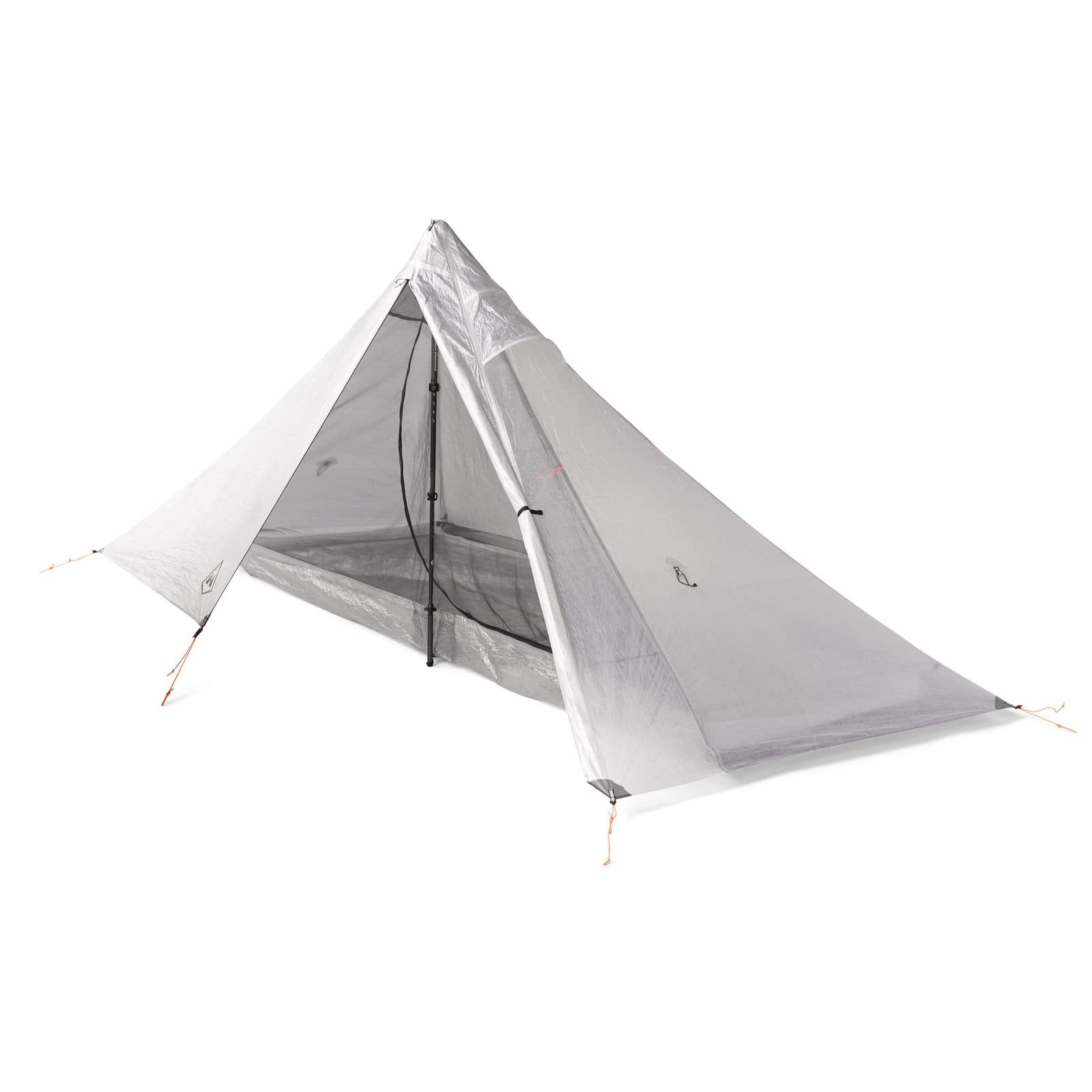
Hyperlite Mountain Gear has earned a reputation as the cottage brand ultralighters recommend to other ultralighters, and the Mid 1 is its solo shelter: a single trekking-pole-supported DCF pyramid built for steep, weather-shedding geometry rather than livability. Where the Zpacks Duplex Pro is engineered around thru-hike comfort for two people, the Mid 1 is engineered around one question — how do you keep a single hiker safe and dry in genuinely rough alpine conditions at the lowest possible weight?
The answer is a steep-walled pyramid built around a single trekking pole, using 0.55 oz/yd² DCF for the shell. At $695, it costs the same as the Tarptent Double Rainbow Li, though the two shelters are aimed at completely different buyers — one prioritizes ventilation and two-door livability, the other prioritizes minimalism and wind resistance for a solo user.
In use
Trail weight is 16.5 oz (468 g) — floor area is 20.5 square feet, peak height is 44 inches, and there's a single door. The interior is, by design, genuinely tight. This isn't a tent where you spread out gear and cook from inside during a rainstorm; it's a tent for sleeping and for waiting out weather until it's safe to move again.
The single-pole pyramid geometry is the whole point. Because the walls are steep and the structure is simple — one pole, minimal panels — the Mid 1 sheds wind in a way that flatter, more complex shelters can't match. HMG owners "regularly report shrugging off 50+ mph gusts that would knock down semi-freestanding tents," which is the kind of performance that matters if your trip plan includes exposed ridgelines, alpine passes, or shoulder-season storms.
The trade-off for that wind performance is ventilation. The steep walls that make the Mid 1 so stable in wind leave less room for the kind of passive airflow paths that a design like the Tarptent Double Rainbow Li's side-entry geometry creates. Condensation management here is worse than in either the X-Mid Pro 2 or the Double Rainbow Li, and that's a real cost for extended trips in humid conditions.
Strengths
Wind performance is the headline and it's not marketing exaggeration — it's the specific, repeated feedback from owners who've used the Mid 1 in real alpine conditions. A single-pole pyramid with a low, steep profile has fundamentally less surface area for wind to catch than a taller or more complex shelter, and HMG's DCF construction holds its shape under load rather than deforming.
Weight is the second strength, and it compounds with the first: at 16.5 oz, the Mid 1 is genuinely one of the lightest credible solo shelters in production, which matters directly for anyone counting grams on a long solo trip.
Durability is the third. HMG's reputation for DCF construction quality is well-earned — The Trek described it as "what experienced ultralighters carry when they've stopped caring about being comfortable inside the tent," which captures the trade-off precisely: this is a tool built for function under stress, not a home base you want to spend a rainy afternoon in.
The trade-offs — who should skip it
Anyone new to trekking-pole shelters should look elsewhere first. The single-pole pitch takes practice, the interior tolerances leave little margin for a sloppy setup, and the tight living space rewards a hiker who already knows how to pack efficiently and doesn't need room to spread out. Gavler's guidance points beginners toward the Six Moon Designs Lunar Solo or the Nemo Hornet Osmo 2P instead — both are explicitly framed as the better entry points before stepping up to something like the Mid 1.
Anyone who wants a livable interior for waiting out multi-day weather should also skip it. The Mid 1's condensation management is its weakest point relative to competitors specifically engineered for airflow, and a cramped 20.5-square-foot floor plan is not where you want to be stuck for 36 hours in a storm.
How it compares
Within the same $695 price point, the Tarptent Double Rainbow Li is the closest comparison on Gavler's list, though the two solve for opposite priorities. The Double Rainbow Li trades some weight (26 oz vs. 16.5 oz) for two doors, better passive ventilation, and a livability profile that works for shoulder-season trips where you might actually spend daylight hours inside. The Mid 1 trades that comfort for a genuinely lighter, more wind-stable solo setup.
For hikers not yet ready for a trekking-pole pyramid at all, the Nemo Hornet Osmo 2P — ranked third on the same list at 9.1 — offers a conventional freestanding pitch and OSMO fabric that dries three times faster than standard nylon, at the cost of roughly 6 oz more weight for a solo user carrying a two-person-rated tent.
The Gavler verdict
The Mid 1 earns its 8.7 by doing one job better than almost anything else in its weight class: surviving real wind while adding as little weight as possible to a solo kit. It is not a compromise pick, and it doesn't try to be — it's a purpose-built tool for the experienced solo ultralighter who has already put in the trekking-pole-pitch learning curve and wants the lightest setup that still holds up when conditions turn. If that's not you yet, this isn't the tent to learn on. If it is you, the Mid 1 is exactly the upgrade Gavler frames it as.
Common Questions
It's worth it specifically for experienced solo ultralight backpackers, not as a general recommendation. It ranks number 5 on Gavler's Best Backpacking Tents list at 8.7, and the verdict is explicit: it's 'bombproof' but 'sleeping-and-waiting-out-weather-only — not a hangout tent.' At $695 for 16.5 oz, you're paying for wind performance and HMG's DCF pedigree, not comfort.
No. Gavler's own guidance is direct on this: 'It's not a starter tent.' The single-pole pyramid pitch requires trekking-pole skill you build up over time, and the interior is tight enough that it rewards experience rather than accommodating beginners. The Six Moon Designs Lunar Solo or Nemo Hornet Osmo 2P are recommended as better entry points.
This is its defining strength. OutdoorGearLab called it 'bombproof in wind that would flatten lighter shelters,' and HMG owners regularly report the single-pole pyramid geometry shrugging off 50+ mph gusts that would collapse semi-freestanding tents.
Where to Buy.
Prices checked regularly
90-day price history
Price History
Steady at $695 for the entire 90-day tracking window — no increases, no discounts, across 91 tracked days.
Tracked daily across retailers. Vote Want itabove and we’ll alert you the moment the price drops.
Some links are affiliate links — Gavler may earn a commission. This never affects rankings or scores. Learn more.
Precision Engineering
16.5 oz Trail Weight
Among the lightest credible solo shelters in production.
Single-Pole Pyramid
Steep wall geometry shrugs off 50+ mph wind that flatters semi-freestanding tents.
HMG DCF Pedigree
Bombproof DCF construction with seam-taped fabric panels — long-term durability that owners cite as the value justification.
Technical Specifications
The Scoreboard
HMG owners cite long-term durability as the reason they paid $695 for a 16.5 oz tent. Editorial coverage is bounded by the tight interior.
Cast Your Vote
Do you think Hyperlite Mountain Gear Mid 1 deserves the #5 spot in Best Backpacking Tents?
Global Critique
“Bombproof in wind that would flatten lighter shelters.”
“What experienced ultralighters carry when they've stopped caring about being comfortable inside the tent.”
More from Best Backpacking Tents.
See how other top picks compare in this category.