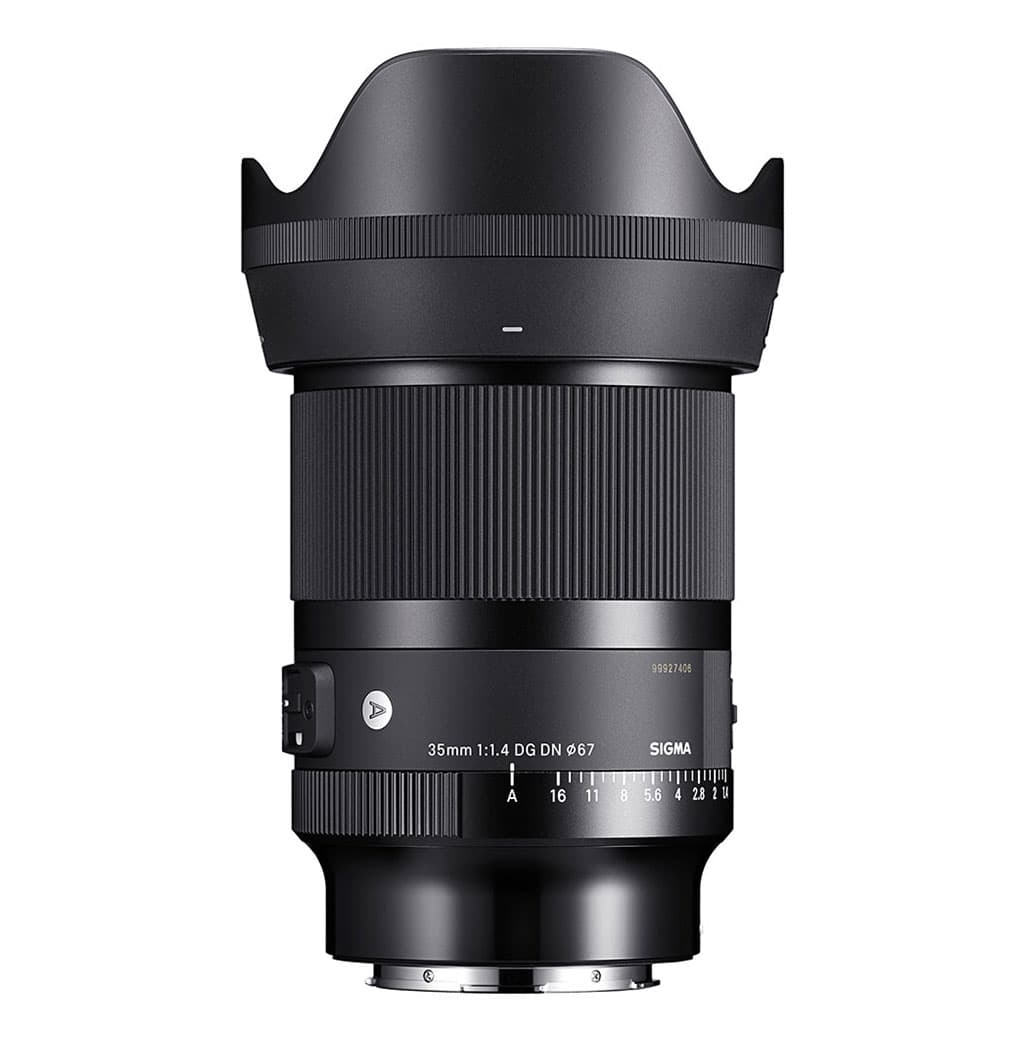
Sigma 35mm f/1.4 DG DN Art.
Sigma's mirrorless redesign of an Art classic. Lighter, faster-focusing, and weather-sealed — the value-conscious 35mm pro lens.
The Verdict.
Gavler Meta-Score
“The DG DN Art is the best value in fast 35mm primes. It delivers optical quality that stands within arm's reach of Sony and Canon's first-party flagships at nearly half the price. Weather sealing, fast AF, and a proven optical pedigree make it the 35mm that belongs in every photographer's bag.”
The Gavler Verdict
The Gavler Review.
Sigma 35mm f/1.4 DG DN Art Review: The Value Case Against First-Party 35mms
The Sigma 35mm f/1.4 DG DN Art ranks number 5 on Gavler's Best Camera Lenses list with a 9.1, and it exists to answer one question: how much do you actually need to pay for a genuinely excellent 35mm prime? DPReview's field testing found it "sharp at f/1.4 and impressively so stopped down," and at $899 — roughly 60% of what Sony and Canon charge for their own flagship 35mm f/1.4 lenses — the value case against first-party glass is, in DPReview's words, "hard to argue with."
What it is
Sigma's original 35mm f/1.4 Art, released in 2012, is widely credited with starting the "Art lens revolution" — proof that a third-party manufacturer could build optics that beat first-party lenses on quality while undercutting them dramatically on price. The DG DN version reviewed here is a ground-up redesign for mirrorless mounts, not a simple rehousing of the DSLR original. Sigma used the shorter flange distance of mirrorless bodies to improve corner sharpness at f/1.4, tighten control of sagittal coma for astrophotography, and smooth out an already well-regarded bokeh signature. It's also lighter than the original DSLR version (645g versus 665g), smaller, and — for the first time in this lens's history — fully weather-sealed.
At 17 elements with a stepping-motor autofocus system optimized for hybrid contrast/phase-detect mirrorless AF, the lens is built to be a working tool rather than a specialty optic, and it's available across both Sony E and Leica L mounts.
In use
The consensus across independent testers is unusually consistent for a lens at this price. ePHOTOzine's lab and field testing found "excellent results in most criteria — very low chromatic aberration and distortion, nice bokeh, and build quality comparable to the best professional OEM lenses." OpticalLimits reached a similar conclusion, calling it "another winner" for Sigma and noting it's "even affordable relative to its performance" — a pointed way of saying the optical quality alone would justify a higher price than Sigma actually charges.
DPReview's field review zeroed in on the sharpness specifically: "sharp at f/1.4 and impressively so stopped down; the value case against first-party 35mm primes is hard to argue with." That combination — usable wide-open sharpness plus continued improvement stopped down, with well-controlled coma for night shooting — is exactly what buyers expect from a modern Art-series lens, and by all independent accounts, Sigma delivered it.
Strengths
- Optical performance that competes with lenses costing far more. Multiple independent testers rate it close to first-party flagship glass, with only the extreme corners showing a measurable gap.
- Full weather sealing for the first time in this lens's history. The brass bayonet mount and dust/moisture sealing bring genuine professional durability to a third-party price point.
- Fast, quiet stepping-motor autofocus. Built specifically for modern hybrid AF systems, it removes what used to be the classic third-party lens weakness — sluggish or hunting autofocus.
- Multi-mount availability. Sony E and Leica L coverage makes it accessible to a broader range of shooters than a single-mount first-party lens.
The trade-offs — who should skip it
There's no dramatic flaw here — the honest limitations are about where this lens sits relative to its first-party rivals, not standalone defects:
- First-party lenses still win in the extreme corners. Sony's FE 35mm f/1.4 GM and Canon's RF 35mm f/1.4L VCM are both marginally sharper at the far edges of the frame, which matters for architecture and landscape work shot wide-open at close range, but rarely for portraiture or documentary use.
- No in-body stabilization support beyond the camera's own IBIS. As with virtually all wide-angle primes, this isn't a major limitation at 35mm, but it's worth noting for video shooters used to lens-based stabilization on longer glass.
- 645 grams is respectable but not minimal. Photographers prioritizing an absolute minimum-weight kit may still prefer a smaller, slower 35mm option.
- Canon RF and Nikon Z mount availability is absent. This lens currently serves Sony E and Leica L shooters only — Canon and Nikon users need to look at first-party or other third-party options.
How it compares
On the same list, the Sony FE 24-70mm f/2.8 GM II sits at rank 1, earning near-unanimous acclaim as one of the best standard zooms ever tested — a fundamentally different proposition for photographers who want one lens covering the 35mm focal length among many others, rather than a dedicated prime. The Canon RF 50mm f/1.2L USM at rank 2 shows what the opposite end of the price spectrum buys: Canon's own flagship-tier rendering at f/1.2, for photographers for whom optical character matters more than value.
Against both, the Sigma's pitch is specific and compelling: it's the lens for photographers who want genuinely excellent 35mm optics without paying flagship prices, on a mount where Sigma has full first-party-equivalent AF integration.
The Gavler verdict
A 9.1 for a lens that does exactly what Sigma's Art series has always promised: professional-grade optics at a price no first-party manufacturer can match. DPReview's framing is the fairest summary — sharp wide open, sharper stopped down, and a value case against Sony's and Canon's own 35mm primes that's genuinely hard to argue with. The extreme corners and mount limitations are the only real asterisks. For photojournalists, street photographers, and documentary shooters on Sony E or Leica L who need a fast, sharp, weather-sealed 35mm without breaking their budget, this remains the obvious recommendation.
Common Questions
For photojournalists, street, and documentary shooters on Sony E or Leica L mounts, yes. DPReview called it 'sharp at f/1.4 and impressively so stopped down,' and Gavler's scoring notes it delivers '90-95% of the quality' of Sony's and Canon's first-party 35mm primes at roughly 60% of the price.
The Sony is marginally sharper in the extreme corners and costs $1,398 versus the Sigma's $899. ePHOTOzine's testing found the Sigma delivered 'excellent results in most criteria — very low chromatic aberration and distortion, nice bokeh, and build quality comparable to the best professional OEM lenses' — a small optical gap for a large price gap.
Yes. The stepping-motor AF system is built specifically for hybrid phase/contrast-detect mirrorless systems, and reviewers across OpticalLimits, ePHOTOzine, and DPReview reported no autofocus complaints — the discussion around this lens centers entirely on optics and value, not speed.
Where to Buy.
Prices checked regularly
90-day price history
Price History
Steady at $899 for the entire 90-day tracking window — no increases, no discounts, across 91 tracked days.
Tracked daily across retailers. Vote Want itabove and we’ll alert you the moment the price drops.
Some links are affiliate links — Gavler may earn a commission. This never affects rankings or scores. Learn more.
Precision Engineering
Art-Series Optics
Clean-sheet mirrorless design with exceptional sharpness at f/1.4 and well-controlled sagittal coma for astrophotography.
Weather-Sealed Construction
Full dust and moisture sealing with a brass bayonet mount — professional reliability at a third-party price.
Stepping Motor AF
Silent, fast autofocus optimized for hybrid phase/contrast-detect AF systems on modern mirrorless bodies.
Technical Specifications
The Scoreboard
Community scores are particularly high due to the exceptional price-to-performance ratio. Experts note that while first-party 35mm primes from Sony and Canon offer marginally better corner performance, the Sigma delivers 90-95% of the quality at a significantly lower price.
Cast Your Vote
Do you think Sigma 35mm f/1.4 DG DN Art deserves the #5 spot in Best Camera Lenses?
Global Critique
“Sigma has another winner here, and it is even affordable relative to its performance.”
“Excellent results in most criteria — very low chromatic aberration and distortion, nice bokeh, and build quality comparable to the best professional OEM lenses.”
“Sharp at f/1.4 and impressively so stopped down; the value case against first-party 35mm primes is hard to argue with.”
More from Best Camera Lenses.
See how other top picks compare in this category.