GIGABYTE MO27U2.
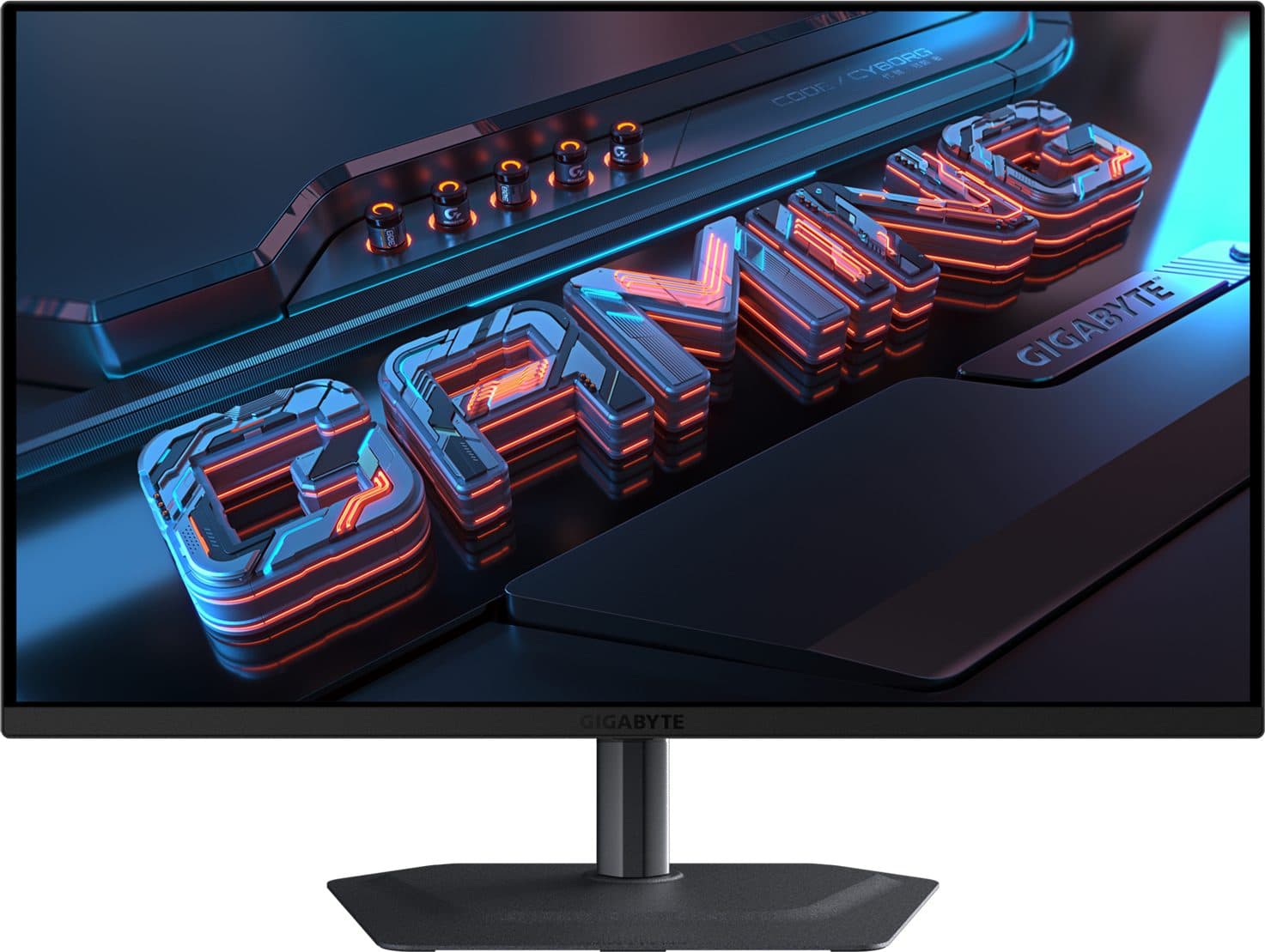
GIGABYTE MO27U2 — 27" 4K @ 240Hz QD-OLED with USB-C KVM, HDMI 2.1, 0.03ms response and a 3-year burn-in warranty. The sub-$700 4K OLED value benchmark.
The Verdict.
Gavler Meta-Score
“The cheapest route to a 27" 4K 240Hz QD-OLED. It compromises on brightness and stand, not on the panel — the sub-$700 value benchmark for the 4K OLED category.”
The Gavler Verdict
The Gavler Review.
GIGABYTE MO27U2 Review: The Cheapest Door Into 4K OLED Gaming
The GIGABYTE MO27U2 has one job: get a real 4K 240Hz QD-OLED panel in front of the largest number of buyers possible, at the lowest price anyone's managed yet. It does that job — at $649, it's the cheapest way onto a panel class that otherwise starts around $899. It sits at rank 9 on our Best Gaming Monitors list with an 8.5, a strong score for a monitor that TechRadar's own hands-on testing found genuinely good but not fully polished.
What it is
The MO27U2 runs a 27-inch tandem QD-OLED panel at 3840x2160 (166 PPI) and 240Hz with a 0.03ms response time — the same core resolution, refresh rate, and response as pricier 27-inch 4K OLED rivals on this list. TechRadar's Nick Ross described the panel technology directly: "It's a tandem QD-OLED screen with a multi-layer OLED structure that boosts brightness and efficiency, while Gigabyte's OLED Care features help reduce burn-in risk." GIGABYTE rounds out the package with a USB-C KVM switch (useful for anyone running two machines off one monitor), 2x HDMI 2.1, DisplayPort 1.4, and a three-year warranty. Newegg and B&H Photo both currently list it at $649.99, discounted from a $999.99 list price — confirmed live at both retailers as of this review.
In use
TechRadar's full review is the most useful independent source available on this specific monitor, and it lands on a genuinely mixed but fair verdict. On the positives: "It gets bright (1,000-nit peak HDR brightness), with rich and vibrant colors, very good contrast and very nearly true blacks." Ross's overall summary captures the trade-off precisely: "Gigabyte's MO27U2 has plenty going for it, with a fast, colorful UHD QD-OLED panel, useful gaming features and a sober design that works well for both work and play. However, it's expensive and its mediocre HDR performance, awkward settings and barely functional companion app make it frustrating to live with. It's good, but at this price it needs to be better."
That's an important quote for buyers to sit with, because it's a real, hands-on criticism, not a nitpick — TechRadar's assessment is specifically that the panel and gaming features are strong, but the surrounding software experience (the on-screen settings menu and the companion desktop app) is genuinely frustrating in daily use. Ross's headline framing puts it bluntly: this is a monitor that "looks like a dream, but living with it was more complicated." The technology itself isn't the problem — it's the implementation around it.
Strengths
Price is the unambiguous headline strength: $649 for a 4K 240Hz QD-OLED panel undercuts every other monitor in this class on our list, including the value-tier Dell Alienware AW2725Q by $250. The panel itself performs well on the metrics that matter for gaming — TechRadar specifically praised motion clarity, color vibrancy, and contrast, confirming that the budget positioning didn't come at the cost of the core visual experience. The USB-C KVM is a genuinely useful, not-always-included feature at this price point, letting one monitor serve two machines cleanly. And the three-year warranty puts a real backstop under the OLED burn-in question, matching the coverage level of pricier rivals.
The trade-offs — who should skip it
The software experience is the real weakness, and it's worth taking seriously rather than dismissing as a minor annoyance — TechRadar's testers specifically called the settings menu awkward and the companion app "barely functional," which affects daily usability in a way spec sheets don't capture. HDR performance is the second honest limit: TechRadar rated it "mediocre" relative to the panel's own potential and to pricier rivals, despite the 1,000-nit peak spec looking competitive on paper. And it lacks Dolby Vision, a feature the pricier Dell Alienware AW2725Q includes — a real, if secondary, gap for HDR content that supports it.
Buyers who do most of their time in fast-paced gaming, where TechRadar found genuine strengths, will likely be happy. Buyers who spend more time adjusting settings, using HDR content critically, or relying on the companion software for day-to-day monitor management should weigh TechRadar's frustration seriously before buying at this price.
How it compares
One step up in price, the Dell Alienware AW2725Q costs $250 more but adds Dolby Vision and — based on independent reviews — a more refined, less frustrating software experience alongside the same core panel class; TechSpot's own head-to-head assessment of that monitor concluded the extra spend over a budget rival is "absolutely worth it" for most buyers weighing this exact trade-off. Further up, the ASUS ROG Swift PG27UCDM sits at the true flagship tier with DisplayPort 2.1 and the fullest feature set on this list, for buyers who want the ceiling rather than the floor of 4K OLED gaming.
The Gavler verdict
An 8.5, backed by an 84 expert consensus and an 80 community score — a real gap that reflects the genuine mixed-bag nature of this monitor: strong panel, weak software polish. Buy it if price is your top priority and you're comfortable working around a rough settings menu and companion app to get real 4K 240Hz QD-OLED gaming performance. Spend the extra $250 on the Alienware AW2725Q instead if a more refined day-to-day experience and Dolby Vision are worth the premium to you.
Common Questions
If budget is the top priority, yes. At $649 it's the cheapest 27-inch 4K 240Hz QD-OLED on the market, and TechRadar's testing found 'excellent motion clarity and vibrant color.' The trade-offs are real, though — TechRadar's own verdict was that it 'can't quite live up to its price tag' against the very best implementations of the same panel technology.
Confirmed at $649.99 at both Newegg and B&H Photo as of this review, discounted from a $999.99 list price. That makes it the budget entry point into the 27-inch 4K 240Hz QD-OLED category, undercutting rivals like the Dell Alienware AW2725Q by $250.
TechRadar describes it as 'a tandem QD-OLED screen with a multi-layer OLED structure that boosts brightness and efficiency,' combined with GIGABYTE's own OLED Care anti-burn-in system. It's a genuine, current-generation panel technology — TechRadar's caveat was that the MO27U2 isn't the best implementation of it, not that the technology itself is lacking.
Buy the MO27U2 if price is the deciding factor and you can tolerate a less polished companion app and settings menu. Buy the AW2725Q if you can stretch the extra $250 for Dolby Vision, a more refined software experience, and Dell's more established support and warranty handling.
Where to Buy.
Prices checked regularly
90-day price history
Price History
Steady at $649 for the entire 90-day tracking window — no increases, no discounts, across 45 tracked days.
Tracked daily across retailers. Vote Want itabove and we’ll alert you the moment the price drops.
Some links are affiliate links — Gavler may earn a commission. This never affects rankings or scores. Learn more.
Precision Engineering
27" 4K QD-OLED
A 27" QD-OLED panel delivers 3840x2160 at 166 PPI with per-pixel OLED contrast and 99% DCI-P3 coverage — flagship-class sharpness at a value price.
240Hz, 0.03ms
The 240Hz refresh and 0.03ms grey-to-grey response keep fast motion clear, matching the pricier 4K OLEDs on speed.
USB-C KVM + 3-Year Warranty
A USB-C KVM switches peripherals between two machines, and GIGABYTE's anti-burn-in system is backed by a 3-year warranty.
Technical Specifications
The Scoreboard
Reviewers (TFTCentral, TechRadar) rate it a strong-value 4K 240Hz QD-OLED with a useful USB-C KVM and burn-in warranty; the common caveats are ~250-nit SDR brightness, a basic stand, and a tandem-panel implementation that trails the very best.
Cast Your Vote
Do you think GIGABYTE MO27U2 deserves the #9 spot in Best Gaming Monitors?
Global Critique
“A fast tandem QD-OLED display that can't quite live up to its price tag.”
“27" 4K 240Hz QD-OLED panel with a range of new gaming features.”
More from Best Gaming Monitors.
See how other top picks compare in this category.
TCL Is Coming for OLED Monitors — and the Prices Should Follow
TCL just unveiled its 32X3B and 27X3B OLED monitors and is building a fab to crack the panel duopoly. Here's what it means for OLED monitor prices.
4K OLED Gaming Just Crossed Under $650. The Cheapest One Ranks #9 for a Reason.
The Gigabyte MO27U2 is a 27-inch 4K 240Hz QD-OLED for $649 — a panel class that debuted above $1,300. A real price-floor moment, with trade-offs to match.
27-Inch vs 32-Inch 4K OLED: The ASUS PG27UCDM Is the Better Monitor, and the MSI 321URX Just Made That Stop Mattering
Two 4K 240Hz QD-OLED gaming monitors, same resolution, very different sizes — and a price gap that blew open in 2026. Here's which one to buy.
The Best Gaming Monitors in 2026: Pick the Tier, Not the Spec Sheet
ASUS ROG, MSI, Alienware, Samsung, LG. Gavler ranks the best gaming monitors of 2026 — 4K OLED, 1440p OLED, ultrawide, and budget picks, by tier.