Shibumi Shade.
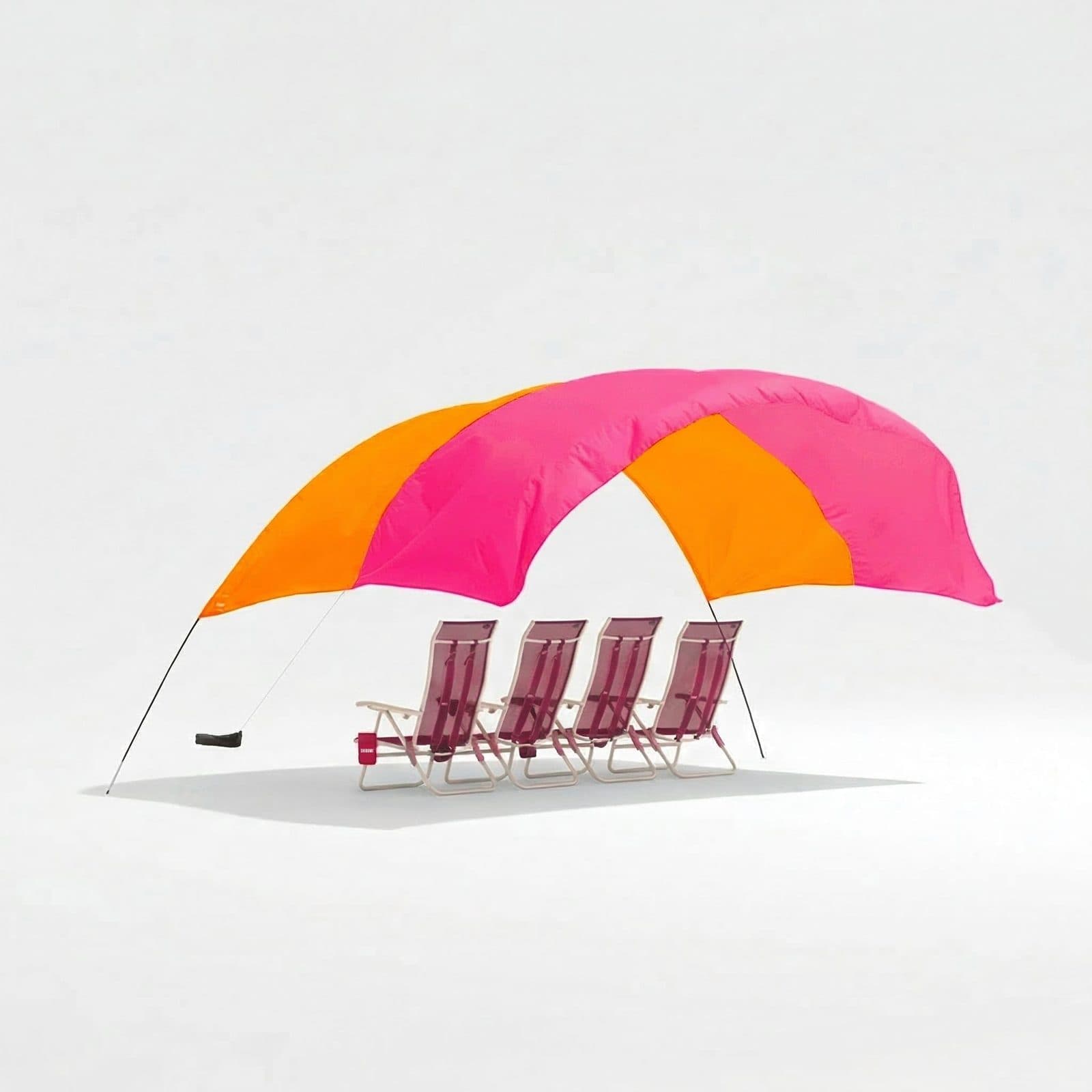
A single-pole canopy that catches the breeze to billow into the largest shaded footprint of anything tested, and gets more stable as wind picks up rather than less.
The Verdict.
Gavler Meta-Score
“The shade-coverage benchmark. On any beach with a steady breeze, nothing here throws a bigger, more stable patch of shade — and it gets steadier as the wind builds. Needs wind to shine; not the pick for dead-calm conditions.”
The Gavler Verdict
The Gavler Review.
Shibumi Shade Review: The Beach Canopy That Gets Stronger in the Wind
The Shibumi Shade sits at number one on our Best Beach Umbrellas list with a 9.4, and it earns that ranking by solving beach shade with a genuinely different idea: instead of building a rigid structure to resist the wind, it uses the wind to do the work. Buy it if you're headed to a beach with a reliable onshore breeze and want the biggest, most stable shaded footprint you can get for a group. If you need stability specifically on dead-calm days, or you're worried about wind uprooting a traditional umbrella, the beachBUB All-In-One is the honest alternative built for exactly that scenario. For most coastal beach trips, the Shibumi Shade is the standout.
What it actually is
The Shibumi Shade reinvents beach shade around a single mechanical insight: a lightweight, breathable canopy threads over a single arching pole and is held aloft by the breeze itself, billowing into a large, low-profile shaded footprint rather than standing rigid against the wind. Because there's no umbrella-style canopy acting as a sail, it doesn't fight gusts the way a traditional umbrella does — it uses them, and gets more stable, not less, as the wind builds.
The canopy is made from UPF 50+ fabric with roughly 40% ocean-bound recycled plastic, covering approximately 150 square feet — enough shaded area for four to six people, well beyond what a standard beach umbrella provides. At just 4 pounds, it packs into a compact carry bag and, per multiple reviewers, sets up in about three minutes for one person. Priced at $250, it's positioned as a premium shade solution, and the engineering behind the wind-powered design is what justifies that price over a basic umbrella.
In use
The core claim — that it gets more stable as wind increases — is the thing worth verifying independently, and multiple sources back it up. Yahoo Lifestyle summarized the underlying design philosophy well: "A wind-powered shade that's light, easy to set up, and won't fly away in the wind — operating on the principle of floating with the breeze rather than battling against it." That's the exact opposite failure mode of a spike umbrella, which becomes more dangerous, not less, as wind speed climbs.
Real-world durability claims support that engineering thesis. The Best Beach Gear reported: "Customers have reported that the Shibumi Shade stays put even in 15 mph breezes, offering stable and secure shelter." Fifteen miles per hour is a meaningfully strong coastal breeze — the kind of wind that regularly sends unanchored umbrellas cartwheeling down the sand — and the Shibumi's design turns that same wind into the force holding it in place.
Setup speed is the other practical detail that matters on a real beach day with kids, coolers, and gear to unload. Combing The Coast's assessment was direct: "At only 4 pounds, with the portable carrying bag the setup is simple — about three minutes from bag to shade." Three minutes from parking on the sand to full shade is meaningfully faster than digging a spike umbrella into loose sand deep enough to trust it, let alone filling a ballast base.
Where it shines
- The largest shaded footprint on the list. At roughly 150 square feet, it covers a group of four to six — well beyond what a standard umbrella manages, and the low-profile design doesn't require deep sand penetration to stay stable.
- Gets more stable as wind increases, not less. This is the design's defining advantage and the opposite of how a traditional spike umbrella behaves under the same conditions — real user reports back the 15 mph stability claim.
- Genuinely fast, simple setup. Three minutes for one person, with no sand-filling or ballast to haul, at just 4 pounds packed.
The trade-offs — who should skip it
This is the shade-coverage benchmark on windy beaches, not a universal pick, and the honest reasons to consider something else are specific:
- It needs wind to work. On dead-calm days, the canopy doesn't billow into its full shaded shape the way it does with even a light breeze, and it underperforms a rigid canopy or umbrella in those conditions.
- The shadow moves, it doesn't stay fixed. Because the canopy shape shifts with the breeze, the shaded area isn't static the way a traditional umbrella's shadow is — something worth knowing if you want to set up chairs in one exact spot and leave them.
- It's a premium price for what is, mechanically, a piece of fabric and a pole. At $250, buyers who don't need the largest possible footprint or don't regularly face wind can get adequate shade from a cheaper traditional umbrella.
How it compares
For beachgoers whose top priority is wind resistance specifically on calm-to-gusty transitional days rather than sheer coverage, the beachBUB All-In-One at rank two takes a different approach entirely — a fillable ballast base independently wind-tested to 44 mph, beyond the ASTM standard, that keeps a traditional umbrella planted rather than relying on wind to hold shape. It requires more setup effort and pack bulk in exchange for that stability regardless of wind conditions. For budget-conscious buyers who want basic wind resistance without either premium price tag, the Rio Beach Wind Resistant Tilt Umbrella at rank ten uses an integrated sand-screw anchor at a fraction of the cost, with owner-reported performance in around 17 mph sustained winds.
The Gavler verdict
A 9.4, reflecting a genuinely clever piece of beach gear that solves shade coverage and wind stability with the same mechanical idea rather than treating them as separate problems to engineer around. The Shibumi Shade's 150-square-foot footprint and wind-powered stability make it the standout for groups on any beach with a reliable breeze — which describes most coastal beaches most of the time. The one condition where it doesn't shine is dead calm air, and for buyers in that specific situation, a traditional rigid umbrella remains the better tool.
Common Questions
For groups who want the biggest possible shaded footprint on a beach with a reliable onshore breeze, yes. It ranks first on Gavler's Best Beach Umbrellas list with a 9.4, and its design covers roughly 150 square feet — enough shade for four to six people — using the wind itself rather than fighting it. The catch is it needs at least a light, consistent breeze to work; on dead-calm days, a rigid canopy or umbrella performs better.
Yes, and that's the core engineering insight behind the design. Because there's no rigid umbrella canopy acting as a sail, the Shibumi Shade billows and tensions further as wind increases, rather than catching wind and flipping or uprooting the way a spike umbrella can. The Best Beach Gear notes customers report it staying put even in 15 mph breezes.
About three minutes for one person, according to Combing The Coast's testing: 'At only 4 pounds, with the portable carrying bag the setup is simple — about three minutes from bag to shade.' That's meaningfully faster than a ballast-base umbrella like the beachBUB, which requires hauling and filling a sand base on site.
It's the one scenario where the Shibumi Shade underperforms relative to a traditional rigid canopy or umbrella. Because the entire design depends on wind billowing the fabric into its shaded shape, dead-calm conditions leave it flatter and less effective. If you're beaching somewhere with consistently still air, a standard umbrella or pop-up canopy is the more reliable choice.
Where to Buy.
Prices checked regularly
90-day price history
Price History
Steady at $250 for the entire 90-day tracking window — no increases, no discounts, across 91 tracked days.
Tracked daily across retailers. Vote Want itabove and we’ll alert you the moment the price drops.
Some links are affiliate links — Gavler may earn a commission. This never affects rankings or scores. Learn more.
Precision Engineering
Wind-Powered Canopy
Engineered to harness breezes as light as 3 mph — the canopy billows into a large, low-profile shaded footprint and grows more stable as wind builds.
4 lb, ~3-Min Setup
Packs to a compact carry bag; one person assembles it in roughly three minutes — far easier than a ballast-base umbrella.
UPF 50+ Recycled Fabric
UPF 50+ canopy made from approximately 40% ocean-bound recycled plastic, covering ~150 sq ft of shade for four to six people.
Technical Specifications
The Scoreboard
Widely cited across beach-gear roundups for shade coverage and wind behavior. Common note: requires a steady breeze to perform; casts a moving rather than fixed shadow.
Cast Your Vote
Do you think Shibumi Shade deserves the #1 spot in Best Beach Umbrellas?
Global Critique
“A wind-powered shade that's light, easy to set up, and won't fly away in the wind — operating on the principle of floating with the breeze rather than battling against it.”
“Customers have reported that the Shibumi Shade stays put even in 15 mph breezes, offering stable and secure shelter.”
“At only 4 pounds, with the portable carrying bag the setup is simple — about three minutes from bag to shade.”
More from Best Beach Umbrellas.
See how other top picks compare in this category.
Beach Umbrellas Finally Have a Wind Safety Standard. Almost Nobody Is Following It.
A windblown beach umbrella is a real injury hazard — and there's now an ASTM standard for which ones stay planted in a gust. Most on Amazon still ignore it.
The Best Beach Umbrellas in 2026, Ranked by the People Who Have Chased One Down the Sand
Wind-tested ballast bases, billowing canopies, and stake-out shades — the beach umbrellas worth packing for the 2026 summer, ranked by the community.