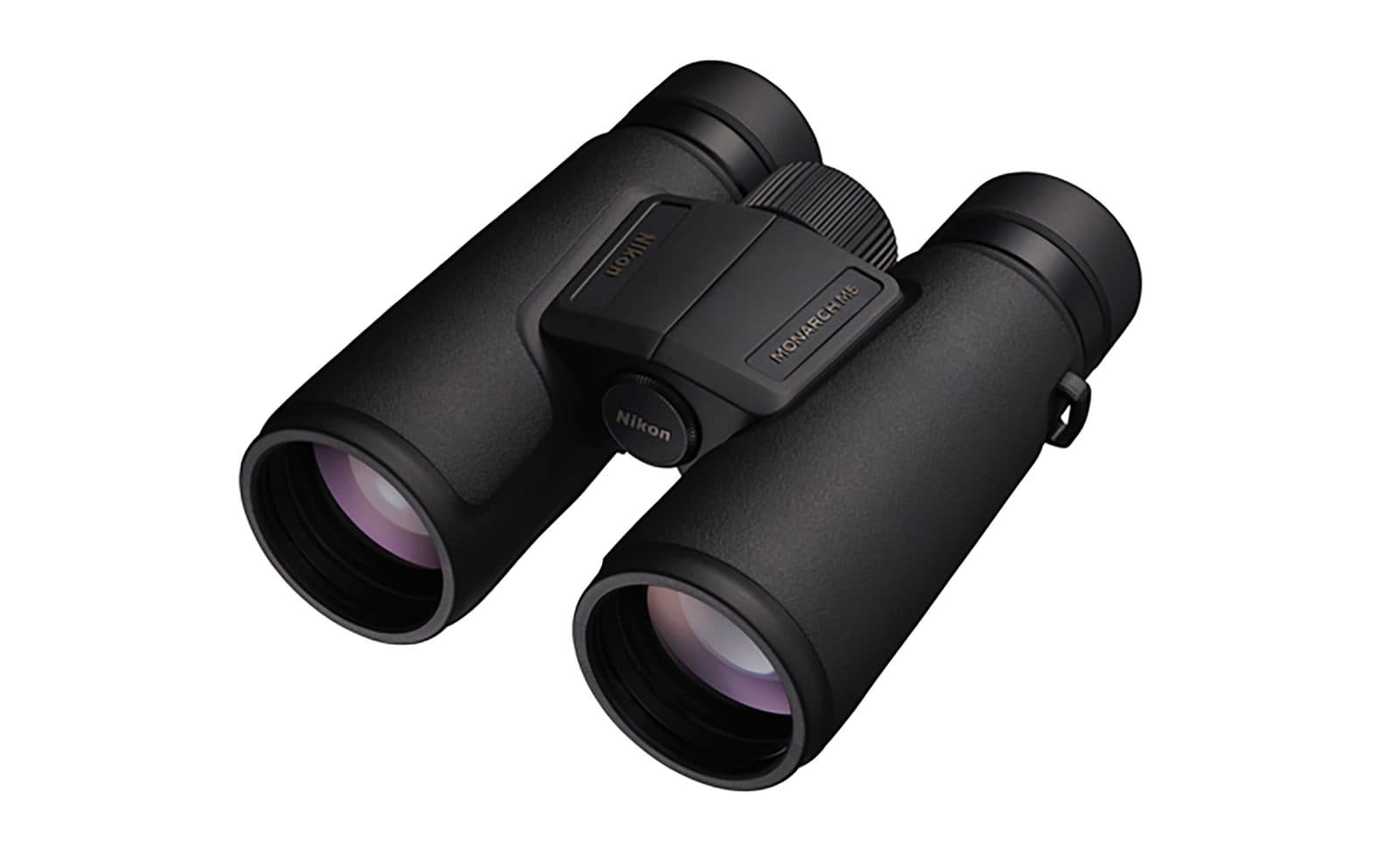
Nikon Monarch M5 8x42.
Genuine ED glass and forgiving ergonomics for around $270 — the value benchmark under $300, though its field of view runs narrow.
The Verdict.
Gavler Meta-Score
“The one to beat under $300: genuine ED glass and high-end brightness at a price that undercuts almost everything comparable. Just know the trade — a narrow ~336-foot field that can feel like tunnel vision when you're chasing fast birds.”
The Gavler Verdict
The Gavler Review.
Nikon Monarch M5 8x42 Review: Real ED Glass at a Price That No Longer Says $270
The Monarch M5 8x42 exists to answer one question: how much real optical quality can Nikon deliver before the price catches up to the alpha-tier brands? For years, the answer was "more than you'd expect" — genuine ED glass that tames color fringing, brightness that OutdoorGearLab found belies its price bracket, and a comfortable rubber-armored grip that makes it an easy recommendation for a first serious pair of binoculars. It sits at rank 8 on our Best Binoculars list with an 8.5. The catch worth knowing up front, on both counts that matter: the field of view runs distinctly narrow, and the price has climbed well past the figure still floating around in some buying guides.
What it is
Nikon built the Monarch M5 to bring genuine extra-low-dispersion (ED) glass — the kind of optical element that controls chromatic aberration and typically appears only in pricier binoculars — down into a value bracket. OutdoorGearLab's review is direct about the result: "The Nikon Monarch M5 8x42 performs very admirably for its price range. These binoculars manage to provide high-end optical quality and impressive brightness while shielding themselves from the astronomical prices typical of a high-end set of optics." That's the core pitch, verified independently rather than taken from Nikon's own marketing copy.
Ergonomics back up the value case. A textured rubber-armored coating makes the M5 comfortable to hold through long observation sessions — OutdoorGearLab specifically credits this as part of why the M5 works well as a new birder's first serious pair. Close focus is a genuine surprise too: testing measured a real-world close focus around 6.2 feet, nearly two feet tighter than Nikon's own 8.2-foot claim, useful for butterflies and songbirds at close range (though All About Birds' independent measurement came in closer to Nikon's stated figure — the two outlets don't fully agree, and we're reporting both rather than picking a winner).
In use
The field of view is where the M5's value proposition runs into its real limit, and it's the single most consistent criticism across independent reviews. All About Birds, Cornell Lab's ornithology-focused reviewers, put it without hedging: "The main difference is the M5's substantially narrower field of view, which gives them a sense of tunnel vision and can make it hard to find and follow birds." At roughly 336 feet at 1,000 yards, that's a meaningfully tighter view than most binoculars in this class offer, and it shows up specifically when tracking fast, erratic subjects rather than glassing a fixed landscape.
Fringing is a secondary, smaller knock: faint magenta-and-cyan color fringing appears at the extreme edges of the field, a common trade-off at this price point but worth knowing about if edge-to-edge sharpness matters to your use case. Neither issue undoes the core value proposition — brightness and center-field clarity remain genuinely strong for the price — but both are the reason this sits mid-pack on Gavler's list rather than at the top.
Strengths
Genuine ED glass at a value price is the headline strength, verified independently rather than assumed from spec-sheet language — this isn't a marketing claim, it's what OutdoorGearLab's actual optical testing found. Brightness is the second real strength: reviewers consistently describe image quality that outperforms the price bracket, which matters most in the low-light conditions — dawn and dusk — when serious birders do much of their glassing. The rubber-armored ergonomics genuinely matter for anyone new to binoculars, since a comfortable grip is what keeps a beginner using the optics rather than leaving them in a bag. And the tighter-than-claimed close focus is a real bonus for anyone splitting attention between birds and closer subjects like butterflies or garden wildlife.
The trade-offs — who should skip it
The narrow field of view is the trade-off to weigh most seriously, and it's not a minor nitpick — All About Birds' "tunnel vision" description reflects a real, felt limitation for anyone chasing warblers or other quick, unpredictable flyers through foliage. If your birding is mostly fast-moving songbirds in dense cover, a wider-field binocular will serve you better even at a higher price. Faint edge fringing is a smaller concern, noticeable mainly to buyers who already know to look for it. And the price is the trade-off that's changed most since this binocular first built its reputation: Nikon's own site now lists it at $339.95, and B&H Photo confirms $336.95 — both meaningfully above the roughly $270 figure that still shows up in some buying guides and comparison charts. At $340, the M5 is competing in a different price bracket than its reputation suggests, and it's worth comparing directly against alternatives in that range rather than assuming it's still the budget pick it once was.
How it compares
One rank up this list, the Maven B.1.2 10x42 plays in a genuinely different tier — a direct-to-consumer alpha-class binocular that costs several times the Monarch M5's price, aimed at buyers who've already decided optical performance is worth paying up for. One rank down, the Bushnell Forge 10x42 competes more directly on value, trading the M5's narrower field for a wider 348-foot view and genuinely strong low-light performance, though at a heavier, bulkier build.
Within Nikon's own lineup, the honest comparison is to the step-up Monarch M7: buy the M5 if price is still the deciding factor even at its current $340, and you can live with the tighter field of view; step up to the M7 if a wider view matters more to you than saving the difference.
The Gavler verdict
An 8.5, backed by an 85 expert consensus that sits closely aligned with an 83 community score — reviewers and owners agree on both the real strengths (ED glass, brightness, comfort) and the real limit (field of view) without much daylight between them. Buy it if you want genuine optical quality for a value-bracket binocular and don't mind a tighter field of view — just budget for its current roughly $340 price, not the lower figure some older guides still quote. Skip it if you specifically chase fast-moving birds through cover, where the narrower view will cost you more sightings than the savings are worth.
Common Questions
Yes, for a new or budget-conscious birder. It sits at rank 8 on Gavler's Best Binoculars list with an 8.5, and OutdoorGearLab's review found it delivers 'high-end optical quality and impressive brightness while shielding themselves from the astronomical prices typical of a high-end set of optics.' The one real caveat is a narrow field of view that some reviewers describe as tunnel vision.
More than you might expect from older listings. Nikon's own site currently prices it at $339.95, and B&H Photo lists it at $336.95 — both well above the $270 figure that circulates in some older buying guides. Budget close to $340 rather than $270 when comparison shopping.
For fast-moving subjects, yes, according to two independent reviewers. All About Birds/Cornell Lab put it plainly: 'The main difference is the M5's substantially narrower field of view, which gives them a sense of tunnel vision and can make it hard to find and follow birds.' At roughly 336 feet at 1,000 yards, it's noticeably tighter than most binoculars in its class — a real trade-off for anyone chasing warblers or other quick, erratic flyers.
Buy the M5 if price is the priority and you can live with a tighter field of view; buy the M7 if you want a wider view and don't mind paying more for it. The M5's whole case is optical quality that punches above its price bracket, not being the widest-viewing option in Nikon's own lineup.
Where to Buy.
Prices checked regularly
90-day price history
Price History
Steady at $270 for the entire 90-day tracking window — no increases, no discounts, across 91 tracked days.
Tracked daily across retailers. Vote Want itabove and we’ll alert you the moment the price drops.
Some links are affiliate links — Gavler may earn a commission. This never affects rankings or scores. Learn more.
Precision Engineering
High-End Brightness Under $300
OutdoorGearLab found it delivers high-end optical quality and impressive brightness while dodging alpha-tier prices — genuine ED glass tames color fringing.
Comfortable Rubber-Armored Grip
A textured rubber coating makes it easy to hold for long sessions — a big part of why reviewers hand it to new birders.
6.2 ft Measured Close Focus
Tested nearly two feet closer than Nikon's 8.2 ft spec — useful for butterflies and nearby songbirds.
Technical Specifications
The Scoreboard
Expert (85) and community (83) scores align. Sourced across two independent outlets (OutdoorGearLab, Cornell Lab/All About Birds); note the 8x42's field is ~336 ft (not 410 ft), and testers measured close focus ~6.2 ft against Nikon's 8.2 ft claim.
Cast Your Vote
Do you think Nikon Monarch M5 8x42 deserves the #8 spot in Best Binoculars?
Global Critique
“The Nikon Monarch M5 8x42 performs very admirably for its price range. These binoculars manage to provide high-end optical quality and impressive brightness while shielding themselves from the astronomical prices typical of a high-end set of optics.”
“The Nikon Monarch M5 8x42 binoculars feel very comfortable in hand, which mostly boils down to a rubber coating that improves texture and ergonomics.”
“The main difference is the M5's substantially narrower field of view, which gives them a sense of tunnel vision and can make it hard to find and follow birds.”
“Our tests measured the close focus range of the Monarch M5 8x42 at 6.2 feet, which is an impressive 2 feet closer than the manufacturer-stated 8.2 feet.”
More from Best Binoculars.
See how other top picks compare in this category.
Before You Buy Binoculars: 8x42 vs 10x42
10x hangtags are the wrong first question. 8x42 field vs 10x42 glass vs lightweight carry is the useful split. Shop the ranking.
The Best Binoculars in 2026, Ranked by People Who Actually Glass With Them
Swarovski, Zeiss, Vortex, Nikon. Gavler's birders and hunters rank the binoculars worth carrying — by glass, not brand mythology.