Why Baristas Love the LELIT Bianca (And You Will Too)
Seattle Coffee Gear
E61 group head with integrated flow control paddle for real-time pressure profiling.
Gavler Meta-Score
“The Bianca earns its price with a flow-control paddle that genuinely works — real pressure profiling at a price well below the machines that usually offer it, per Seattle Coffee Gear. It is the wrong first machine, though: the controls overwhelm newcomers, and testers found the factory temperature runs cold enough that you should buy from a dealer who calibrates it. For an enthusiast ready to profile shots, little else at the price offers this much control and build.”
The Gavler Verdict
Lelit Bianca V3 Review: Flow-Control Espresso Below GS3 Money
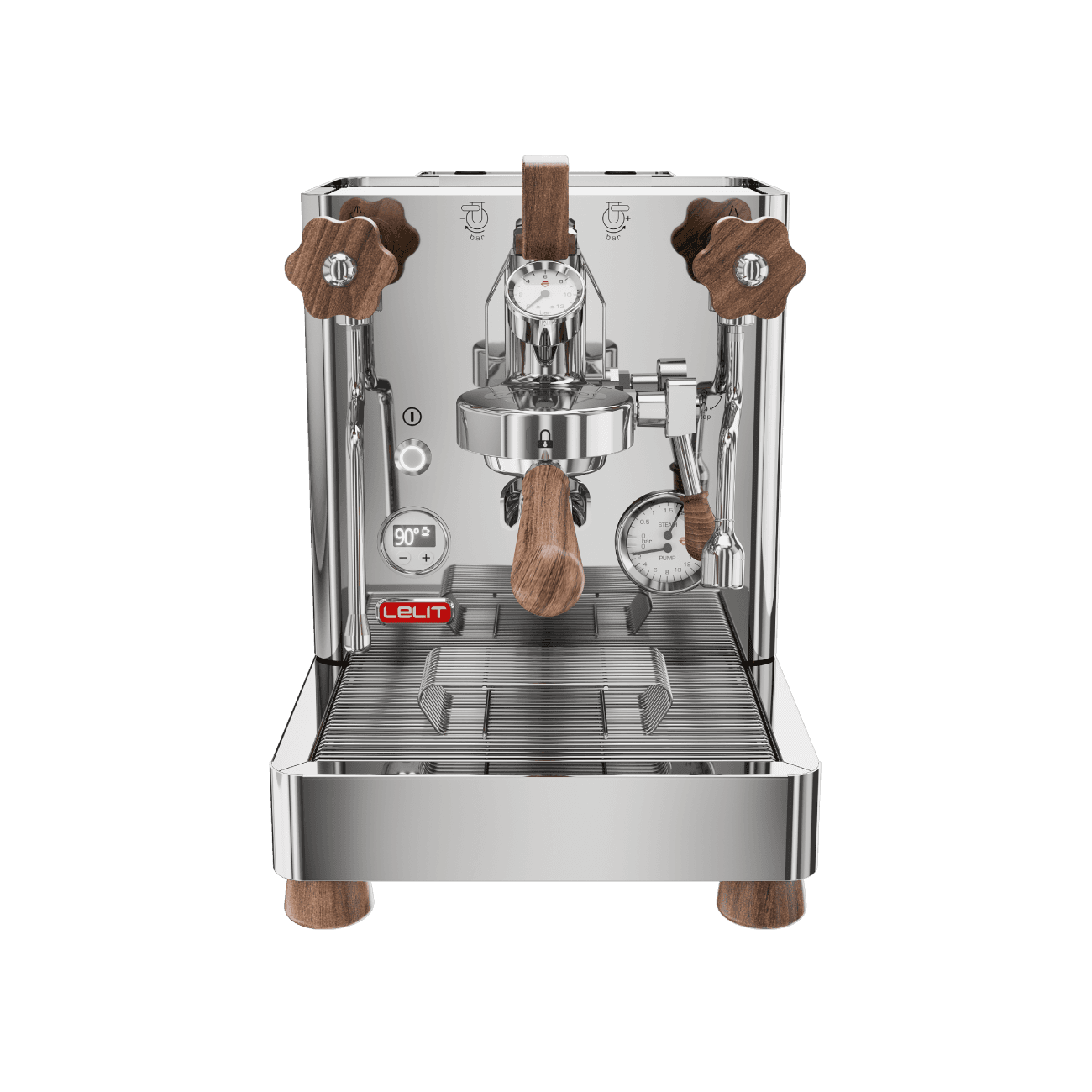
The Lelit Bianca V3 sits at rank six on our Best Espresso Machines list with an 8.4. It is the machine home baristas graduate to once a basic prosumer machine stops being enough: an E61 group topped with a walnut flow-control paddle that lets you raise and lower water flow by hand mid-shot, reading pressure off a group-mounted gauge, so you can profile an extraction the way machines costing thousands more do. CoffeeGeek's Mark Prince, mid-way through his own testing, put it bluntly — "pretty much everything the La Marzocco GS3 paddle group machine can do, the Bianca can do in a package costing almost 2/3rds less." That is the pitch, and on the evidence, it holds up. The catch is that this is a machine for someone who already knows what they're profiling for, and testers have flagged a factory temperature calibration that runs cold enough to need attention before you get there.
The Bianca V3 pairs a 0.8-liter brass brew boiler with a 1.5-liter steam boiler fed by a quiet rotary pump, and Clive Coffee's Charles Kelso notes the steam boiler carries a 1,400W heating element on par with rival high-end dual boilers — enough to steam milk for larger lattes without running out of steam mid-pitcher. It can run from its removable, repositionable reservoir (a genuinely clever touch for tight counters, since the tank can sit behind or to either side) or be plumbed in directly; it ships with the fittings either way. The signature feature is the paddle: three independent pressure-modification systems, per Prince's count — two programmed automatic pre-infusion modes and one fully manual channel you drive by hand through the shot. Clive Coffee's staff, using it day to day, described one common technique directly: "Starting with a slow flow, allowing the pressure to build to about 3 bar for a few seconds, and then slowly ramping up to 9 bar to finish the shot." The V3 revision adds a brew-temperature offset in the Lelit Control Center menu — several degrees adjustable up or down — plus a faster warm-up than the V2 it replaces. Weight runs about 58 to 58.5 lbs, with a roughly 2.5-liter reservoir, and MSRP is $2,999.
Seattle Coffee Gear's dealer-floor experience is the source of the Bianca's headline caution: the control surface can overwhelm someone still learning to pull a shot, and the Lelit Control Center's menus are dense on a small screen. Brew Coffee Home's Chris Clark, who bought the machine rather than borrowing a review unit, corroborates that from an owner's chair: "Nevertheless, there is still a learning curve to pulling the ideal shot," and elsewhere, "you will still need some barista skills to pull the best shots." Two independent voices landing on the same "this rewards experience, not a first attempt" point is a real, repeated finding, not a one-off gripe.
The temperature story is the more concrete catch. Independent tester Kaffeemacher measured a factory offset running several degrees cold out of the box and recommends buying from a dealer who calibrates the unit rather than ordering online blind — advice worth taking seriously given the price. CoffeeGeek's Prince, mid-review at time of writing, called the PID system "smarter and more modern" than the GS3's, while also flagging — without yet detailing — that "it isn't perfect (we noticed more than a few things we'd like to see updated in the Bianca)." That is a real, if incomplete, criticism signal from someone deep in hands-on testing, not a dismissal.
Once dialed in, the reviews agree the ceiling is high. Prince's assessment: "For $3,000, you are getting an incredibly advanced, extremely high end, generational machine that is absolutely state of the art." Shot-to-shot temperature stability, once the factory offset is corrected, is among the best in its class.
The flow-control paddle is the reason to buy this machine over a plain E61 dual boiler, and it is not a gimmick — it is real, usable pressure profiling, on the same conceptual footing as a GS3's, at a fraction of the cost. The dual-boiler layout with a quiet rotary pump means simultaneous brew-and-steam with no recovery lag, and the repositionable water tank is a small but genuinely useful accommodation for narrow counters. Lelit also outfits the machine generously: Prince noted it ships with four IMS filter baskets and two portafilters — a spouted model and a bottomless one — where the GS3 comes with only one. For an enthusiast ready to use them, the flow-control modes give three distinct ways to shape a shot in one machine.
Skip the Bianca if you're buying your first espresso machine. The control surface, the dense menu system, and the flow-control paddle itself all assume you already know what a shot should taste like and what you're adjusting for — Seattle Coffee Gear and Brew Coffee Home independently agree on that. Budget for calibration, too: a factory temperature offset that runs cold is a real, measured finding from an independent tester, and at $2,999 it's reasonable to expect a dealer-calibrated unit rather than gambling on an online order. It's also large, heavy, and thirsty with the steam boiler engaged — plan your counter space accordingly.
Against the Rancilio Silvia Pro X (rank seven on this list), the trade is precise: the Silvia Pro X's solenoid ring group cannot add flow control at any price, but it brews and steams simultaneously with dual independent PIDs and a simpler, more repeatable workflow for someone who doesn't want to profile shots by hand. Against the Breville Bambino Plus (rank eight), the gap is the whole point of the Bianca's price — the Bambino Plus is the easiest path to a genuinely good shot with almost no learning curve, while the Bianca demands the learning curve in exchange for far more control once you've climbed it.
An 8.4 for delivering real GS3-adjacent flow control at a price that undercuts it by roughly two-thirds — CoffeeGeek's own comparison, from someone actually testing both. The Bianca earns that score on the strength of its paddle, its dual-boiler stability, and generous included accessories, and loses ground on two independently corroborated points: a real learning curve for anyone still developing barista technique, and a factory temperature offset worth catching before it becomes your problem. Buy it if you're ready to profile shots and willing to get it calibrated; buy something simpler if you're not there yet.
For an enthusiast who wants to profile shots by hand, yes — CoffeeGeek's Mark Prince argues it does most of what a La Marzocco GS3 does for roughly two-thirds less. It is not a beginner's machine, though: the flow-control paddle and dense Lelit Control Center menus have a real learning curve, and testers have found the factory temperature calibration runs cold.
Independent tester Kaffeemacher measured a factory offset running several degrees cold and recommends buying from a dealer who calibrates the machine rather than ordering it online blind. The V3 does let you offset brew temperature in the Lelit Control Center to compensate, but you have to know to do it.
Buy the Bianca if hands-on flow-control profiling is the point — its walnut paddle lets you shape pressure mid-shot, something the Silvia Pro X's solenoid ring group cannot do at any price. Buy the Silvia Pro X if you want simultaneous brew-and-steam with zero profiling fuss and don't mind a plainer, more utilitarian machine.
Prices checked regularly
90-day price history
Steady at $2,999 for the entire 90-day tracking window — no increases, no discounts, across 91 tracked days.
Tracked daily across retailers. Vote Want itabove and we’ll alert you the moment the price drops.
Some links are affiliate links — Gavler may earn a commission. This never affects rankings or scores. Learn more.
Hand-adjust water flow mid-shot for real pressure profiling, read against the group pressure gauge.
Separate 0.8L brew and 1.5L steam boilers brew and steam at once, fed by a quiet rotary pump.
Removable reservoir mounts behind or to the side, or plumb in directly using the included fittings.
Seattle Coffee Gear highlights flow control as a feature usually found on machines twice the price; independent tester Kaffeemacher praises class-leading temperature stability once dialed in but flags a cold factory offset and dense menus. Community scores stay high among enthusiasts who want hands-on control.
Do you think Lelit Bianca V3 deserves the #6 spot in Best Espresso Machines?
“Flow control is a premium feature often found on machines as much as twice the cost of the LELIT Bianca, so the fact that it works so well here is definitely noticeable.”
“If you're new to espresso it may not be the best machine to get started with, as the control options can overwhelm and get in the way of your learning to brew espresso on a machine like this.”
“The Lelit Bianca's offset is typically between 4 and 8 degrees Celsius. In all cases so far, this was negative, meaning the machine was effectively too cold.”
“the richness in the menus also makes the interface a bit clunky to use due to its small screen.”
Watch
Hand-picked from creators we trust — playable inline.
Why Baristas Love the LELIT Bianca (And You Will Too)
Lelit Bianca V3 Espresso Machine Review
Lelit Bianca V3, Really THAT Good?
Lelit Bianca V3 | Reliability, Value & If It Still Competes In 2024
BUDGET END-GAME ESPRESSO MACHINE?: Lelit Bianca V3 Review
LELIT BIANCA V3 - A Near Perfect Blend Of Technology & Tradition
See how other top picks compare in this category.
Portafilter kits and drink menus are the wrong first question. Semi-automatic vs super-automatic vs capsule is the shot path. Then shop Gavler's live ranking.
Six tech gifts for Mother's Day 2026 picked from Gavler's community-ranked lists. Six categories, six price points, zero gadgets that end up in a drawer.
An espresso machine is the rare gift that gets used every morning. Four picks for four kinds of mom — beginner to enthusiast — at four price points.
Breville's all-in-one Barista Express Impress vs Gaggia's purist Classic Evo Pro — the decision that shapes the next decade of your home espresso life.
Breville, Gaggia, Profitec, La Marzocco. Gavler's home baristas rank the espresso machines worth the counter space — from $400 to $4000.