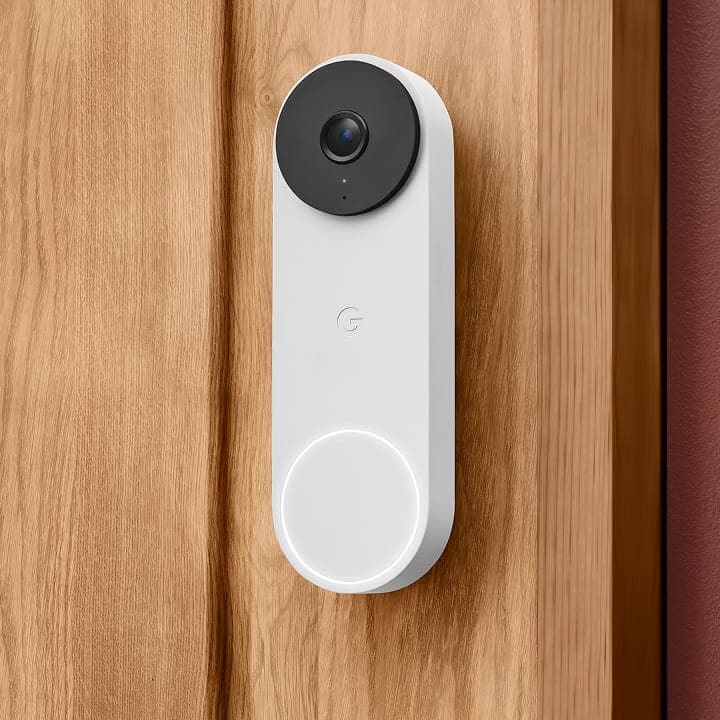
Google Nest Doorbell (Wired, 3rd Gen).
Google Nest Doorbell (Wired, 3rd Gen) — 2K square sensor (1:1, 166° FOV), upgraded night vision, Gemini for Home AI features rolling out early 2026. Wirecutter top pick 2026.
The Verdict.
Gavler Meta-Score
“The Wirecutter-positioned wired flagship and the right pick for buyers with functional doorbell wiring who want best-in-class Google ecosystem integration. The Gemini for Home rollout makes the 3rd Gen the forward-looking pick over the 2nd Gen at the same price.”
The Gavler Verdict
The Gavler Review.
Google Nest Doorbell (Wired, 3rd Gen) Review: The One That Never Misses
The Google Nest Doorbell (Wired, 3rd Gen) sits at number one on our Best Smart Doorbells list with a 9.4, and it earns that spot on a claim most doorbells can't back up: it doesn't miss events. Wirecutter's long-term testing named it the outlet's new top pick specifically because of that reliability, and the hardware behind it — a 2K square sensor with a 166-degree field of view, continuous wired power, and the early rollout of Gemini for Home AI features — makes the case complete. Buy it if you have functional existing doorbell wiring and want the most dependable motion detection and the deepest Google ecosystem integration available. If your home doesn't have doorbell wiring, or you're already invested in a different ecosystem, that's the honest reason to look elsewhere. For most buyers with a wired setup, this is the default.
What it actually is
The 3rd Gen is Google's October 2025 hardware refresh of the wired Nest Doorbell line, and the headline change is the sensor: a 2K square, 1:1 aspect-ratio sensor with a 166-degree diagonal field of view. That aspect ratio matters more than it sounds — a square frame captures both a visitor's face and whatever is sitting at their feet (a package, a delivery, a pet) in a single shot, without the vertical distortion that wide-but-rectangular doorbell cameras introduce when they try to do the same thing.
Power comes from existing 16-24V doorbell transformer wiring, continuously, rather than from a battery. That single design choice is the backbone of the doorbell's whole value proposition: continuous power means uninterrupted 24/7 video history (with Nest Aware) and a faster wake-time on motion events than any battery-powered doorbell can offer, because a battery unit has to balance responsiveness against battery drain in a way a wired unit simply doesn't.
At $179, it's priced in line with premium competitors, with the ongoing cost being a Nest Aware subscription — $8 to $15 a month — required for the features that make the hardware worth its price: video history, familiar-face recognition, and package/vehicle/animal classification.
In use
The reliability claim is the one that matters most for a doorbell, because a smart doorbell that misses events is a smart doorbell that has failed at its one job. Wirecutter's long-term testing put it plainly: the 3rd Gen was "the most accurate motion detector we have found in any doorbell we have tested — it never missed an event." That's not a spec-sheet number, it's the result of extended real-world testing, and it's the reason Wirecutter moved its top pick to this generation.
Video quality backs that up. Engadget called the 2K sensor "easily the biggest step up from the prior generation, with a clearer image and improved low-light performance," and Tom's Guide's testing ranked it best overall in the category. The newest piece is the Gemini for Home rollout, which PCWorld described as "a game-changer — it generates natural language descriptions of captured events and lets you search through videos without endless scrolling." That's a meaningfully different way to review a day's worth of doorbell footage than scrubbing through a timeline manually, and it's still expanding through 2026 rather than being a finished feature.
Where it shines
- Motion detection that doesn't drop events. Wirecutter's "never missed an event" finding is the single most important claim a doorbell camera can earn, and it's the direct result of continuous wired power rather than battery-conserving motion algorithms.
- A sensor shape built for the actual job. The 2K square, 166-degree FOV captures head-to-toe framing — face and porch floor in one shot — solving the classic doorbell-camera problem of catching a face but cropping out the package sitting below it.
- Gemini for Home is a real, growing feature, not vaporware. Natural-language search across motion history, as PCWorld's testing found, changes doorbell footage from something you scrub through to something you can just ask about.
The trade-offs — who should skip it
This is the most reliable wired doorbell on the list, not the right pick for every home, and the honest reasons to buy something else are specific:
- You don't have existing doorbell wiring. The continuous-power advantage that makes this doorbell reliable is also its installation requirement. If your home doesn't already have 16-24V doorbell transformer wiring, a battery alternative like the Ring Battery Doorbell Pro at number two installs anywhere without an electrician.
- You don't want an ongoing subscription. The core hardware is excellent, but 24/7 history, familiar-face recognition, and Gemini search all sit behind Nest Aware's $8-15/month fee. If you want a doorbell that's fully capable without a subscription, weigh that cost into the total price before buying.
- You're already deep in the Ring/Alexa ecosystem. If your home security setup already runs through Ring and Alexa, the Ring Wired Doorbell Pro (3rd Gen) at number three offers a comparable wired experience without forcing a switch to Google Home.
How it compares
On its own list, the Nest Doorbell's closest rivals sit right behind it. The Ring Battery Doorbell Pro at number two is the flexible-installation alternative — no wiring required, at some cost to motion-detection speed and continuous history compared to the Nest's wired design. The Ring Wired Doorbell Pro (3rd Gen) at number three is the more direct like-for-like comparison: another wired flagship, for buyers who prefer Ring's app and Alexa integration over Google Home and Gemini.
The Nest's case rests on the two things wired power buys it: motion-detection reliability that Wirecutter's testing couldn't fault, and the fastest event response time in the category. Ring's flexibility on installation and its own ecosystem loyalty are the legitimate reasons buyers pick differently — but on raw reliability, the Nest 3rd Gen is the one to beat.
The Gavler verdict
A 9.4, with an expert consensus of 94 against a community score of 92 — the small gap reflecting the ongoing Nest Aware subscription cost that's required to unlock the doorbell's advanced features, not any complaint about the hardware itself. The Google Nest Doorbell (Wired, 3rd Gen) earns its top spot on Gavler's list by doing the one thing a doorbell camera exists to do — catch every event — better than anything else tested. Buy it if you have functional wiring and want the most dependable wired doorbell with the deepest Google Home integration and the most forward-looking AI feature set. If wiring or ecosystem loyalty rules it out, Ring's wired and battery options are the honest next stop.
Common Questions
For buyers with functional existing doorbell wiring, yes. It ranks first on Gavler's Best Smart Doorbells list with a 9.4 and is Wirecutter's new top pick after long-term testing found it never missed an event. At 179 dollars, the 2K square sensor and 166-degree field of view capture a visitor's face and any packages at their feet in a single shot, and the Gemini for Home AI rollout adds long-term upside the 2nd Gen doesn't have. The main caveat is that advanced features need a Nest Aware subscription.
Buy the Nest if you have working doorbell wiring and want the most reliable motion detection and the deepest Google Home integration. Buy the Ring if you don't have doorbell wiring, want battery flexibility for installation anywhere, or you're already invested in Ring's ecosystem and Alexa. The Nest's continuous power gives it a real edge on motion-detection speed and reliability that a battery doorbell, by design, can't fully match.
Not to use the doorbell at all, but you need it for the features that make it worth buying over a cheaper option — 24/7 video history, familiar-face recognition, and package/vehicle/animal classification. Nest Aware runs 8 to 15 dollars a month, and that ongoing cost is the honest asterisk on an otherwise straightforward recommendation.
The headline changes are a new 2K square (1:1 aspect ratio) sensor with a 166-degree field of view, upgraded night vision, and the rollout of Gemini for Home AI features across the Google Home ecosystem starting in early 2026. Wirecutter's long-term testing reported the 3rd Gen never missed a motion event, which the outlet frames as the meaningful reliability upgrade over the 2nd Gen.
Where to Buy.
Prices checked regularly
90-day price history
Price History
Steady at $180 for the entire 90-day tracking window — no increases, no discounts, across 91 tracked days.
Tracked daily across retailers. Vote Want itabove and we’ll alert you the moment the price drops.
Some links are affiliate links — Gavler may earn a commission. This never affects rankings or scores. Learn more.
Precision Engineering
2K Square Sensor (1:1, 166° FOV)
2048 by 2048-pixel square sensor with a 166-degree diagonal field of view — captures both a visitor's face and packages at the door in one shot, without the vertical distortion of older wide-FOV doorbells.
Familiar Faces + Gemini for Home
On-device people, packages, vehicles, and animals classification through Nest Aware; the Gemini for Home AI rollout adds natural-language event search across motion timeline.
Wired 16-24V — Continuous Power
Continuous transformer power means no battery recharge cycles, faster motion-event wake than any battery doorbell on the market, and 24/7 video history with Nest Aware.
Technical Specifications
The Scoreboard
Wirecutter's new top pick after long-term testing reported it never missed an event. Tom's Guide ranks it best overall. Expert consensus reflects the 2K square sensor upgrade and Gemini for Home AI rollout; community scores reflect Nest Aware subscription dependency for advanced features.
Cast Your Vote
Do you think Google Nest Doorbell (Wired, 3rd Gen) deserves the #1 spot in Best Smart Doorbells?
Global Critique
“The most accurate motion detector we have found in any doorbell we have tested — it never missed an event.”
“An excellent smart video doorbell with 2K resolution and handy AI tools — best overall in our testing.”
“The 2K-resolution video on the new Nest Doorbells is easily the biggest step up from the prior generation, with a clearer image and improved low-light performance.”
“Gemini is a game-changer — it generates natural language descriptions of captured events and lets you search through videos without endless scrolling.”
More from Best Smart Doorbells.
See how other top picks compare in this category.