My honest review after trying CAROL Bike for one week #cardioworkouts
CAROL Bike
AI-powered exercise bike using REHIT protocol — scientifically validated 8-minute workouts that deliver equivalent cardio benefits to 45-minute sessions.
Gavler Meta-Score
“CAROL is the exercise bike for people who don't enjoy exercise but want the health benefits. Eight minutes and forty seconds, three times per week, with peer-reviewed evidence of effectiveness. No community, no leaderboards, no entertainment — just the shortest path to cardiovascular fitness improvement that science currently validates. Time efficiency is the product.”
The Gavler Verdict
CAROL Bike Review: Eight Minutes of Science, One Expensive Membership
The CAROL Bike ranks number 8 on Gavler's Best Smart Home Gyms list with an 8.5. It's built on a single, peer-reviewed premise: that two 20-second all-out sprints, properly calibrated, can deliver the cardiovascular benefits of a 45-minute moderate-intensity ride. Tom's Guide's hands-on testing backs the concept up directly — "it's effective and a lot of fun too" — but also flags the two things every buyer needs to know going in: it's expensive, and the best features require an ongoing subscription.
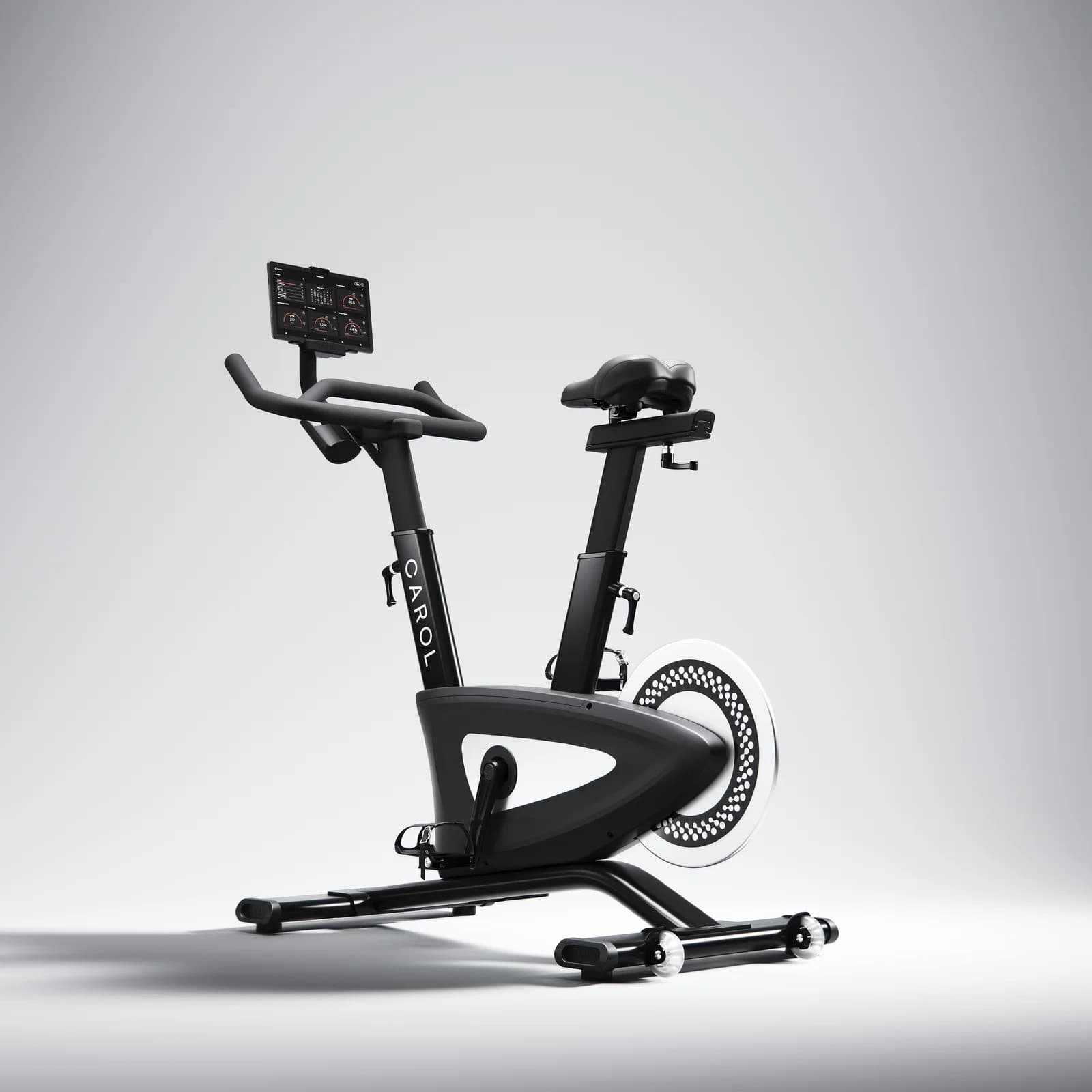
CAROL stands for Cardiovascular Optimization Logic, and the bike is engineered around Reduced Exertion High-Intensity Interval Training (REHIT) — a protocol backed by peer-reviewed research showing it can match the VO2max gains, insulin sensitivity improvements, and cardiovascular adaptations of a 45-minute moderate session in roughly 8 minutes and 40 seconds. The mechanism is two 20-second maximal sprints per session, with the bike's AI automatically applying resistance calibrated to deplete glycogen stores — the physiological trigger for adaptation — without requiring the rider to manually adjust anything mid-sprint.
The hardware itself is well-built: a commercial-grade steel frame, a near-silent belt drive, an 11-inch touchscreen, and a compact footprint under 7 square feet that's meaningfully smaller than a Peloton. Beyond the signature 8:40 REHIT rides, CAROL also offers 15, 30, and 45-minute sessions for variety. Basic free-ride functionality works without any subscription.
Tom's Guide's Jessica Downey, an experienced distance runner, tested the AI resistance directly against her own sense of what a 45-minute run feels like, and came away impressed with the core technology: "From my experience working out on this bike, the AI-controlled resistance levels are remarkably intuitive and adaptive... this was a great way to stay focused and fully immersed in a workout." She also noted the adjustments happen "without needing to take my hands off the handlebars," which matters during an all-out sprint where fumbling with a resistance dial would break form.
Garage Gym Reviews' testing of the CAROL 2.0 echoed the hands-free praise, with founder Coop Mitchell describing it as "literally plug and play, you just focus on your output," and calling the AI's incremental difficulty scaling "what makes it special." Both outlets also independently ran into the bike's biggest limitation: it isn't for everyone's workout style. Tom's Guide's tester, who "enjoys longer workouts that allow me to fully disconnect from work and responsibilities," found the eight-minute sessions "didn't quite replicate the same post-workout feeling as a longer run." Garage Gym Reviews' testing hit a similar snag with the built-in VO2 max test, where inconsistent heart rate readings caused the bike to repeatedly reset its 4-minute timer.
The core value proposition — genuine, peer-reviewed time efficiency — is real and repeatedly validated across both outlets that tested it hands-on. For time-constrained riders, that's not a marginal benefit; it's the entire reason to choose this bike over a conventional trainer. The AI resistance system is also praised consistently for feeling adaptive rather than gimmicky, learning from session to session and scaling difficulty as fitness improves.
Build quality holds up under the specific demands of REHIT training too — Garage Gym Reviews noted the belt-drive system and "frictionless, magnetic brake" let riders "put all of your effort into the bike and it remains stable," which matters when the entire workout hinges on two all-out sprints rather than steady-state pacing.
Cost is the clearest barrier, and it's twofold. The bike itself is $2,595 — more than a Peloton Bike+ — and the AI-personalized resistance that defines the product requires an ongoing membership on top of that. Here Gavler's own sourcing runs into a real discrepancy worth flagging directly: Garage Gym Reviews lists the membership at $15/month, matching Gavler's product specs, but Tom's Guide's own reporting states "an additional $19.99 monthly fee you will have to pay for your CAROL bike" for the AI features. Given that both figures come from reputable, independently reported sources, buyers should verify current pricing directly with CAROL before purchasing rather than relying on either number as final.
The workout style itself is also a genuine mismatch for some riders. If exercise is a mental outlet as much as a physical one — something Tom's Guide's own reviewer identified as her personal experience — an 8-minute-40-second session may feel abrupt rather than satisfying, no matter how sound the underlying physiology.
For riders who want a longer, more immersive cardio session rather than CAROL's short-burst format, the Hydrow Wave — ranked number 9 on Gavler's Smart Home Gyms list — takes the opposite approach entirely: full-body rowing sessions filmed on real rivers and lakes, engaging roughly 86% of muscles versus cycling's 40%, for $1,495 plus a monthly membership.
Riders who want a longer-format bike with a different kind of engagement should look at the Bowflex VeloCore 22, ranked number 10, which leans 10-15 degrees side to side during rides to force continuous core engagement — a physical rather than algorithmic answer to the "how do I make cycling more effective" question CAROL solves with AI and REHIT.
The CAROL Bike delivers on its core scientific promise, and both Tom's Guide and Garage Gym Reviews' hands-on testing back that up independently rather than simply repeating CAROL's marketing claims. For genuinely time-constrained riders who want the shortest, best-validated path to cardiovascular fitness improvement, it's a legitimate solution with real research behind it. But the price is steep even before the membership question is settled, and the discrepancy between reported membership costs is a good reason to call CAROL directly and confirm current pricing before buying. If eight minutes of effort three times a week sounds appealing rather than abrupt, this is the bike built specifically for you.
If you genuinely cannot find 45 minutes for cardio but can find 10, yes. Tom's Guide's tester concluded "it's expensive, and the features are locked behind a monthly membership, but it's effective and a lot of fun too," praising how "the AI-controlled resistance levels are remarkably intuitive and adaptive." At $2,595 plus a required membership for the AI features, it's a serious commitment for a workout format that won't suit everyone.
Gavler's verified data and Garage Gym Reviews list it at $15/month, but Tom's Guide's own testing found "an additional $19.99 monthly fee" required for AI-controlled resistance. Confirm current pricing directly with CAROL before buying, since sources disagree.
Yes, but you lose the feature that makes CAROL unique. Garage Gym Reviews found that "without the membership, there's no optimization of resistance, only the starting resistance" — meaning free-ride mode works, but the AI-personalized REHIT protocol that's the entire point of the bike does not.
Prices checked regularly
90-day price history
Steady at $2,595 for the entire 90-day tracking window — no increases, no discounts, across 91 tracked days.
Tracked daily across retailers. Vote Want itabove and we’ll alert you the moment the price drops.
Some links are affiliate links — Gavler may earn a commission. This never affects rankings or scores. Learn more.
Peer-reviewed science: two 20-second AI-calibrated sprints deliver equivalent VO2max gains to 45-minute moderate sessions.
Automatic optimal resistance during sprints — heavy enough to trigger glycogen depletion, calibrated to your fitness level.
Core REHIT rides work without membership — $15/month optional for coaching, history, and longer formats.
Strong scientific credibility and time-efficiency praise. Community split between lovers (time-constrained) and those who miss Peloton-style engagement.
Do you think CAROL Bike deserves the #8 spot in Best Smart Home Gyms?
“It's expensive, and the features are locked behind a monthly membership, but it's effective and a lot of fun too.”
“From my experience working out on this bike, the AI-controlled resistance levels are remarkably intuitive and adaptive.”
“Without the membership, there's no optimization of resistance, only the starting resistance.”
Watch
Hand-picked from creators we trust — playable inline.
My honest review after trying CAROL Bike for one week #cardioworkouts
CAROL Bike 2.0 Review | Can AI Workouts Help You Lose Weight?
CAROL Bike 2.0 Review: Cycle Smarter, Not Harder
This Stationary Bike is Crushing my Soul (CAROL 2.0 Bike Review)
CAROL Bike 2.0 Review - a GREAT Peloton alternative!
The AI-Powered Fitness Bike I Can't Stop Using...CAROL Bike Review!
See how other top picks compare in this category.
A membership hangtag is the wrong first question. Digital weights vs bike vs rower vs boxing vs mirror is the job. Then shop Gavler's live ranking.
Tonal, Vitruvian, Tempo, Hydrow, CAROL. Gavler ranks the best smart home gyms of 2026 — survivors of the connected-fitness shakeout, sorted by how you train.