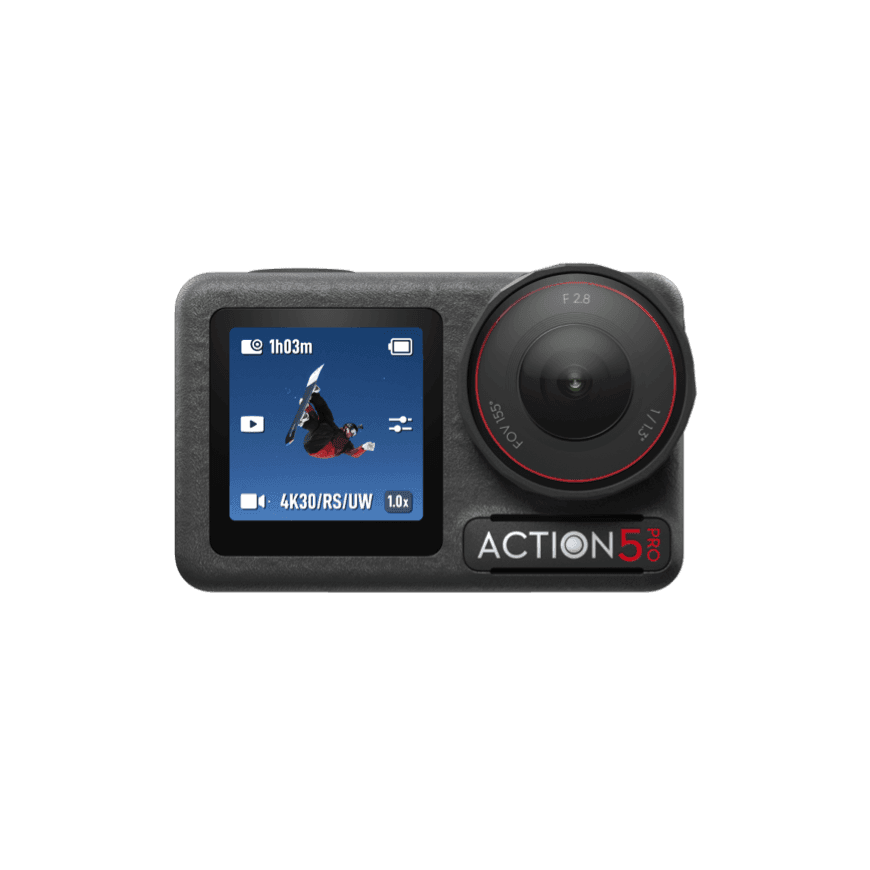
DJI Osmo Action 5 Pro.
1/1.3-inch sensor, dual OLED screens, waterproofing to 20m without a case, and up to four hours of battery — a $50-cheaper GoPro Hero 13 rival.
The Verdict.
Gavler Meta-Score
“The Osmo Action 5 Pro is the best-value action camera you can buy, and the DJI Mic 2 compatibility makes it a vlogger's dream — pristine wireless audio no rival matches, plus class-leading waterproofing and battery. The trade-off is resolution and low light: there's no 5.3K/8K mode for heavy croppers, and the SuperNight night mode is merely okay, still grainy versus a mirrorless. Buy it for daylight vlogging, diving, and clean audio at $50 under a GoPro; look elsewhere if you crop aggressively or shoot mostly in the dark.”
The Gavler Verdict
The Gavler Review.
DJI Osmo Action 5 Pro Review: Battery Life and Low Light, Nailed
The DJI Osmo Action 5 Pro holds down the number-two spot on Gavler's Best Action Cameras list, and the hands-on reviews back up why: this is the battery-life and low-light specialist of the current generation, priced $50 to $100 below its two closest rivals. At $349 it undercuts both the GoPro HERO13 Black and the Insta360 Ace Pro 2, and it does that while outlasting both of them on a single charge by a wide margin — Engadget clocked "well over two hours" of 4K/60p recording against roughly 88 minutes for the HERO13 Black and about 90 minutes for the Ace Pro 2. The trade-off is real, too: this camera tops out at 4K where its rivals shoot 5.3K and 8K, and more than one reviewer flagged its color science as noticeably oversaturated straight out of the camera. If runtime and low-light performance matter more to you than maximum resolution, the Action 5 Pro is an easy recommendation. If you're a video editor who wants to crop and reframe in post, it's a harder sell.
What it is
The Action 5 Pro is DJI's flagship — and, as Tom's Guide's Peter Wolinski pointed out in his review, currently its only — entry in the Osmo Action line, going up directly against GoPro's HERO series and Insta360's Ace series. It's built around the same physical sensor size as its predecessor, the Osmo Action 4, but nearly everything else changed: a new 40-megapixel 1/1.3-inch sensor, a bigger 1,950mAh battery (up from 1,770mAh), 47GB of internal storage where the Action 4 had none, dual upgraded OLED touchscreens, and RockSteady 3.0+ stabilization. Engadget's Steve Dent called it "perhaps the biggest upgrade yet in this series," even though the body looks nearly identical to the Action 4's.
The pitch is straightforward: DJI has never out-specced GoPro on resolution or accessory ecosystem, so instead it's leaning hard into the two things a bigger sensor and a bigger battery can actually deliver — better low-light image quality and longer runtime — while pricing meaningfully below the competition.
In use
The sensor size difference is the headline, and it's a real one, not a marketing footnote. At 1/1.3 inches, the Action 5 Pro's sensor is "much larger than the GoPro Hero 13's sensor with more than double the area," Engadget's Dent wrote, and that extra size is what lets the camera "produce clearer shots with more detail, especially in lower light." His conclusion after testing both side by side: "the Action 5 Pro is superior to the GoPro Hero 13 in low light, with far less noise and artifacts."
Daylight footage is similarly strong. TechRadar's Sam Kieldsen found "strong dynamic range (DJI claims up to 13.5 stops), and beautifully clean colors and excellent detail in good daylight conditions," and rated the camera's image and video quality 4 out of 5. Tom's Guide agreed the standard 4K/60p footage "looks gorgeous and sharp," praising the availability of 10-bit color, D-Log and HLG gamma profiles for grading — genuinely "pro" features other cameras in this price bracket skip.
Battery life is where the numbers get striking. DJI's own claim is up to four hours, and TechRadar confirmed that figure is honest — but only in the least demanding configuration: 1080p at 30fps with stabilization off. Push the camera into the settings people actually shoot with — 4K/60p, RockSteady on — and TechRadar measured "just under two hours," Tom's Guide measured 112 minutes in a controlled indoor test, and Engadget measured "well over two hours." All three land well ahead of the GoPro HERO13 Black, which Tom's Guide clocked at 80 minutes and Engadget at 88 minutes under similar 4K/60p conditions, and ahead of the Insta360 Ace Pro 2 as well.
Stabilization has historically been DJI's weak point against GoPro's HyperSmooth, but the newest RockSteady 3.0+ closed real ground: Dent tested it "through a mix of sports, including biking, swimming and kayaking" and found it "delivered stable shots with none of the minor weaving or jolting that I've seen before" on earlier DJI cameras — a meaningfully different read than the "slightly less refined" reputation this camera's stabilization has carried in some earlier writeups.
Strengths
- Real low-light advantage. The larger 1/1.3-inch sensor produces genuinely cleaner, more detailed footage after dark than GoPro's smaller sensor, confirmed independently by TechRadar and Engadget.
- Best-in-class battery life. Even in demanding 4K/60p testing, it beat the HERO13 Black and Ace Pro 2 by 20-plus minutes of continuous runtime, and DJI's headline 4-hour claim holds up under lighter settings.
- 47GB of built-in storage. Neither the HERO13 Black nor the Ace Pro 2 offers any internal storage — this is a real, unique safety net if you forget a card.
- Waterproof to 20m (about 65 feet) without a housing — roughly double the GoPro HERO13 Black's case-free depth rating.
- DJI Mic 2 wireless compatibility at full 48kHz quality, which Tom's Guide called a "game-changer for live voiceover recording" and noted no rival camera currently matches.
- 10-bit color and dual log/gamma profiles (D-Log and HLG) in a $349 camera — genuinely useful for creators who color-grade footage, not just a spec-sheet line item.
Trade-offs — who should skip it
The most consistent knock across all three reviews is resolution. This camera caps out at 4K/120fps (or 4:3 "open gate" 4K, also at 120fps); the GoPro HERO13 Black shoots 5.3K and the Insta360 Ace Pro 2 shoots 8K at 30fps. Tom's Guide summed it up plainly: unless you specifically need that extra resolution for cropping and reframing in post, "there's very little reason not to buy the Osmo Action 5 Pro" — but for editors who do need it, this isn't the camera.
Color is the second real ding. Engadget's Dent, testing the HERO13 Black side by side, preferred GoPro's out-of-camera color: "to my eye the colors look less natural than on the GoPro Hero 13. Skin tones aren't as warm, and the colors are too intense for my taste." Shooting in D-Log and applying DJI's LUT in post fixes this, but that's an extra editing step casual users may not want to take.
SuperNight, DJI's dedicated low-light mode, is genuinely inconsistent between reviewers: TechRadar and Tom's Guide both found it noisier and softer than the camera's regular low-light footage in direct comparisons, while Engadget liked it more but still flagged "an artificial look" from the aggressive noise reduction. Treat SuperNight as a mode to test for your own use case rather than a guaranteed upgrade. And if you shoot a lot of slow motion, note that 240fps is available only at 1080p — at 2.7K and 4K, the ceiling is 120fps, a distinction worth knowing before you buy expecting higher-resolution super slow-mo.
Also worth a beat: subject tracking, DJI's answer to gimbal-free framing, is capped at 2.7K output and only works reliably in well-lit conditions, per Tom's Guide's testing.
How it compares
Ranked one spot above on this list, the GoPro HERO13 Black is the resolution and ecosystem leader — 5.3K video, swappable lens mods, and color that testers preferred out of the box — but it costs $50 more and loses badly to the Action 5 Pro on battery life and case-free waterproofing. If your work depends on cropping 5.3K footage or you're already invested in GoPro's mod ecosystem, that extra cost buys something real.
The Insta360 Ace Pro 2, ranked just behind the Action 5 Pro at number three, splits the difference on price with the HERO13 Black and pushes resolution even further with 8K capture — but its battery life trailed the Action 5 Pro in every test we found, and it lacks any internal storage. It's the pick for resolution-hungry shooters who don't want to pay full GoPro pricing; the Action 5 Pro is the pick for anyone who'd rather not think about battery anxiety or forgotten SD cards.
The Gavler verdict
At $349, the DJI Osmo Action 5 Pro is doing something specific and doing it well: trading peak resolution for real, testable advantages in battery life, low-light image quality, and built-in storage, all while undercutting its two biggest rivals on price. That's not a marketing angle — three independent testers measured the battery numbers themselves and got results in the same range, all clearly ahead of GoPro and Insta360. The honest caveats are resolution (4K is the ceiling), color science that leans oversaturated out of the box, and a SuperNight mode that doesn't always deliver on its name. None of that changes the core calculus: for anyone shooting more hours than they're editing pixels, this is one of the smartest buys in the category. Full rankings and the rest of the field are on our Best Action Cameras list.
Common Questions
DJI's 4-hour claim is real, but it's a best-case number: it applies to 1080p recording with stabilization off. Shooting the way most people actually shoot — 4K at 60fps with RockSteady on — Engadget clocked it at well over two hours, and Tom's Guide measured 112 minutes in an indoor 4K/60p test before the camera hit its thermal limit. Either way, that beats the GoPro HERO13 Black (roughly 80 to 88 minutes at 4K/60p in the same tests) and the Insta360 Ace Pro 2 (76 to 90 minutes) by a wide margin.
It's a mixed bag, and the reviews don't fully agree on how mixed. TechRadar found 4K SuperNight footage soft and unimpressive next to standard low-light shooting. Tom's Guide went further, saying SuperNight looked noisier and fuzzier than the camera's regular video mode in side-by-side low-light tests. Engadget was more positive on the mode itself but noted the aggressive noise reduction can leave footage looking artificial and less sharp. The safer takeaway: the camera's base low-light performance, driven by its larger sensor, is a genuine strength; SuperNight specifically is hit-or-miss.
No. It tops out at 4K, up to 120fps (or 4:3 'open gate' 4K at up to 120fps). The GoPro HERO13 Black shoots 5.3K and the Insta360 Ace Pro 2 shoots 8K at 30fps, both of which give editors more room to crop and reframe in post. If you need that headroom, look at those two instead.
No — that combination doesn't exist on this camera, and it's worth flagging because it's an easy spec to get wrong. Per Tom's Guide's and Engadget's hands-on testing, 240fps slow motion is available only at 1080p (FHD); at 2.7K and 4K, the maximum frame rate is 120fps.
It's cheaper ($349 vs. $399), has notably longer battery life, a physically larger 1/1.3-inch sensor that helps in low light, and 47GB of built-in storage the GoPro lacks. The GoPro shoots sharper 5.3K video, supports swappable lens mods, and — per Engadget's side-by-side — produces more natural, less saturated color straight out of the camera. See our full rundown on the Best Action Cameras list.
Where to Buy.
Prices checked regularly
90-day price history
Price History
Steady at $349 for the entire 90-day tracking window — no increases, no discounts, across 91 tracked days.
Tracked daily across retailers. Vote Want itabove and we’ll alert you the moment the price drops.
Some links are affiliate links — Gavler may earn a commission. This never affects rankings or scores. Learn more.
Precision Engineering
1/1.3" Sensor, Up to 4K/120fps
Superb detailed daylight 4K with up to ~13.5 stops of dynamic range and 40MP stills; night footage beats a GoPro even if the SuperNight mode is only okay.
Up to 4-Hour Battery
TechRadar measured just under four hours at 1080p/30fps and just under two hours at 4K/60fps with stabilization on — no overheat shutdown.
DJI Mic 2 at 48kHz
The only action camera that records pristine 48kHz wireless audio from up to two DJI Mic 2 transmitters — a genuine advantage for vloggers.
Technical Specifications
The Scoreboard
TechRadar rates it 'Recommended,' praising superb daylight image quality, long battery life, and game-changing DJI Mic 2 audio, while flagging the merely-okay SuperNight mode and absence of a 5.3K/8K option.
Cast Your Vote
Do you think DJI Osmo Action 5 Pro deserves the #2 spot in Best Action Cameras?
Global Critique
“It's a tiny, versatile camera with some serious creative capabilities.”
“Not only is its image quality superb (in daylight, at least – and even at night it's still better than a GoPro), but it has long-lasting battery life, effective image stabilization, a rugged lightweight build, two beautifully color-rich OLED screens.”
“The pristine 48kHz recording compatibility between this tiny wireless mic and the Action 5 Pro is a game-changer for live voiceover recording.”
“DJI's SuperNight mode may produce better low-light video than most action cameras, but it's still grainy and lacking in detail compared to video from a mirrorless camera.”
More from Best Action Cameras.
See how other top picks compare in this category.

Match the Action Camera to How You Shoot
8K hangtags are the wrong first question. Pocket vs wearable vs 360 is the form factor — then shop Gavler's live ranking.
Two 8K 360 Cameras Launched This Week. In the US, Only One Is a Real Choice.
The Insta360 X6 and DJI Osmo 360 II launched a day apart. Both shoot 8K — but only the $699.99 X6 can reach US shelves. Here's what to buy.
GoPro's Mission 1 Pro Is the Best Action Camera Ever Made — and the Wrong One for Most People
Reviewers agree GoPro's $699 Mission 1 Pro has the best action-cam video quality yet. Here's why most buyers are still better off with a HERO13 or DJI.
GoPro Might Not Survive the Year. Should You Still Buy One?
GoPro's auditor flagged 'substantial doubt' about its survival, and in July its founder lent it $20M. What that means if you're about to buy an action camera.
GoPro HERO 13 Black vs Insta360 Ace Pro 2: The Action Camera Decision US Buyers Are Actually Making in 2026
GoPro's Hero 13 Black vs Insta360's Ace Pro 2. Updated July 2026 with the MISSION 1 launch, current prices, and GoPro's going-concern warning.
The DJI Osmo Pocket 4 Is Official — And US Buyers Are Locked Out
DJI's pocket gimbal returns with a 1-inch sensor and a longer battery. Here's what's new, what it costs, and who should care.
The Best Action Cameras in 2026, Ranked by People Who Actually Use Them
GoPro, DJI, and Insta360 all want your money. Gavler's community ranks the action cameras that actually survive the abuse you'll throw at them.